

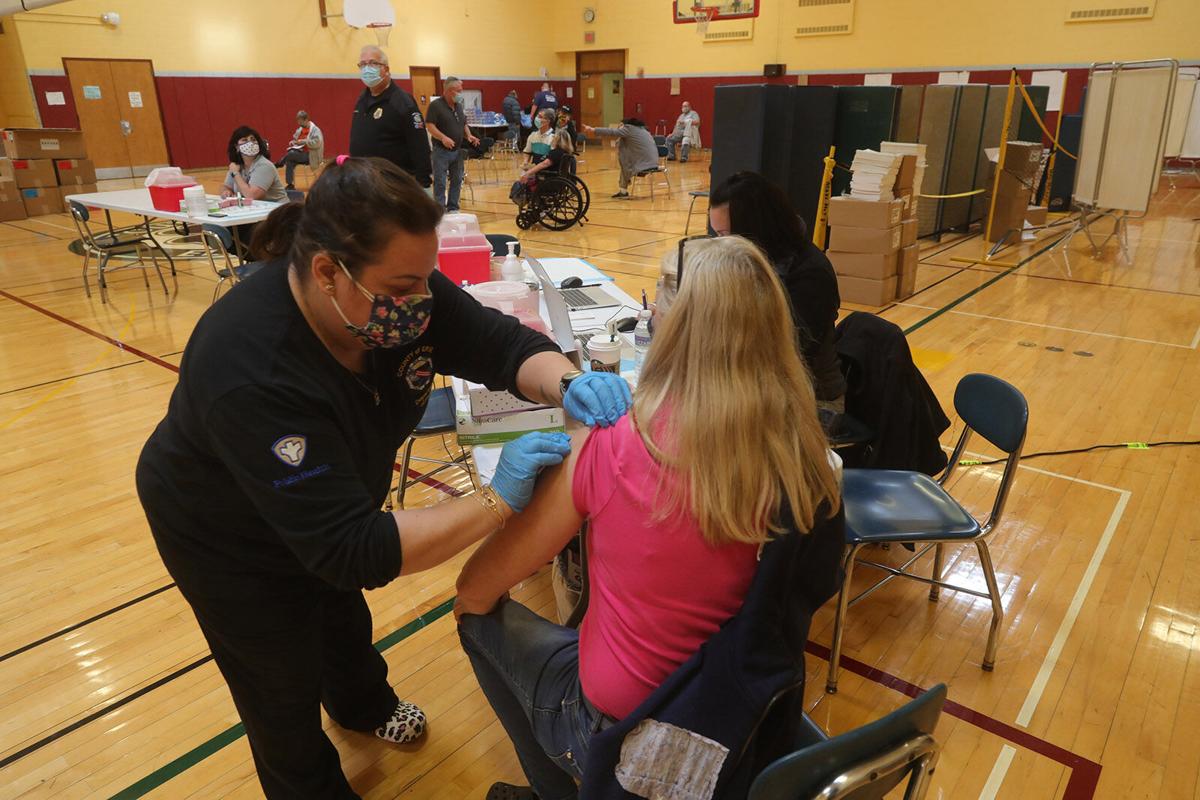
Outside the White House last week, President Biden told a reporter, “Look, the only pandemic we have is among the unvaccinated.”
Biden was answering a question about disinformation spread on Facebook and other social media platforms, and his point was that half-truths and lies are stopping people from getting vaccinated. But does his blanket statement – which suggests the unvaccinated are at steep risk, and which is widely echoed by infectious disease experts – apply here in Western New York?
At a glance, our Covid-19 numbers look good. Really good, if you consider the big picture, even as the daily case count locally – and in most places nationally – creeps higher. But we’ve done better, and the upward trend is the opposite of what it takes to actually exit the pandemic.
In this week’s “Pandemic Lessons,” we explore how concerned we should be about the uptick, and what we can do about it.
People are also reading…
Are we even still in a pandemic?
Yes.
Depending on your worldview, this question may seem ridiculous. If you and most of the people around you are vaccinated, it’s possible you’ve been living much of your life as if the pandemic is over: Gathering without masks, leaving them in your pocket or bag when you’re in a store, even attending events as you would have prior to mid-March 2020. Doing those things is scientifically sound – for most people – if you’re fully vaccinated.
But it doesn’t mean the pandemic is over.
It’s also possible you’ve been living as described above without a vaccination, figuring that there’s enough immunity out there – from other people’s shots, and from previous infection – to keep you protected. There’s some truth in this thinking, too: Nearly half of Americans are fully vaccinated, and more than 34 million cases of Covid-19 have been reported in the country. That absolutely has slowed the spread of Covid-19. But it hasn’t stopped it, and particularly with the more contagious and widely circulating Delta variant, it doesn’t mean you’re fully safe.
Take Western New York’s case numbers. On July 14, the seven-day average for cases was 25. That’s more than four times higher than the the lowest figure from early June – but it’s significantly less than last summer’s lowest numbers, which hovered around 40 for a seven-day average.
“We’re going to have a reasonable summer,” said Dr. Thomas Russo, the chief of infectious diseases at the University at Buffalo’s Jacobs School of Medicine and Biomedical Sciences. “Last summer was really pretty good, and we had no vaccination and a small proportion had been naturally infected. … We had a lot more cases than we’re having now.”
Russo noted, too, that hospitalization and death numbers locally are at all-time lows, and nearly two-thirds of eligible Erie County residents are fully vaccinated.
We’re doing better. But doing better is not the same as the pandemic being over – particularly with the pesky Delta variant circulating.
Who's vulnerable?
That depends on a few factors: What you’re doing (and where), coupled with your vaccination status and the strength of your immune system. If you are fully vaccinated, you’re largely OK to conduct your life as you did pre-March 2020. However, if you have a compromised immune system, that’s not true – even with vaccination. (More on that next.)
If you’ve had Covid, you likely have some natural immunity. “Who knows how durable naturally acquired immunity is? But I think we have to assume that it’s durable,” said Dr. George Rutherford, an epidemiologist with the University of California, San Francisco.
But infectious disease experts are questioning how effective natural immunity is against the Delta variant, which seems to be able to more easily evade the body’s defenses. Fully vaccinated individuals are generally still believed to be well protected against Delta, but people who have only one shot of Pfizer or Moderna have minimal protection – closer to 30% efficacy, Russo notes, which makes it about one-third as protective as having two shots.
“If you’re fully vaccinated, it does a really good job in protecting you against disease, and, importantly, landing in the hospital and having a bad outcome,” Russo said. “So the vaccines seem to be getting it done for the Delta variant."
Let’s get back to people with compromised immune systems, or those who’ve recovered from serious illnesses such as cancer. What do they need to know?
Dr. Brahm Segal, an infectious diseases specialist at Roswell Park Comprehensive Cancer Center, describes the populace in three categories:
• Green light: People with normal, healthy immune systems who have been vaccinated can go after life as they wish to live it. “They can go to a Billy Joel concert,” Segal said, referring to the rock star’s Aug. 14 show at Highmark Stadium. “They can do what they want to. They are kind of back to normal.”
This green-light status may also apply to people with “a history of cancer, but it’s cured cancer,” Segal added. This means you haven’t been “on active therapy for a long period of time,” Segal said, “or people who may be treated only with a hormonal therapy, but not a therapy that is immunosuppressive.”
Clearly, this involves nuances best addressed directly with your doctor. But the bottom line remains: If you’re vaccinated and your immune system is strong, you’re still relatively safe from Covid.
• Yellow light: Fully vaccinated cancer patients who have a solid tumor (as opposed to, say, a blood-based cancer) should still proceed with caution. Studies have indicated that most people with solid tumors “do mount antibody responses,” Segal said, “(but) that doesn’t mean they have the same level of immunity as the general public.”
That means loosening the protocols that were recommended before vaccination, but not lifting them altogether. “We could liberalize some of the restrictions that they had before, but they still have to be careful,” said Segal, who is co-leader of the National Comprehensive Cancer Network’s Covid-19 Vaccine Advisory Committee. “It could be that an outdoor cafe is fine. Having vaccinated people come into your home is fine.”
• Red light: Even with full vaccinations, tight restrictions and layers of caution are still important for people with blood and bone marrow cancers, which include leukemia, lymphoma and myeloma. Their immune systems may be impaired, particularly if they underwent a stem cell transplant or are on active therapy that targets B cells, which are a type of white blood cell. Even with the disease-fighting instructions that a vaccine provides, their immune systems may be too weak to effectively stop the virus. People in this category, as well as organ-transplant patients and people with HIV/AIDS, are wise to have a “high level of restriction,” Segal said. “You should be very careful. I would argue that you should still be wearing masks” when with a group and when “you don’t know who the people are.”
He added, “Don’t count on the vaccine to give you protection. It may give you protection, but I wouldn’t have a false sense of security that the vaccination will be as effective for you as it would be for the general public.”
If our Covid-19 numbers stay low, that will help everyone. What are the chances we can keep them down?
Decent. But again, down is not gone, which means there’s still a risk, particularly to people who may be more vulnerable.
Outdoor activities are helping keep our numbers in check now. As the weather cools in fall, Russo points out, we’ll see a coinciding rise in cases, though likely not the spike in hospitalizations and deaths we saw last fall and winter.
“We’re never going to go where we were before, where we’re concerned with overwhelming our health care systems with that sort of post-Thanksgiving surge that lasted a couple of months,” Russo said. “We’re never going to be there again, fortunately, unless a variant evolves that evades vaccine-induced immunity.”
While most fully vaccinated people “are kind of in post-pandemic mode,” Russo said, people who are unvaccinated and immunocompromised will be at higher risk in the fall. For the former group, he added, now is the time to start the vaccination process to have full protection come September. For the two-dose Pfizer and Moderna vaccines, it takes five weeks from the first shot to be fully vaccinated.
“That window is starting to shrink for those yet to get vaccinated,” Russo said. “This is the moment to probably do it, so they’ll have that protection when their risk will go up further in the cooler months.”


