When he was 18 months old, Roberto Navarro Bocanegra moved to Tucson from northern Mexico with his parents. Since then, the University of Arizona senior has weathered lots of up and downs in his life, including donating his bone marrow to his little sister after her leukemia diagnosis and spending long nights at the hospital in the days leading up to her death in 2018.
He's celebrated milestones like securing a full scholarship to the UA, where he studies mechanical engineering, and marrying his girlfriend, Savannah, a U.S. citizen, in 2024.
But after Navarro Bocanegra, who is undocumented, filed paperwork to start the process of becoming a citizen through marriage, U.S. Immigration and Customs Enforcement opened a deportation case against him, despite his having no criminal record.

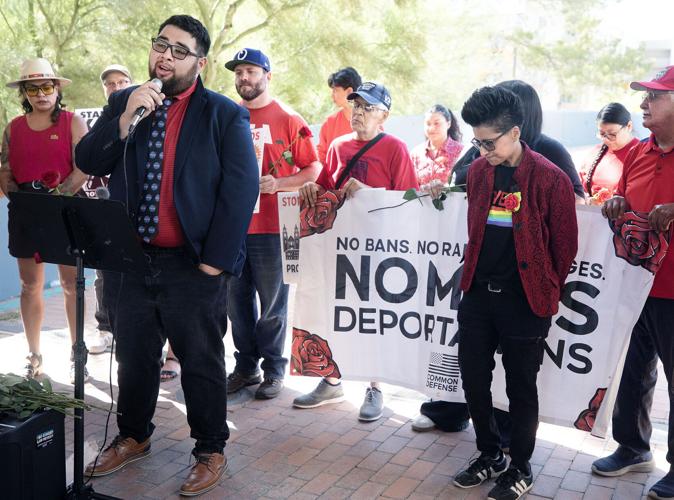
Roberto Navarro Bocanegra, left, speaks during a rally Tuesday in downtown Tucson. The rally was in support of Dreamers and those with protection under Deferred Action for Childhood Arrivals, or DACA. Bocanegra was brought to the U.S. when he was 18 months old. He began the legal process to adjust his immigration status through his U.S. citizen spouse. But after filing with U.S. Citizenship and Immigration Services, he was placed into deportation proceedings.
"I feel just as American as anybody else. I grew up here, I speak English, all of my education is in the United States," said Navarro Bocanegra, 24, who is fighting the deportation while simultaneously trying to plan for his first job after college — if he's allowed to stay. "My life is uncertainty right now," he said.
People are also reading…
Navarro Bocanegra was one of three "Dreamers" — immigrants brought to the U.S. without authorization as children — who spoke to media Tuesday about being targeted by ICE, and about the long-running failure of U.S. legislators to create a pathway to permanency for Dreamers.
"America is the only home I truly know, and my personal, family and cultural ties are deeply rooted here," said Tucson resident Myndy Valencia Sánchez, who arrived in the U.S. at age 7. Despite her current DACA status being valid through January 2027, ICE has reopened a deportation case against her, as well.
"I have maintained a clean record, respecting the law and acting with honesty and integrity at all times," Valencia Sánchez, 35, said at the event, held on a pedestrian bridge in downtown Tucson. "We need immediate, secure pathways (to permanency) that honor our humanity and keep our families together."

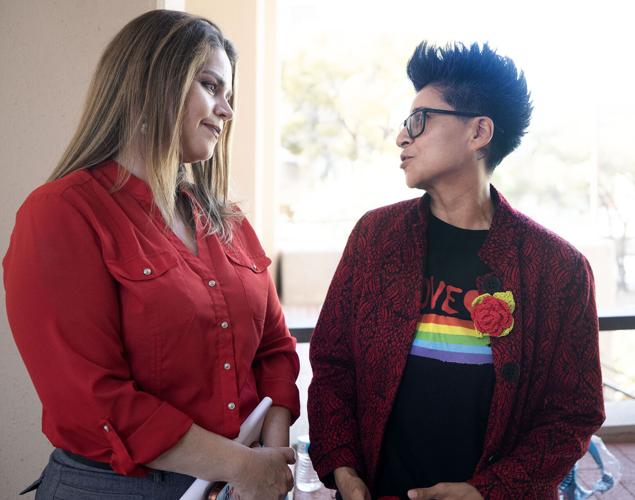
Tucson Mayor Regina Romero, left, speaks with Myndy Valencia Sánchez, a DACA recipient, before a rally Tuesday in Tucson in support of Deferred Action for Childhood Arrivals recipients and "Dreamers," immigrants who were brought to the U.S. as children, whether or not they're protected under DACA. Valencia Sánchez came to the U.S. at age 7 and has valid DACA status, but ICE recently reopened her deportation case.
All three Dreamers who spoke are fighting ICE's efforts to deport them with the help of Tucson immigration attorney Mo Goldman.
At the event, organized by Common Defense, a veteran-led pro-Democracy group, elected officials also spoke in support of all Dreamers and the 19,000 DACA recipients living in Arizona.
Tucson Mayor Regina Romero, a Democrat, called on Congress to finally take action on the Dream Act. Since 2001, at least 20 versions of the Dream Act have been introduced in Congress; all would have provided a pathway to legal status for undocumented people who came to the U.S. as children, according to the American Immigration Council.
"We should not give up on the idea of comprehensive immigration reform," Romero said at the press conference. "We should not give up on the idea of passing the Dream Act. We should continue that fight."
U.S. Rep. Adelita Grijalva, a Tucson Democrat, said she stands in solidarity with Dreamers and DACA recipients, and that creating a pathway to citizenship for them shouldn't be controversial. The idea has long had bipartisan support in the U.S., polling data show.
"Many of us are here because someone in our family had the courage to come here," Grijalva said, noting that her grandfather came to the U.S. through the bracero guest-worker program. Romero said her dad also came through the program when he was 16.
"That's our American story. Every single person here ... deserves that same opportunity, to not live in fear, to not be afraid," Grijalva said.
The DACA renewal process, which recipients have to go through every two years, used to take six to eight weeks, and is now taking closer to eight months. Processing times have become unpredictable, and that's by design, Grijalva said.
"There's no explanation from this administration (for the delays), because I think the goal is to cause fear, to sow this sort of anxiety that discourages people from wanting to even go through any kind of process," she said.
Tucson Ward 1 City Council member Lane Santa Cruz, also a Democrat, said although immigration is a federal issue, it's local officials and advocates who often receive worried calls from family members of immigrants detained by federal officials.
"Local government does not get to stay quiet just because this is technically someone else's jurisdiction," she said. "This (federal) administration keeps manufacturing crises on purpose so it can justify violating our rights and profiting from the chaos it creates."
Dreamers targeted
President Barack Obama created the Deferred Action for Childhood Arrivals program, known as DACA, in 2012 through executive order. DACA was intended as a temporary measure to shield qualifying Dreamers from deportation until U.S. legislators could create a pathway to permanency for them.
Under President Donald Trump's second term, ICE has been targeting the population for deportation, despite claims that the agency is targeting "the worst of the worst," and despite Trump himself telling NBC News that he wants Dreamers to be allowed to stay in the U.S.
"In many cases they've become successful, they have great jobs. In some cases they have small businesses," Trump said in a December 2024 interview. "I think we can work with the Democrats and work something out."
The Star has repeatedly asked U.S. Rep. Juan Ciscomani's office if he still supports a path to citizenship for DACA recipients, a stance he held as recently as May 2025.
Ciscomani, a Tucson Republican, has not responded to the Star's question on his stance since the Trump administration began arresting DACA recipients last fall. Ciscomani's office did not respond to the Star's Tuesday query on his stance.
The Department of Homeland Security — ICE's parent agency — now emphasizes in media statements that DACA doesn't automatically provide protection from deportation, although the original intent of the DACA program was to "defer action" on those cases, since they weren't a priority for removal.
"DACA does not confer any form of legal status in this country," DHS said in a statement. "Any illegal alien who is a DACA recipient may be subject to arrest and deportation for a number of reasons including if they’ve committed a crime."
The agency has not explained why it's targeting DACA recipients without any criminal history, such as in the case of Tucson DACA recipient Karla Toledo, who was detained by ICE in May.
ICE spokeswoman Yasmeen Pitts O’Keefe said she could not respond to the Star’s query, sent Tuesday at 12 p.m., about why ICE has targeted the three Dreamers who spoke to media Tuesday, citing the Star's "unreasonable" daily deadline.
Instead, within an hour Pitts O’Keefe sent photos and a small amount of information about four other people that she claimed were DACA recipients who have been charged with or convicted of crimes. (The Star requested more information to verify ICE's claims, but got no response.)
No "right way"
Tucson DACA recipient Toledo also spoke Tuesday, responding to the widespread misconception that Dreamers and DACA recipients have a path to citizenship and are simply failing to pursue it.
"DACA recipients do not have a pathway to citizenship," other than through marrying a U.S. citizen, Toledo said. She said she's been most "deeply" hurt by criticism from some of her fellow Latinos who claim, "'My family did it the right way'."
"What is the right way? We don't have a right way right now," Toledo said. "We deserve to be here. This is our home."
Toledo, 31, was arrested at her Tucson home May 18, despite having current DACA status. Immigration agents aggressively entered her home without a warrant, Toledo's home-surveillance video showed. She was held in ICE detention at Eloy Detention Center for several nights before ICE reversed course and released her, later dropping the deportation case against her.
ICE then filed a second deportation case against Toledo, who has become an outspoken advocate for DACA and Dreamers since her arrest. Toledo recently renewed her DACA status, which is now active through June 2028.
On May 20, DHS claimed Toledo had assaulted a law enforcement officer during the arrest, which Toledo denied. The allegation appears to have been false; more than two months later, Toledo hasn't been charged criminally with assault. But the allegation has nevertheless spread on social media.
The Star has repeatedly asked ICE for an explanation or evidence of the claim, without a response. ICE spokeswoman Pitts O’Keefe again declined to respond Tuesday.
Contact reporter Emily Bregel at ebregel@tucson.com. On X, formerly Twitter: @EmilyBregel

Emily Bregel
Border reporter


 'Dangerous' moment, as Trump's DHS ignores DACA protections, advocates say