Wildlife officials are planning an emergency rescue operation for an endangered species that could see its last remaining U.S. habitat wiped out by the Trump administration’s second border wall across Southern Arizona.
The Sonoyta mud turtle is an olive brown freshwater reptile that is only found in the waters of Quitobaquito Springs at Organ Pipe Cactus National Monument and in a handful of shrinking water sources along its mostly dry, namesake river in northern Mexico.

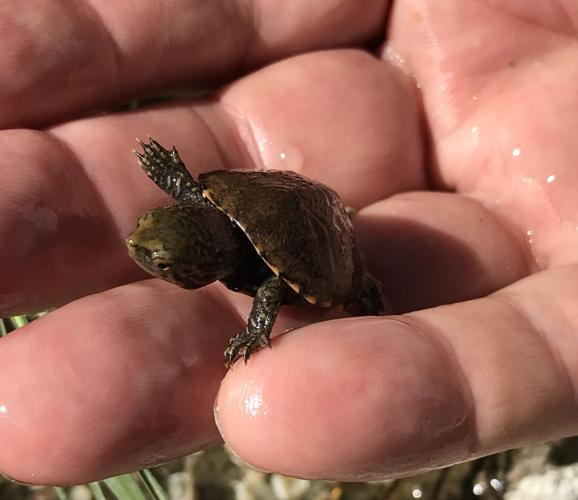
A researcher holds a juvenile endangered Sonoyta mud turtle during a scientific survey at Quitobaquito Springs in southwestern Pima County in 2019.
It was listed as endangered in 2017 after 20 years as a candidate species, but according to experts, its survival in the wild is now under threat from the same federal government charged with protecting it.
“It's insanity,” said University of Arizona freshwater biologist Michael Bogan, who heads up the Sonoyta Mud Turtle Recovery Team.
People are also reading…
Bogan and his all-volunteer, multiagency team are supposed to be putting the finishing touches on a final plan for how to protect the turtle and eventually get it off of the endangered list. Instead, they’ve spent the past two months drafting an emergency salvage plan, just in case the species’ only remaining refuge north of the border is damaged or destroyed by more wall construction.
Bogan said they need to have a formal plan in place so they can be ready to mobilize at a moment’s notice. The stakes could not be higher, he said. “There's potential that whatever turtles we salvage from Quitobaquito may not be able to go back there for a long time — or, worst-case scenario, ever.”
And the turtles are not the only ones at risk. The remote desert oasis roughly 170 miles southwest of Tucson is also home to two species found nowhere else on Earth: a tiny springsnail called the Quitobaquito tryonia that is a candidate for the endangered species list and the already listed Sonoyta pupfish, which went extinct in the wild in Mexico sometime last year.

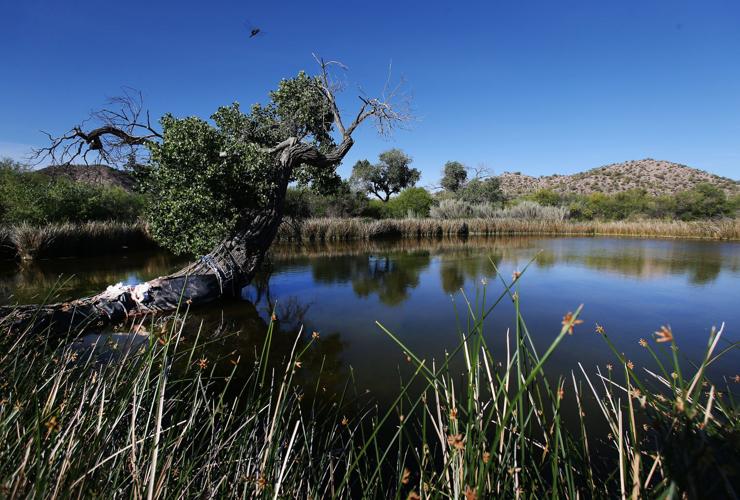
An earthen dam built in 1961 creates the pond at Quitobaquito Springs just north of the U.S.-Mexico border in Organ Pipe Cactus National Monument.
Time is of the essence. Bogan said they have been told to expect survey work on the second wall near Quitobaquito to start “fairly soon,” with a contract for construction to follow as soon as this summer.
Wall plans murky
It’s unclear exactly what U.S. Customs and Border Protection intends to build at the springs. The agency’s interactive online "Smart Wall Map" currently shows plans for secondary barriers along the entire length of the border in Organ Pipe Cactus National Monument, just as it does for nearly all of Arizona’s 373-mile southern boundary.
Bogan said officials from the National Park Service, the U.S. Fish and Wildlife Service and the Department of Homeland Security have been in discussions for months about how to minimize the impacts to Quitobaquito. He hasn’t been involved in those talks, but he said he and his fellow turtle recovery team members were recently told to “prepare for the worst.”

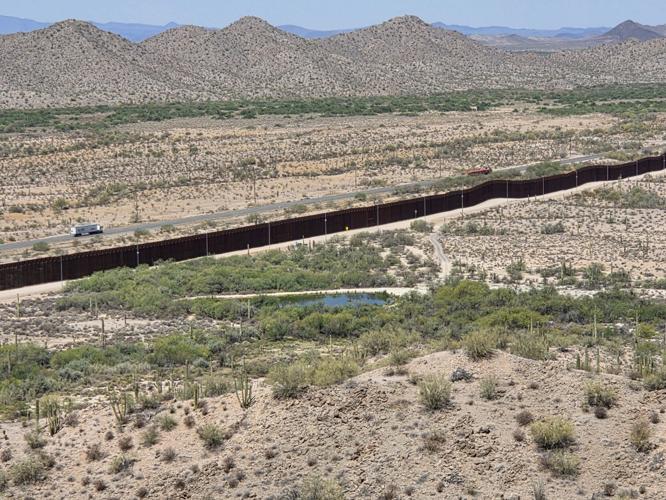
The view from a nearby hilltop shows Quitobaquito Springs, with the border wall and Mexico’s Highway 2 just south of it. Wildlife officials fear a planned secondary border barrier could damage or destroy the spring-fed oasis, which provides the only habitat in the U.S. for three rare animal species.
The Park Service, which manages Organ Pipe, and the Fish and Wildlife Service, which oversees endangered species protections, both declined to comment for this story, referring all inquiries about border wall construction to Customs and Border Protection.
In a written statement to the Star, CBP said it is working with Interior Department agencies to “avoid Quitobaquito Springs and minimize impacts to sensitive resources” but offered no specifics about a possible secondary barrier there.
CBP did say that no groundwater will be pumped for border wall construction within five miles of the springs and that “mitigation strategies” will be implemented as needed.
But Bogan said such concessions won’t mean much if the agency bulldozes through critical habitat for the mud turtle and builds a new wall or access road that compromises spring flows or the manmade earthen dam that collects that precious water in a pond.
Even if the dam and the pond manage to survive construction of a secondary barrier right next to them — “which is a big if,” he said — the swath of disturbance would wipe out a thicket of mesquite trees immediately downstream where turtles shelter in the winter.
“Obviously, in the ideal world for the species, there would be no second border wall there,” Bogan said. “If we can't have that, then the goal would be to have at least some section of the second wall at Quitobaquito be closer to the initial wall, so that it's not disturbing as much of the pond as it would otherwise.”
Readying rescue
The emergency salvage plan anticipates various levels of disturbance at Quitobaquito, ranging from increased truck traffic in the area as a result of secondary-wall work elsewhere to heavy construction directly on top of the oasis that causes the dam to fail, the pond to drain and the springs that feed it to dry up.
For each scenario, the plan spells out how many turtles will be collected, where they will be kept, and for how long. For moderate or short-lived disruptions, for example, around 50 turtles would be captured and held on site, basically in kiddie pools, Bogan said.
In the case of something catastrophic — like the failure of the spring or damage to the dam resulting in a sudden drop in the pond’s water level — an effort would be made to collect the springs’ entire population of around 250 turtles and eventually move them to off-site holding facilities at the Arizona-Sonora Desert Museum, the Phoenix Zoo and elsewhere.

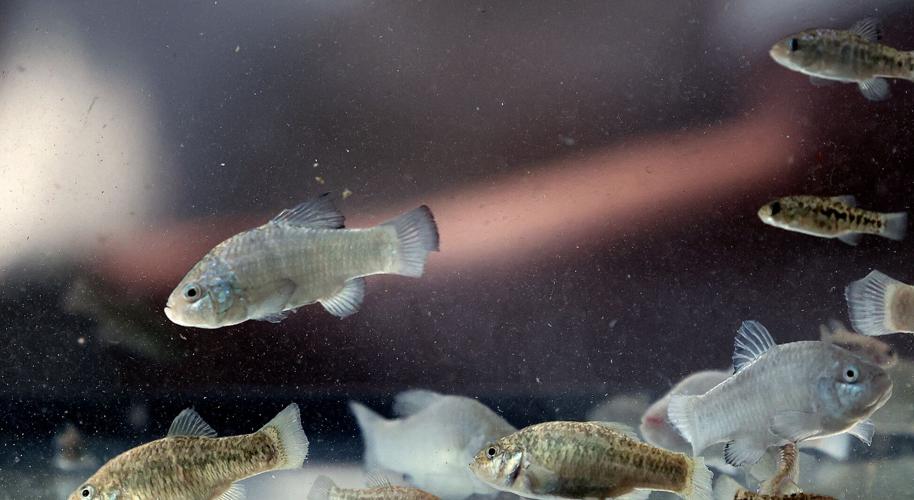
Sonoyta pupfish swim in a tank before being released into an artificial stream inside the University of Arizona’s Biosphere 2 in 2025. Biologists believe the endangered pupfish went extinct in Mexico last year, leaving Quitobaquito Springs at Organ Pipe Cactus National Monument as its last remaining home in the wild.
“Under the worst-case scenario, we’ll have twice as many turtles as we’ll have homes for,” Bogan said, so the team needs to be ready to set up holding facilities on the fly in such unexpected places as the U of A’s Campus Agricultural Center on Campbell Avenue and Roger Road.
The all-volunteer Sonoyta Mud Turtle Recovery Team includes representatives from the Park Service, Fish and Wildlife, Arizona Game and Fish Department, the Tohono O’odham Nation and partners in Mexico, as well as Bogan from the U of A and a retired professor from Central Oklahoma University who is an expert in mud turtles.
They started working on the salvage plan about two months ago, and they are on track to finish it next month. The planning effort is being rushed because of the dizzying pace of the wall work, which has been boosted by $46.6 billion in funding approved last year as part of the so-called One Big Beautiful Bill.
“In an ideal world, we would wait until the (secondary wall) contract was issued, because then we'd know what the specs are of what we're dealing with,” Bogan said. “But those contracts could be issued, and they could be out there a week later bulldozing, so we can't wait until then to come up with a salvage plan.”
Zoos step up
The Desert Museum has been keeping Sonoyta mud turtles since as far back as 2007, and it is the first facility to successfully breed them in captivity.
Tom Weaver, the museum’s curator of herpetology, said they currently have about 20 turtles and are ready to take on more if necessary, though there are limits to how much space and resources they have available.
The same goes for the Sonoyta pupfish and the Quitobaquito springsnail. If the worst happens, “we’ll probably have pupfish in every water source we have out here,” Weaver said. “We’ll help out any way we can.”
The Arizona Center for Nature Conservation at the Phoenix Zoo is already caring for the world’s only “assurance population” of Quitobaquito tryonia.

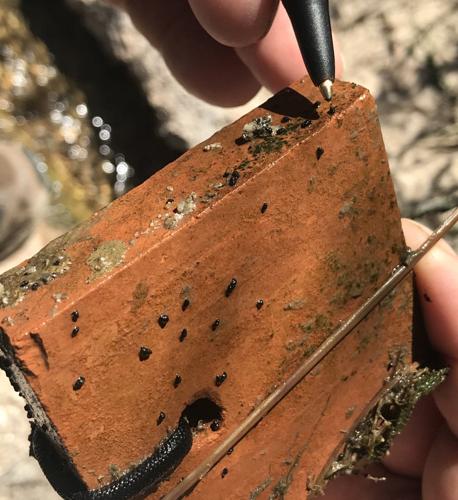
A researcher uses a pen to point to a tiny spring snail known as a Quitobaquito tryonia during a population survey of the species at Organ Pipe Cactus National Monument in 2019.
Tara Harris, the zoo’s director of conservation and science, said they have roughly 4,000 of the sesame-seed-sized snails living happily in a pair of tanks at their facility, but she was planning a trip to Quitobaquito in the coming days to collect around a hundred more to increase their population’s genetic diversity.
Harris said the snails also appear to be thriving in the wild at the moment, but that could easily change. After all, she said, the species’ entire natural habitat is confined to an area smaller than three parking spaces.

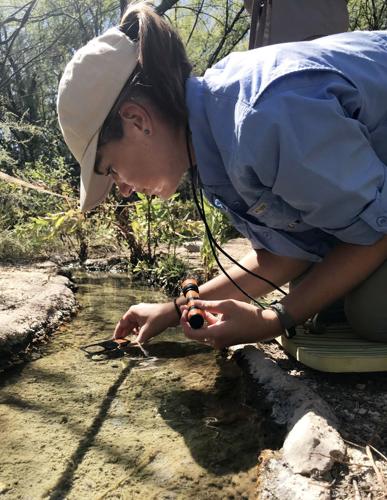
National Park Service intern Katie Biardi uses a flashlight and a magnifying glass to look for native spring snails smaller than a sesame seed in the waters of Quitobaquito Springs in 2019.
The Phoenix Zoo has also committed to taking in rescued Sonoyta mud turtles and pupfish, “as long as we have the space and the ability to do it,” Harris said.
Additionally, she and Weaver put out a call during a recent conference asking other accredited zoos across the country to stand ready to help if necessary, though they’re hoping it doesn’t come to that.
“Obviously, emergency salvage is a temporary solution,” Harris said. “We’d much rather see a solution that would spare the pond.”
Dodging the dozer
But hopes for that may be dimming, as CBP continues to issue billions of dollars in border wall contracts while Homeland Security issues waivers exempting those projects from federal laws designed to protect endangered species, cultural resources and the environment.
During a May 13 committee hearing in the House, U.S. Rep. Adelita Grijalva pressed Interior Secretary Doug Burgum for details on what could happen at Quitobaquito, especially in light of an incident last month when a border wall contractor bulldozed a roughly 1,000-year-old archaeological site at Cabeza Prieta National Wildlife Refuge.
“Many are concerned that Quitobaquito Springs could be next, as construction of Trump’s secondary border wall moves closer,” the Democratic congresswoman from Tucson said.
Burgum called the damage to the giant, fish-shaped land etching known as Las Playas Intaglio a “super unfortunate thing that happened,” and he said that “any additional work on a secondary border wall is going to be done in consultation with the tribe.”
The intaglio site is considered sacred to the Tohono O’odham people, and so is Quitobaquito Springs.
In a statement to the Star after the hearing, Grijalva called for the Trump administration to honor the wishes of the Tohono O’odham Nation and immediately abandon its plans for the “redundant second barrier."
Bogan wants to be hopeful about the future for these rare aquatic species and their fragile home, but as a scientist, he is duty-bound to prepare for the worst, he said.
Thankfully, wildlife officials do have one thing working in their favor, at least when it comes to the Sonoyta mud turtle.

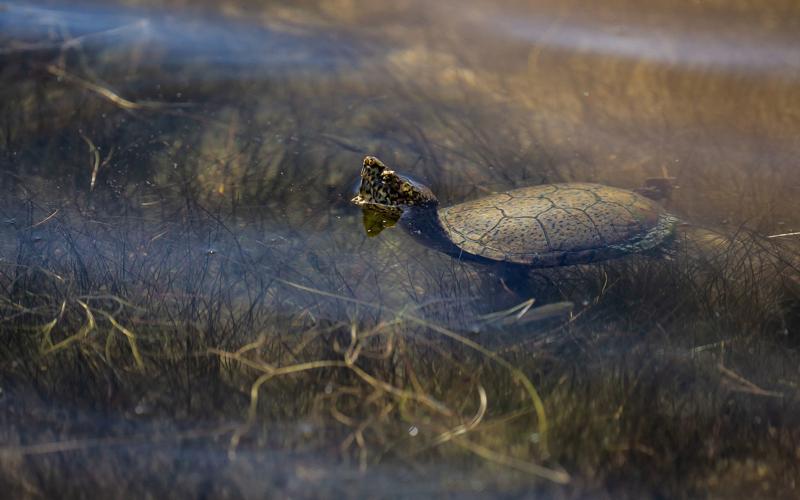
An endangered Sonoyta mud turtle swims in Quitobaquito Springs at Organ Pipe Cactus National Monument in 2020.
“This is actually one of the easiest endangered species to manage. They’ll literally live in raw sewage,” Bogan said. “They’re not that hard to keep happy. They just need water, and they just need to not be run over by a bulldozer.”
Footage of the Sonoyta mud turtle at Quitobaquito Springs in Organ Pipe Cactus National Monument, courtesy of the Center for Biological Diversity, the Tucson-based environmental group that petitioned for the turtle to be added to the endangered species list.



 Plans for border walls on Tohono O'odham land a 'betrayal,' chairman says