After more than four months imprisoned at a decommissioned hotel in Equatorial Guinea, a deported Phoenix man was arrested there Friday, in what attorneys are calling retaliation for his speaking out about abusive, dangerous conditions for dozens of U.S. deportees also detained at the hotel.
Ahmed Soliman, whose family came to Phoenix after fleeing Egypt when he was 4, was being held incommunicado in police custody as of Friday night, said Kate O’Donnell, an attorney with Tucson law firm Green Evans-Schroeder, which is representing Soliman.
"Ahmed understands his rights and he has been speaking out," she said Friday. "This is the latest thing they have done to try to silence him."
In the days before his arrest, Soliman, 30, told the Arizona Daily Star he and others had repeatedly been threatened at gunpoint, most recently on Sept. 5, and that he was reaching the point of despair.
People are also reading…
Soliman said in the most recent incident, he was forced to his knees as police pointed firearms at him, demanding he turn over his phone. But another guard had already seized the device, after catching Soliman recording an interaction between a police officer and another U.S. deportee at the Hotel Bamy, in Malabo, Equatorial Guinea.
Soliman shared videos of the Sept. 5 incident with the Star and with Reuters, in which Soliman is seen on his knees with his hands in the air, as people scream around him.
"How is this not global news yet?" Soliman wrote to the Star in a message with the videos. "I’m genuinely tired and afraid for my life. I can’t take it anymore. I want to go home."
The Star has been reporting on Soliman and other migrants' imprisonment at the Hotel Bamy in Equatorial Guinea, where lawyers say detention conditions are worsening, and the violence against detained migrants is escalating.

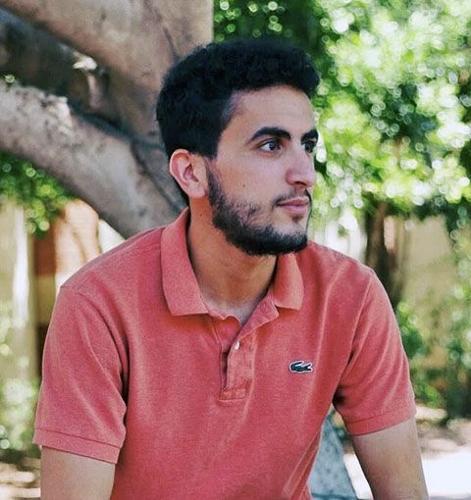
Ahmed Soliman, pictured in Glendale in 2020, grew up in Phoenix after his family moved from Egypt to Arizona when he was 4. He’s been detained at a hotel in Equatorial Guinea since ICE deported him there April 28 without due process. He said he’s intent on speaking out about the injustices he and other deportees at the hotel are facing, despite the risks to his personal safety.
None of the 29 U.S. deportees currently detained at the hotel have any ties to Equatorial Guinea, and all had been granted protection against return to their home countries, attorneys say. None of the deportees at Hotel Bamy have been charged with a crime in Equatorial Guinea, which received $7.5 million from the U.S. in exchange for accepting deportees.
But at least 17 people who were held at the hotel have already been returned to their home countries, a violation of international law known as "refoulement," attorneys say.
In June, international rights groups filed a lawsuit before the African Commission on Human and Peoples' Rights, demanding Equatorial Guinea improve conditions at the hotel and provide assurances the people held there won't be returned to their home countries.
Soliman was "targeted" by Equatorial Guinea officials because of his determination to publicize the dire conditions in the hotel, where he's been held since late April, said Meredyth Yoon, litigation director of Asian Americans Advancing Justice in Atlanta. She's one of the lawyers who filed the lawsuit on behalf of 14 detainees at the hotel, including Soliman.
"Ahmed was arrested in retaliation for speaking out about conditions at the hotel and standing up for his rights," Yoon said. "He knows the risks. He’s just very determined that his story gets out there."
Jamaican national Peta-Gaye Chambers, 35, had lived in the U.S. since she was 5 before she was deported to Equatorial Guinea in June. Chambers said she was also threatened during the Sept. 5 incident.
"That was very traumatic," she wrote to the Star after sharing videos of the incident. "The safety was off. The guard had no remorse."
Communication cut off
Soliman said he'd been using his phone to record a police officer who was ignoring another detainee's pleas to have his phone returned, on Sept. 5.
"When I got inside and was told to get on my knees, the female officer in front of me kept yelling at me to give her my phone or else the officer would shoot me," Soliman said. "I kept telling her I didn’t have my phone, and they already took it, but she wouldn’t believe me."
Guards at the hotel routinely cut off internet access, or confiscate detainees' phones, after they learn detainees have talked with journalists or lawyers. That's left those detained at the hotel cut off from their families and access to legal counsel, deportees told the Star.
Security officials referenced a Reuters report on Soliman's allegations as the reason for confiscating everyone's phones on Wednesday, O'Donnell said.
Soliman and other detainees who witnessed the Sept. 5 confrontation said it's one of many terrifying experiences they've had at the Hotel Bamy, since U.S. Immigration and Customs Enforcement deported them to Equatorial Guinea without warning.
The Star has been unable to reach any sources at the hotel since the phones were seized Wednesday. (One source was able to quickly send a voice memo saying armed guards were confiscating phones, before that person's phone was apparently taken.)
Among those now being held incommunicado is Brazilian national Pietro Graza de Lima, who was previously detained at Eloy Detention Center in Arizona. He arrived at Hotel Bamy in August, after he was deported there without a credible-fear screening, Graza de Lima told the Star in a Sept. 8 interview.
Graza de Lima is gay and, like Soliman, faces real danger in Equatorial Guinea, where homosexuality is de facto criminalized, lawyers say.
The presence of armed guards is a constant threat in the hotel, Graza de Lima said.
"Why do they have guys with big guns in the hotel?” he said, speaking in English, which is not his first language. "This is not a hotel. It’s a detention center."
Graza de Lima was a professor of Portuguese literature in his home country, said his attorney Dana Camilleri, senior attorney at Green Evans-Schroeder. He fled to the U.S. after corrupt Brazilian officials shot him multiple times in a failed assassination attempt, she said.
In immigration court in March, he was awarded protection against return to Brazil under the Convention Against Torture, Camilleri said. Afterward, ICE kept him detained at Eloy, as officials looked for a third country that could receive him.
Lawyers filed a habeas petition for Graza de Lima, but before it was adjudicated in U.S. District Court, ICE deported him without notice or a fear screening, in violation of due process and U.S. statutory and treaty obligations, Camilleri said.
The Star has been unable to reach Graza de Lima since his phone was seized.

Brazilian national Pietro Graza de Lima said he's been held for weeks at the Hotel Bamy in Equatorial Guinea after the U.S. deported him there in August, despite him having no ties to the country. Graza de Lima was granted protection against return to his home country in March, after an immigration judge agreed he'd risk death or torture there, his attorney told the Arizona Daily Star.
No response from officials
The Trump administration has signed third-country removal agreements with at least 35 nations, including 14 in Africa, which agreed to receive U.S. deportees who can't be returned home, according to Third Country Deportation Watch.
In a secretive agreement with Equatorial Guinea, the U.S. agreed to pay the central African nation $7.5 million in exchange for the country receiving deportees from the United States.
Human rights advocates say that by denying migrants a credible-fear screening prior to deportation to a foreign nation, ICE is violating critical due process that aims to ensure people are safe in the countries to which they're deported.
The Department of Homeland Security, ICE's parent agency, argues that as long as a country has provided "diplomatic assurances" to the U.S. State Department that deportees will be treated humanely, a fear screening isn't necessary.
Equatorial Guinea officials have not explained the basis for imprisoning U.S. deportees at the hotel.
In July, the Embassy of Equatorial Guinea acknowledged receiving the Star's questions about the alleged abuse of deportees held at the Hotel Bamy, but has not answered the questions. The Star has submitted questions several times since then, most recently on Sept. 8, with no response.
U.S. Immigration and Customs Enforcement spokesman Fernando X. Burgos has said the agency bears no responsibility for what happens to deportees it sends to third countries.
"Once an alien leaves the United States, ICE is no longer responsible for tracking their location or activities outside the country," Burgos said in a July 27 statement.
Attorney Camilleri said that's false, and that deporting people to countries where they face violence is an abdication of the U.S. responsibility to people in its custody.
"As has been demonstrated many times over, these are intentionally not safe third countries," Camilleri said. "In terms of our laws and treaty obligations, we are not supposed to transfer custody of people under our protection to places where we know they will be tortured, which is what the government has done here, pretty obviously."
Burgos referred the Star to the U.S. State Department, which signed the U.S. removal agreement with Equatorial Guinea. But the State Department has refused to answer the Star's questions on the agreement or to acknowledge the inhumane detention conditions at Hotel Bamy.
In a Friday email, an unnamed State Department spokesperson shared a vague statement in response to the Star's questions.
"The U.S. government will use all legal means to remove those with no right to remain in our country," the statement said in full.
Grijalva advocating for Soliman
After reading the Star's reporting on Hotel Bamy, U.S. Rep. Adelita Grijalva, D-Arizona, said her office reached out to the Embassy of Equatorial Guinea about Soliman's case, but has not received a response.
"I am very afraid for people like Ahmed. They have zero recourse because they’ve been deported to a country that is now governed by an oppressive, authoritarian regime," Grijalva said in a Friday interview with the Star. "The U.S. is essentially putting these people in literal life-or-death situations, and acting as if it’s fine because they’re not here" in the U.S.
Grijalva said the U.S. government must ensure people deported to third countries from the U.S. are going to safe places.
"Why are we sending $7.5 million, in this specific case, to this country to take people? What is the actual point? And how is it making our country safer?" she said. "The Trump administration is trying to tiptoe around the U.S. and international law. It's still illegal, it's still shameful."
Grijalva's office plans to follow up with the embassy and the U.S. State Department.
A spokesperson for U.S. Sen. Mark Kelly's office said they've also reached out to the U.S. State Department about Soliman's case, but have received no response.
U.S. officials have all been trying to avoid accountability for what the country is doing to vulnerable migrants, Camilleri said.
The State Department isn't answering questions, and DHS is "washing its hands" of migrants after they've been deported, she said.
"Everyone is just pointing fingers at each other, like that stupid Spiderman meme," she said.
Pressure to return to unsafe homelands
Deportees and their attorneys say Equatorial Guinea officials have been threatening and abusing the deportees intentionally, so they will become desperate enough to return to their home countries, despite the life-threatening risks they all face there, attorneys say.
"They keep shutting off the internet to try to get all of them to stop talking to reporters and their families," O'Donnell said. "The threats are becoming really violent. ... They say, 'We could just kill you and bury your body and nobody would ever find you.'"
Chambers said Sept. 2 that a guard told her she would go to jail if she didn't agree to get on a plane back to her home country. That's despite a U.S. immigration judge granting Chambers "withholding of removal" to her home country of Jamaica in 2013, agreeing she'd face persecution there.
In another late-night incident, on July 31, Chambers and several other detainees told the Star that guards violently pulled them from their rooms, handcuffed them and threatened them at gunpoint.
"They said if we leave the hotel grounds, they will shoot us and bury us across the street," Chambers told the Star in August.
Before his phone was seized, Graza de Lima said he cannot return to Brazil where both he, and his family still living there, would be at risk of death.
But being imprisoned at the hotel in an unknown country, where the treatment of detainees is worsening, is unsustainable, he said.
"We don’t have toilet paper, we don’t have soap, the food is bad. They try to make it very hard," he said.
In speaking out about conditions at the hotel, "I am risking my life," Graza de Lima said. "They told everybody, 'We don't talk about this. If you make an interview, it's bad for you.'"
Camilleri said the hotel's inhumane detention conditions are intentional.
"The pressure to return to their home countries and be tortured there is immense," she said. At Hotel Bamy, "Pietro was still using a toothbrush he got at Eloy, because none of them are being afforded toothbrushes or toothpaste. They take away the toothpaste as punishment."

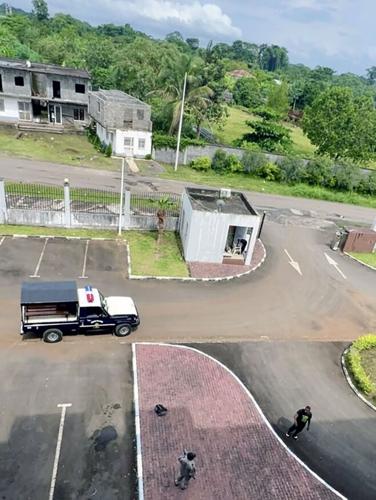
Ahmed Soliman, who grew up in Phoenix, shared his view from inside the decommissioned Bamy Hotel in Malabo, Equatorial Guinea, where he’s been imprisoned since ICE deported him there on April 28. Armed guards patrol outside the hotel, where Soliman said he and more than 20 other deportees from the U.S. are being confined, despite having not committed any crimes in the country.
Natalie Holmes, an ordained pastor who was deported to Equatorial Guinea alongside Chambers in June, said that her U.S.-based family is "heartbroken" at her continued detention at the hotel. No one knows how to help her, Holmes told the Star in an Aug. 31 interview.
"They can’t understand and they keep asking me, 'How did this happen?' I just don't have answers," she said. "My life is in shambles. ... There’s just too much. I’m so tired. I hardly sleep."
In a statement published Friday afternoon, a coalition of human rights groups and lawyers demanded the government of Equatorial Guinea confirm the safety and whereabouts of Soliman, and another U.S. deportee taken into police custody Friday.
The coalition also called on Equatorial Guinea officials to restore detainees' access to communication with their families and attorneys, and to ensure unrestricted access to legal representation, medical care and protection from "violence, threats, intimidation and retaliation."
The group is also calling on the U.S. State Department to "reassess" Equatorial Guinea's "diplomatic assurances" that deportees will be treated humanely there, and to halt any further deportations to the country.
Contact reporter Emily Bregel at ebregel@tucson.com. On X, formerly Twitter: @EmilyBregel

Emily Bregel
Border reporter







 Arizona man hospitalized in Equatorial Guinea; U.S. officials mum on abuse claims