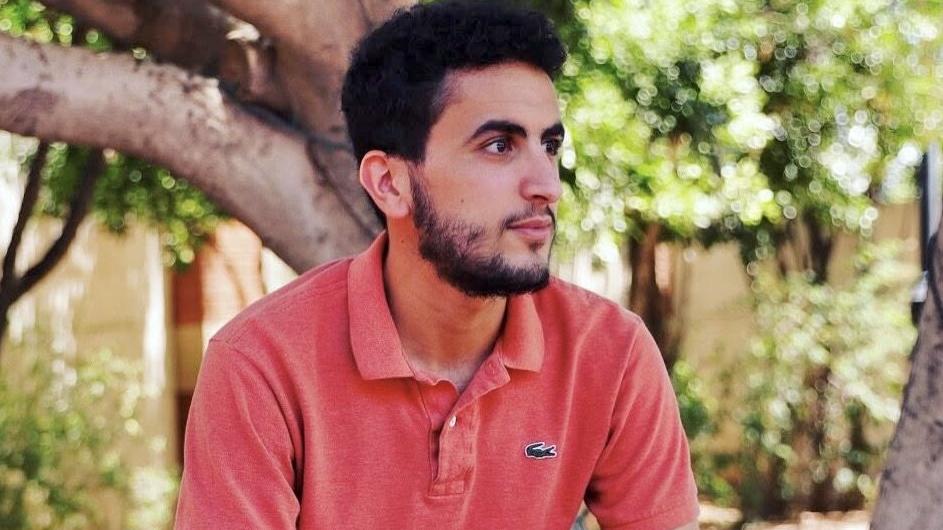
Equatorial Guinea police covered Ahmed Soliman's head with a bag and beat him during the violent arrest of the 31-year-old Phoenix man earlier this month, the Arizona Daily Star reported Sept. 18.

In this screenshot from a Sept. 5 video shared with the Arizona Daily Star, Ahmed Soliman, who grew up in Phoenix, is seen on his knees, in a white shirt as a kneeling police officer aims a firearm at him and another deportee. Less than a week after sharing the video with journalists, Soliman and another U.S. deportee were violently arrested Sept. 11 by Equatorial Guinea police, in what lawyers call retaliation for speaking out.
Here are six things to know about the Star's latest coverage of Soliman's arrest and his arbitrary imprisonment since ICE deported him to Equatorial Guinea in April.
- On Sept. 18, Amnesty International issued a statement calling for the release of Soliman and another U.S. deportee, Samson Birhane, saying they're at "risk of torture" in police custody. The two men were bound, beaten and "unlawfully" arrested at Hotel Bamy in Equatorial Guinea, allegedly in retaliation for speaking out about the inhumane treatment of U.S. deportees arbitrarily imprisoned at the hotel, the rights group said. Soliman, who grew up in Phoenix after his family moved from Egypt when he was 4, was arrested with Birhane on Sept. 11, two days after authorities confiscated the phones of all U.S. deportees being detained at the decommissioned hotel, so they could not communicate with journalists or lawyers.
- Since their arrest, Soliman and Birhane have been held incommunicado in police custody, their lawyers say. On Sept. 11, "Police officers covered the two men’s heads with a bag and beat them in their heads, backs and ribs," Amnesty International said in its statement. "Amnesty International believes that police officers targeted them in reprisal for reporting the authorities’ violent threats to coerce them to agree to return to their countries of origin. ... The authorities must immediately release them, inform them of any charges against them and allow them unimpeded access to counsel."
- The Star has been reporting on Soliman's case, and the treatment of U.S. deportees held at the hotel in increasingly dangerous conditions, since July. Multiple deportees, including Soliman, told the Star they'd been beaten and held at gunpoint at the hotel during one late-night incident on July 31. This month, the New York Times and Reuters also started reporting on Soliman's case.
- After the Star's deadline last week, U.S. Immigration and Customs Enforcement spokesman Fernando X. Burgos emailed a statement highlighting Soliman's criminal history that caused him to lose his green card, which the Star reported on in August. Burgos did not respond to the Star's questions about the abuse Soliman has experienced in Equatorial Guinea. Burgos has previously said ICE is not responsible for what happens to deportees after they leave U.S. custody. "Under President Trump and Secretary Mullin, criminal illegal aliens are NOT welcome in the United States," Burgos said in the Sept. 19 email.
- Burgos also shared an unattributed statement from the U.S. Department of Homeland Security, ICE's parent agency: "All of these illegal aliens were deported to a safe third country. We are applying the law as written. All illegal aliens receive due process. If a judge finds an illegal alien has no right to be in this country, we are going to remove them. Period. The Trump Administration is utilizing all lawful options to carry out the largest deportation operation in history, just as President Trump promised."
- U.S. Rep. Adelita Grijalva, a Tucson Democrat, said the Trump administration "bears full responsibility" for Soliman's perilous circumstances. She has been advocating for Soliman's safe release since reading the Star's reporting on his case. "I am horrified by the disturbing new reports of Ahmed's imprisonment and physical beating, and I fear his life is in immediate danger," Grijalva said in a statement to the Star. "The Trump Administration deported Ahmed into harm's way and bears full responsibility for his treatment — and for what happens to him next. The Administration must act immediately to secure Ahmed's release before it is too late, along with the release of others being involuntarily held in Equatorial Guinea."
People are also reading…
Read the Star's latest story on Soliman's case here.
Contact reporter Emily Bregel at ebregel@tucson.com. On X, formerly Twitter: @EmilyBregel

Emily Bregel
Border reporter