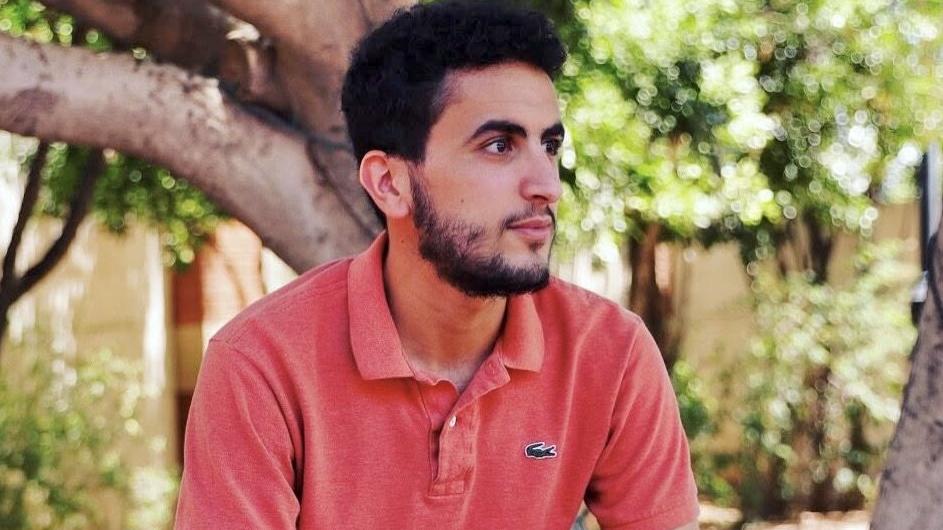
A Phoenix man deported to Equatorial Guinea was hospitalized after passing out in a police-station cell, where he's been held "incommunicado" for two weeks following his arbitrary arrest, lawyers said.
Attorneys for Ahmed Soliman, who grew up in Phoenix and was deported to Equatorial Guinea in late April, said they've learned Soliman has been returned to the police station, following his Tuesday hospitalization.
But the lawyers have still not been allowed to communicate with him, and police-station guards did not share his diagnosis, two lawyers told the Arizona Daily Star.
Malaria and typhoid fever are common in jails and prisons in the central African nation, where the U.S. has deported dozens of migrants who can't be returned to their home countries, said attorney Lucas Olo Fernandes, who was born in Equatorial Guinea. He works with a non-governmental organization, based in Spain, that advocates for human-rights activists and others persecuted in Equatorial Guinea. Most recently, that includes U.S. deportees imprisoned there, despite having committed no crime in the country.
People are also reading…
Two weeks after their arrest, neither Soliman nor Samson Birhane, who was arrested with him, has been charged with a crime, and all communication has been restricted, lawyers said.
The lack of information is "in itself terrifying, because we don’t know what could be happening to them inside," said attorney Kate O'Donnell of Tucson-based firm Green Evans-Schroeder, which is representing Soliman.
Soliman, 31, and Birhane were violently arrested Sept. 11 at Hotel Bamy in Equatorial Guinea, which has been serving as a detention center for U.S. deportees sent there without notice, after receiving protection from U.S. immigration judges against return to their home countries.
Advocates say the arrests were retaliation for speaking out about inhumane, dangerous conditions at Hotel Bamy.
Soliman and Birhane were bound, their heads covered with bags, and beaten during their "unlawful" arrest earlier this month, Amnesty International said in a Sept. 18 statement. The international rights group has called for the men's release, saying they are at "risk of torture" in police custody and decrying their violent arrests.

In this screenshot from a Sept. 5 video shared with the Arizona Daily Star, Ahmed Soliman, who grew up in Phoenix, is seen on his knees, in a white shirt as a kneeling police officer aims a firearm at him and another deportee. Less than a week after sharing the video with journalists, Soliman and another U.S. deportee were violently arrested Sept. 11 by Equatorial Guinea police, in what lawyers call retaliation for speaking publicly about brutal conditions at the hotel.
The two U.S. deportees are not being held in an official prison, but rather in a "police station jail," where conditions are dire, O'Donnell said, citing a U.S. State Department report on human-rights practices in Equatorial Guinea, published in 2023.
"Not only are conditions squalid and violent, but people can be held for months at a time without ever seeing legal counsel and without ever going before a judge," O'Donnell said.
Conditions in the jails are "occasionally life threatening, due to severe physical and emotional abuse, overcrowding, disease, inadequate food, poorly trained staff, limited oversight, and lack of medical care," the State Department's report said.
Equatorial Guinea's government carries out arbitrary arrests of immigrants, political opponents and activists, the report said: "Diplomatic representatives in the country noted the government made foreign nationals vulnerable to abuse through harassment, abuse, extortion, detention, and not renewing residence and work permits in a timely manner."
The report also warned of extrajudicial killings, torture of political opponents and violence committed against incarcerated LGBT+ individuals. Soliman, who is gay, is particularly vulnerable in jail, O'Donnell said.
In July, Soliman told the Star he was determined to inform the public about the injustices he and others held at the hotel were facing, despite being well aware of the dangers he faced, both for speaking out and for revealing his identity as a gay man, while in a country where homosexuality is de facto criminalized.
"I'm at a point in life right now where I will do everything in my power to fight," Soliman told the Star. "I'm doing this for the 17 people that live here, as well. It's not just me."
Deportee 'in critical condition'
The Star has been reporting on Soliman's case and dangerous conditions for third-country deportees held at Hotel Bamy since July. This month Reuters and the New York Times began reporting on the case, after Soliman shared with journalists a Sept. 5 video showing him and another deportee held at gunpoint in the hotel lobby.
Four days later, as media attention grew, authorities seized the communication devices of all deportees held at Hotel Bamy on Sept. 9, two days before Soliman and Birhane were arrested.

Ahmed Soliman, pictured in Glendale in 2020, grew up in Phoenix after his family moved from Egypt to Arizona when he was 4. ICE deported him to Equatorial Guinea, a country he has no ties to, on April 28 without notice.
Conditions have been worsening at the hotel, where a number of U.S. deportees have serious chronic illnesses for which they aren't receiving treatment or medication, other than what lawyers have been able to bring to the hotel, advocates told the Star.
Attorney Olo Fernandes said another deportee held at Hotel Bamy was recently hospitalized "in critical condition," according to information shared by a hotel guard. But attorneys have not been able to locate the man or confirm his health status, he said.
Olo Fernandes said he has visited Hotel Bamy to bring medication and try to speak with deportees, but attorneys were never allowed to provide legal counsel to the people held there. Earlier this month, hotel guards prohibited lawyers from visiting the hotel entirely, he said.
For U.S. deportees like Soliman who have no travel documents or passport, being "stateless" in a foreign country that has a history of exploiting migrants is a dangerous situation, he said.
"All their family, brothers, sisters, mothers are in the U.S., and they don't have any other place to go," he said.
The Embassy of Equatorial Guinea in Washington, D.C. has not responded to the Star's repeated requests for comment.
US officials' response
Equatorial Guinea, long criticized by the U.S. State Department for its human-rights record, received $7.5 million from the U.S. as part of an agreement to receive third-country deportations.
But advocates say U.S. officials have ignored evidence of the violence committed against people the U.S. has deported there, a silence they say amounts to complicity in the human-rights abuses.
ICE spokesman Fernando X. Burgos has claimed the U.S. is not responsible for what happens to deportees once they leave U.S. custody. His latest email on Sept. 19 ignored the Star's questions on Soliman's violent arrest, and instead highlighted Soliman's criminal record that led to his losing legal status, which the Star reported on in August.
"Under President Trump and Secretary Mullin, criminal illegal aliens are NOT welcome in the United States," Burgos said. He referred the Star to the U.S. State Department.
Prior to losing his legal status, Soliman had protection under the Deferred Action for Childhood Arrivals policy, or DACA, and then obtained lawful permanent residency in 2021, his lawyer said.
Over the past two months, State Department officials have not addressed the Star's questions on Soliman's treatment, providing only unattributed, general statements, most recently in a Sept. 11 email: "The U.S. government will use all legal means to remove those with no right to remain in our country."
O'Donnell said Soliman and the others held at the hotel do have a right to be in the U.S.
"They were granted protections under domestic and international law. They have a right to remain," she said.
Olo Fernandes said the U.S. State Department has refused to criticize Equatorial Guinea's inhumane treatment of the people the U.S. has deported there, despite being aware that Equatorial Guinea is violating whatever commitments it made to keep deportees safe.
In addition to the media coverage, advocates have reported at least eight specific incidents of abuse and violence against U.S. deportees at Hotel Bamy to the U.S. Embassy in Malabo, the former capital of Equatorial Guinea, with no response, Olo Fernandes said.
The silence from U.S. officials is striking, he said, when compared to past U.S. critiques of Equatorial Guinea's human rights violations.
"Equatorial Guinea is really feeling that they are able to do anything they want, because the U.S. is not criticizing anything they do," he said. "The fact that the U.S. is condoning this and, I would say, even supporting and encouraging this in some cases, shows the U.S. has changed their policies to where they do not respect human rights."
Under the second Trump administration, the State Department issued guidance scaling back the congressionally mandated reports on international human-rights practices, Amnesty International said in a November 2025 statement.
"Failing to adequately report on human rights violations further damages the credibility of the U.S. on human rights issues, and it leaves Congress and the public with unreliable information that could have catastrophic impacts on people’s lives," the rights group said. "Congress must use its full oversight authority to ensure that future reports are grounded in facts, not ideology, and rooted in long established, universally recognized standards."
On Wednesday, the State Department again declined to identify its spokesperson, who said the agency had no comment on Soliman's case, or on the agency's departure from its history of calling out human-rights abuses in Equatorial Guinea.
U.S. Rep. Adelita Grijalva, a Tucson Democrat, has said the Trump administration "bears full responsibility" for Soliman's and others' precarious situation. She has been advocating for Soliman's safe release since reading the Star's reporting on his case.
"The Administration must act immediately to secure Ahmed's release before it is too late, along with the release of others being involuntarily held in Equatorial Guinea," Grijalva said.
Diplomatic assurances
The U.S. Department of Homeland Security continues to maintain it followed due process in deporting dozens to Equatorial Guinea without having the opportunity for a fear screening.
DHS has argued in court — including in Soliman's habeas corpus case, which was pending in U.S. District Court in Arizona when he was suddenly deported to Africa — that fear screenings aren't necessary for third-country removals, because the receiving countries have provided "diplomatic assurances" that deportees will be treated humanely.
On Sept. 18, a federal appeals court ruled against DHS's argument, deciding those secretive "diplomatic assurances," which have not been publicly released, are insufficient.
The First Circuit court ruling said the U.S. can't deport people to third countries without "meaningful" notice and the opportunity to raise fear of being tortured or persecuted, as required by U.S. statutes.
Nearly everyone imprisoned at Hotel Bamy, including Soliman, has been granted protection against return to their home countries after immigration judges agreed they'd face persecution or death there.
Soliman was granted protection against return to Egypt — which his family fled when he was 4 years old — under the United Nations Convention Against Torture in 2025, due to his identity as a gay man and his family's earlier political activism in Egypt.
The main goal of Trump's third-country removal program is to instill fear in migrants, pressuring them to agree to return to dangers they face in their home countries, rather than risk being sent to a dangerous, unfamiliar country, Ariel G. Ruiz Soto, senior policy analyst for the nonpartisan Migration Policy Institute, told the Star.
Hotel detainees have been under intense pressure from local authorities to return to their home countries. Several deportees imprisoned at the hotel, including Soliman, told the Star that authorities at the hotel have repeatedly threatened them at gunpoint, threatening to shoot them if they don't agree to return to their home countries.
At least 20 people deported by ICE to Equatorial Guinea have already been forced back to their home countries, making the U.S. complicit in "chain refoulement," in violation of international law and U.S. statutes, lawyers say.
U.S. officials' refusal to condemn, or even acknowledge, the abuses against people the U.S. has deported to third countries is "an extraordinary act of hypocrisy," O'Donnell said.
"It is so deeply disappointing that we as attorneys, who use the law to defend people’s rights, are unable to do that because our government is not respecting the law," O'Donnell said.
Contact reporter Emily Bregel at ebregel@tucson.com. On X, formerly Twitter: @EmilyBregel

Emily Bregel
Border reporter