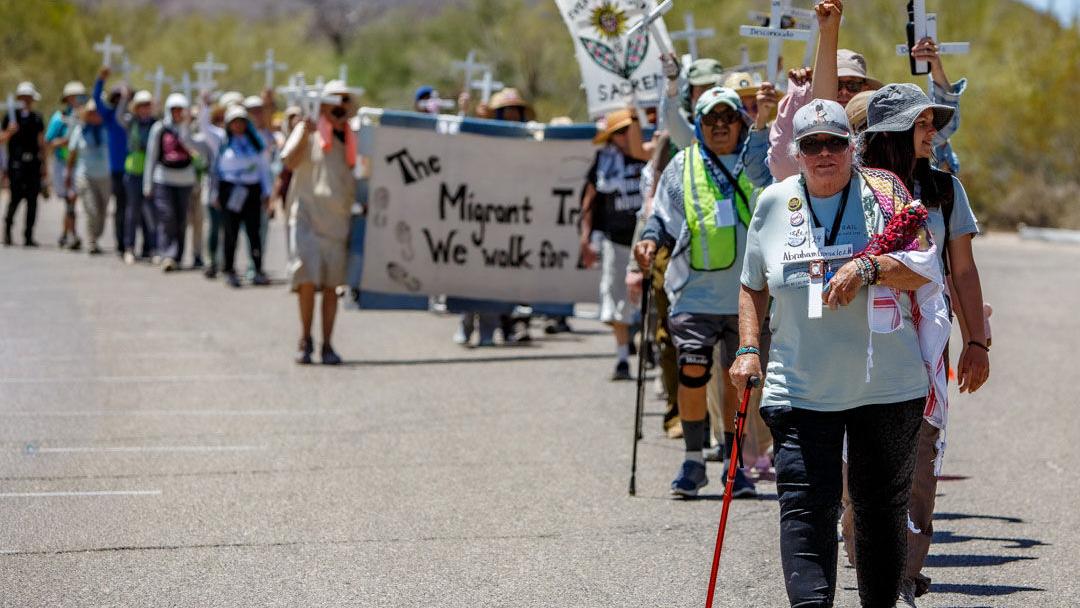
AMBOS NOGALES — Catholic leaders gathered half a mile away from the U.S.-Mexico border wall Friday to call for compassionate treatment of migrants and comprehensive immigration reform one day after the Supreme Court upheld a Trump policy that would turn away asylum-seekers seeking entry at the border.
One of the leaders, Bishop John Dolan of the Roman Catholic Diocese of Phoenix, warned that the United States will suffer a "slow bleed" if it does not attend to its immigration system.
"We need Congress to get together and start to work on a true, valuable and sustainable immigration reform that is going to affect us, and not flip-flop (between presidential administrations), because that's what we're doing. And that's a sign that we just don't have a good immigration system," Dolan said.
The Border Mass 250 was a "pastoral conversation" of the bishops, a Catholic Mass and procession from Nogales, Arizona, to Nogales, Sonora.
People are also reading…
It was led by several Catholic leaders, including Dolan; Archbishop John Wester of Santa Fe; Bishop James Misko of Tucson; Bishop Mark Seitz of El Paso; and Gerald F. Kicanas, bishop emeritus of Tucson.
The event was organized by the Center for Migration Studies, the Kino Border Initiative, Hope Border Institute and the Roman Catholic Dioceses of Phoenix and Tucson.

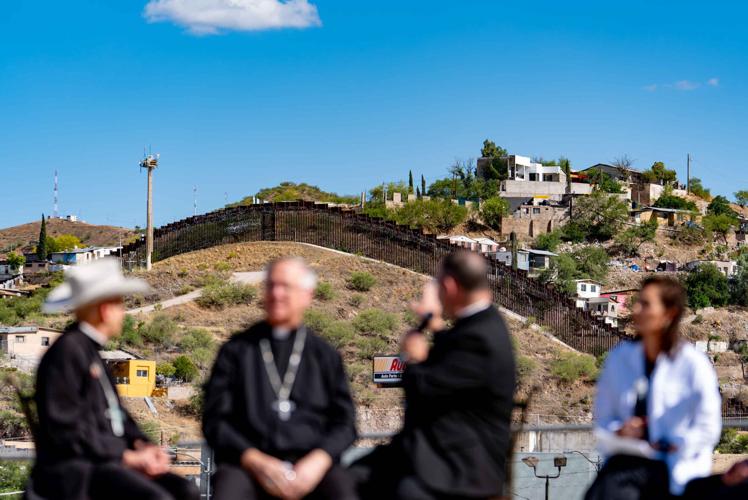
Tucson Bishop James Misko points toward the U.S.-Mexico border Friday in Nogales during a conversation with colleagues from across the Southwest outside of Sacred Heart Catholic Church in Nogales during a discussion that was part of Border Mass 250. The event called for compassionate treatment of migrants and comprehensive immigration reform.
The Catholic leaders gathered under a bright, 98-degree sun to highlight the contributions immigrants have made to the United States as the nation turns 250 years old.
Wester, the archbishop, emphasized that the Catholic church is not for open borders. Rather, it is for well-managed borders, he said.
"Every sovereign nation has a right to have borders, but they have to do that with prudence, and they have to recognize that there are certain rights ... that are God-given," Wester said.
The gathering came four months after several bishops across the country, including those at the event, issued a statement expressing concern over the Department of Homeland Security's "ongoing immigration enforcement activities against individuals and families who are without legal status in our country."
The Feb. 24 statement called for several reforms, including the honoring of the right to apply for asylum at the border.
The bishops expressed concern that "bona fide asylum-seekers" were being denied the opportunity to apply for asylum at the U.S.-Mexico Border, which has left them in "dangerous conditions and situations, subject to abuse by criminal organizations."
The statement, which was issued about four months before the Supreme Court decision, called for a full restoration of access to asylum at the border.
In a 6 to 3 decision on Thursday, June 25, with the three liberal justices dissenting, the Supreme Court upheld a 2016 Trump border policy known as "metering" that turns away asylum-seekers who arrive at U.S. ports of entry through Mexico.
The Trump administration argued the policy was needed to stem a surge in asylum-seekers arriving at the southern border, overwhelming immigration officials at ports of entry.
Critics said the policy violated the rights of people fleeing persecution and danger in their home countries to seek asylum in the United States and forced them to wait in Mexico, where they were often targeted by violent criminal organizations.
But the Supreme Court majority said the U.S. government is not obligated to consider the asylum claims of people who have reached the border but not yet entered the country. The court also noted that "metering" had previously been used by other Republican and Democratic administrations prior to President Joe Biden ending the practice.
Amnesty International called the ruling a "devastating blow to the human rights of people" and a violation of international law.
The high court decision "took direct aim at the rights, dignity, and safety of people who turn to the United States for protection and justice," said Laura Belous, managing attorney of the Florence Project’s advocacy team.
"The Supreme Court has enabled the Trump administration to shut the door to safety and justice to all those who seek protection on our shores, including asylum seekers at our southern borders and TPS holders throughout the United States," Belous said in a written statement.
Kicanas: US doing 'Band-Aids' instead of reform
Kicanas, the bishop emeritus of Tucson, called U.S. immigration policies "Band-Aids" that are not going to solve the issue.
"We have to address the immigration policy of our country, as does most countries around the world today. It's a serious concern. All of us want this situation to improve, and the way it will improve is we have comprehensive immigration policy reform," Kicanas said.
Comprehensive immigration reform cannot be handled from the White House, "or, for that matter, a Supreme Court level," Dolan said in an interview.
"(Immigration reform) really has to be born out of Congress. It has to, otherwise, it will just continue to flip-flop, you know, from one president to the next. And this president is just one of many," Dolan said. "Otherwise, we will just continue. Every four years, we're going to be dealing with this thing again. I think that's a problem."
The United States almost reached immigration reform in the past, but "it was dismissed during an election year," and "that's just terrible," Dolan said.
"We need to get back to the table and invite Congress to do what it's elected to do. And I'm not just speaking as a U.S. citizen here from this perspective, but also from a pastoral perspective, and just from a mental health perspective," Dolan said. "I don't think it's good for the mental health of the United States citizens, residents, and it's certainly not good for the migrants who are wondering if there is a possibility that this might be a nation of opportunity."
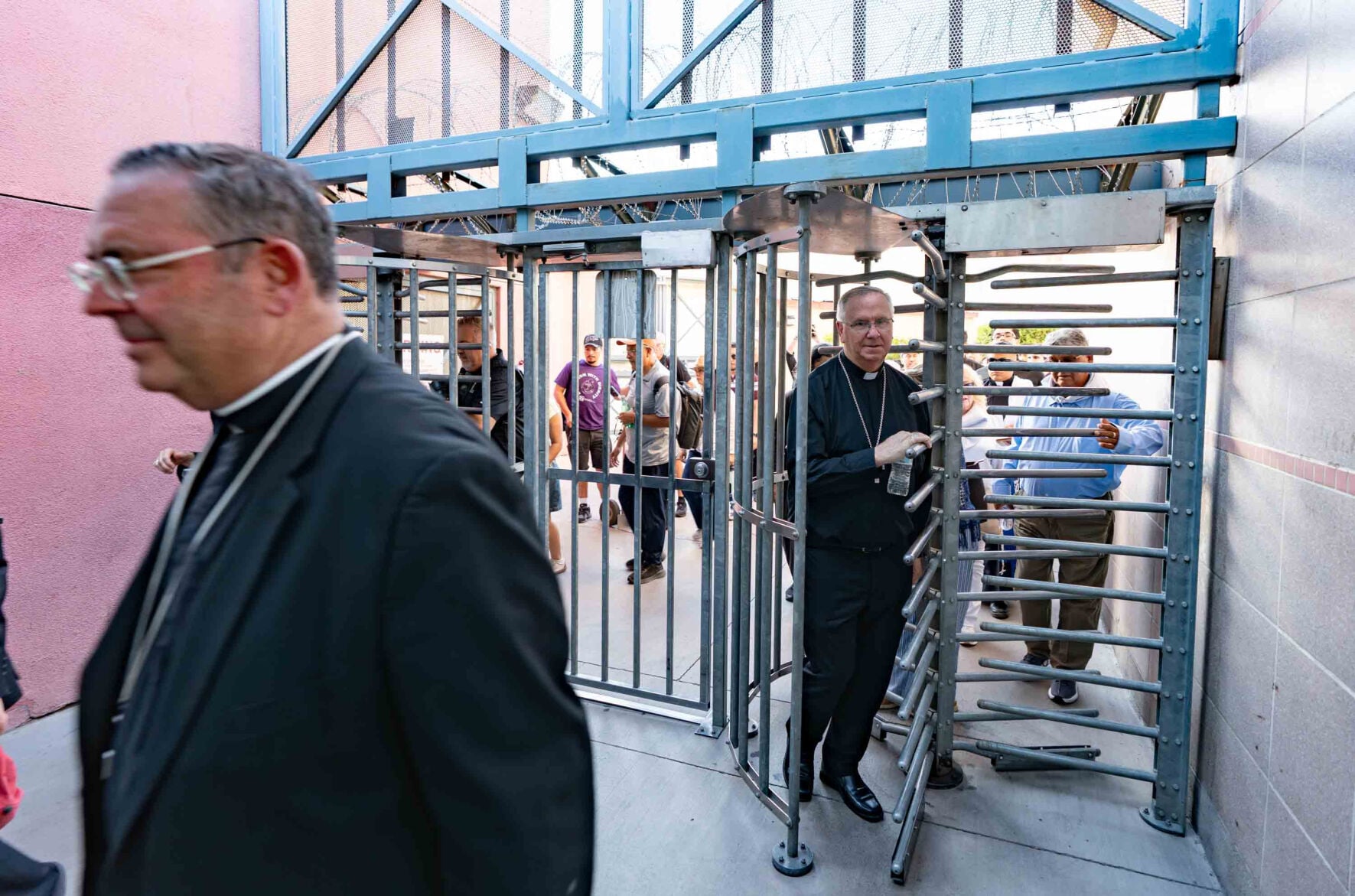
Tucson Bishop James Misko walks ahead of Phoenix Bishop John Dolan as they cross the the U.S.-Mexico border from Arizona into Nogales, Sonora Friday for a procession as part of Border Mass 250.
Misko: Compassion needed from 'all Christians and all Americans under God'
After the pastoral conversation, a Mass of about 300 attendees was celebrated at Sacred Heart Parish in Nogales, Arizona.
The Mass, presided over by Miko, featured the recitation of several Bible verses that immigration advocates often use to call for the compassionate treatment of immigrants.
The verses included Deuteronomy 10:19, Hebrews 13:2, and Matthew 25:35, which touched on themes such as showing love to "those who are foreigners," "showing hospitality to strangers," and Christ rewarding those who helped "one of the least of these."
Misko reminded the congregation that the accompaniment of migrants is not only a "commandment of all Judeo-Christians," but it is also a "key ingredient" of all Christians and all Americans under God.
The management of borders is a "right and responsibility" of nations, but "only if it is built on the foundation of Christian justice," which is in relationship with "God and God's people," Misko said.
"Bringing into light the fact of our current situation, while it is certainly part of an accepted and encouraged function of all nations, managing borders, it has become painfully dysfunctional," Misko said.
The painful dysfunction has led to significant detrimental impacts on the American experience, Misko said.
He provided an example of families now living in fear of separation and, in some cases, due process being disregarded.
Hundreds join in procession across the border
The Mass in Nogales, Arizona, was followed by a procession of more than 200 people.
The bishops led the procession of priests, immigration advocates, and parishioners.
As the bishops and volunteers walked the winding, inclining and declining sidewalks of Nogales, Arizona, they used a microphone and rolling speakers to recite the "Our Father" and other Rosary prayers. The bishops prayed for peace for the migrants directly affected by immigration policies.
When the procession arrived at the Dennis DeConcini Port of Entry, they held a moment of silence as they walked through the port into Nogales, Sonora.
The procession eventually gathered near the entry point of a tall, winding, pedestrian bridge in Nogales, Sonora. They gathered in a tight semi-circle shape and continued to recite prayers for the migrants stuck in Sonora.
After weaving through the bustling streets filled with fast-moving cars, the procession concluded its nearly 1-mile journey at Parroquia De La Purísima Concepción, a stone-brick Catholic church near the port of entry.
How hard was it for people to get asylum?
The Kino Border Initiative was providing humanitarian aid, such as shelter, meals and clothing, to "many, many people at the border requesting asylum" around 2022 and 2023 during the Biden administration, said Juan Cuellar, the Kino initiative's director of education and advocacy. He estimated they helped hundreds of asylum-seekers.
The Kino Border Initiative is a Nogales, Arizona- and Nogales, Sonora-based organization that provides humanitarian aid to people migrating to the United States or people recently deported by the United States.
Since the Trump administration ramped up its goals of mass deportation and limitations on who is allowed into the United States, there has been a "big shift," Cuellar said in an interview.
"There were many families that were stranded at the border without the possibility to go back to their places of origin," Cuellar said.
The Kino Border Initiative now sees "very few" people arriving at the border seeking asylum, Cuellar said. He estimated they provide humanitarian aid to about two people a month who arrive seeking to apply for asylum.

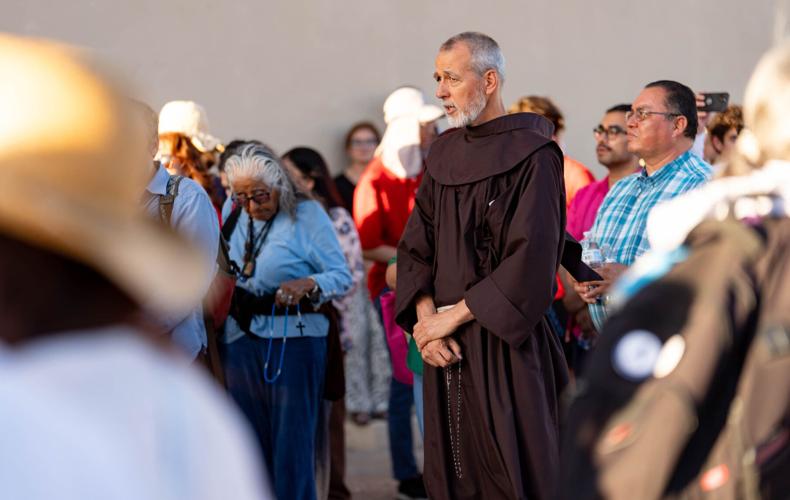
Priests, seminarians and laity pray the rosary Friday after Border Mass 250 at Sacred Heart Catholic Church in Nogales, Arizona.
"It was mostly people who were unaware, or they were fooled by coyotes (Spanish slang for human smugglers), and they were told that if they paid money, they would be taken to the U.S., and from there they could request asylum," Cuellar said.
Kino Border Initiative has seen a "very slow traffic of people" arriving to the border seeking to apply for asylum because the majority of them "knew it was impossible," Cuellar said.
Although it is difficult to pinpoint an exact number of people who arrived at the border seeking asylum during the Biden administration, it is "definitely fair to assume" that many of them were seeking to apply for asylum, said Colleen Putzel-Kavanaugh, a policy analyst for the Migration Policy Institute.
"There were a lot of people who were coming from all parts of the world, fleeing different things. Before the Uniting for Ukraine program, there was a large number of Ukrainians arriving at the border fleeing after the invasion from Russia. There were also a large number of Venezuelans because of the political instability happening in Venezuela," Putzel-Kavanaugh said in a June 24 interview before the ruling.
During the Biden administration, migrants often waited to be apprehended by border authorities so they could "then say 'I have a fear of returning to my country. I intend to apply for asylum,'" Putzel-Kavanaugh said.
The people were screened by border authorities to ensure they did not appear on any government database that barred them from being released into the United States, Putzel-Kavanaugh said.
Once in the United States, the people appeared before an immigration court, where they told the judge why they intended to apply for asylum, Putzel-Kavanaugh said. If successful, the people were given an asylum application, she said.
"The act of actually applying for asylum is several more steps than sort of just arriving to the border and making that intention known," Putzel-Kavanaugh said.
Now, when migrants arrive to the border seeking to apply for asylum, they are placed in a process known as a "credible fear interview," Putzel-Kavanaugh said.
That also was the case under the Biden administration, but "that credible fear process right now is much harder to access, and it's held at a much higher standard. So it's much harder for people to sort of pass that threshold," Putzel-Kavanaugh said.
"Essentially, most people who are arriving at the border right now are being processed in some sort of way that will ultimately result in their removal," Putzel-Kavanaugh said. "Right now, what we're seeing is both far fewer people coming to the border but also a lot more barriers to access any sort of protection."
The requirements to be eligible for other forms of protection, such as "Withholding of Removal" or "Convention Against Torture," have also been set "to a higher bar," Putzel-Kavanaugh said.
"People also have to essentially manifest their fear. Typically, in previous administrations, people were asked outright if they feared a return to their country. That's no longer the case. So people have to express that fear of return and not everyone knows that they have to," Putzel-Kavanaugh said.
Even if people manage to express that fear, the threshold "to be eligible for some sort of protection is much higher," Putzel-Kavanaugh said.
"So for all intents and purposes, right now, asylum is inaccessible, but other forms of protection are also virtually inaccessible because it's so hard to meet that threshold," Putzel-Kavanaugh said.
Organizers join critics in slamming Supreme Court ruling
Cuellar and critics across the country have slammed the recent Supreme Court ruling as a "retreat" from the United States' legal and moral obligations to assist people seeking safety from "violence and crisis."
The June 25 decision was "very heavy and heartbreaking" not only for the binational community of Ambos Nogales but for the families Kino Border Initiative accompanies every day at the border, Cuellar said.
"They are affecting the core values of human dignity and legal protection that we stand for as Kino," Cuellar said.
He added, "We're talking about human beings who are being rejected because of their place of origin. For us, it's very concerning that there are parts of the U.S. Supreme Court that, right now, as a majority, consider that not every human should be considered with the same dignity just because of the place they were born."
Republic reporter Daniel Gonzalez contributed to this story.