Get your morning recap of today's local news and read the full stories here: tucne.ws/morning
PHOENIX — Attorney General Kris Mayes won't commit to defending the legality of a controversial voter-approved measure that lets state and local police arrest border crossers.
At a news conference Monday, the Democratic attorney general acknowledged that it is generally her role to oppose legal efforts to void state laws approved at the ballot. And Mayes did already convince a federal judge to deny a migrant rights group's request to immediately delay enforcement of the border law while its legality is litigated.
But Judge Michael Liburdi has yet to decide whether Proposition 314 runs afoul of a U.S. Supreme Court ruling voiding parts of a 2010 Arizona law that sought to allow the state to enforce federal immigration laws. That sets the stage for a hearing on the measure voters approved in 2024, and the question of whether Mayes will defend it.
People are also reading…
"What I will say is, we haven't gotten there yet,'' Mayes said.
She said her job is to defend laws "when I think there is a good-faith argument to be made, and a constitutional and lawful argument to be made to defend the will of the voters.''

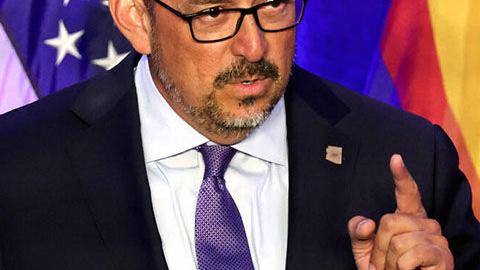
Attorney General Kris Mayes answers questions Monday over whether she will argue that Proposition 314 is constitutional.
Mayes has refused in the past to go to court to fight for laws she believes are unconstitutional. Those included the state's original 1864 ban on abortion and more recent restrictions, such as a 24-hour waiting period to terminate a pregnancy, and a still-pending case in Maricopa County Superior Court about whether the Legislature can bar certain advance practice nurses with specialized training from performing abortions.
She also did not defend a 2022 measure approved by lawmakers to prevent transgender girls — those defined in the statute as being born biologically male — from participating in girls' sports. Mayes said the law is unconstitutional.
That led to the law being defended instead by Republican state schools chief Tom Horne; the case ended up being dismissed by the challengers.
Now the question is whether Mayes thinks the law on border enforcement is legal.
"As you know, I was not a fan of it,'' Mayes conceded. "I thought it was an unfunded mandate.''
In fact, her opposition to the 2024 ballot measure went farther, as she said it "could very well lead to racial profiling.''
When a first lawsuit was filed against the measure, to keep it from even going on the ballot, Mayes' office took no position. That left it up to Republican legislative leaders to fight and win the right to send it to voters, where it was approved by a 2-to-1 margin.
Now the question before Liburdi is whether the law is constitutional — and what position Mayes will take.
The measure contains various provisions.
One makes it a crime to submit false information to get employment or government benefits. Another imposes a harsher penalty when someone sells fentanyl that was imported from another country and it causes the death of another person.
The heart of the measure, however, is a provision that allows state or local police to arrest non-citizens who enter Arizona at other than a port of entry. That offense is a misdemeanor.
But the new state law is constructed in a way that a judge can dismiss the charges if the person agrees to be taken to the border and deported.
While the law was approved in 2024, it was crafted so that it would not take effect until 60 days after final resolution of litigation over a similar Texas law. That occurred July 14.
The Florence Immigrant & Refugee Rights Project filed suit last month, arguing that Prop. 314 unconstitutionally usurps federal immigration enforcement powers.
Its lawyers specifically cited the 2012 ruling of the U.S. Supreme Court that struck down key provisions of SB 1070, the 2010 Arizona law aimed at giving state and local authorities the power to detain people suspected of being here without legal immigration status.
In that case, the high court voided provisions making it a state crime to seek work in Arizona without legal presence, and making it illegal for migrants to carry federally issued immigration cards.
Liburdi, however, refused to consider those claims.
He rejected the Florence Project's bid to enjoin enforcement, concluding the organization lacked legal standing to challenge the law because it could not show it was harmed. The judge also noted that no one has yet been arrested for violating the new law.
But the judge reserved for a future argument whether Prop. 314 is legal.
On Monday, Mayes sidestepped the question of whether she, as the state's attorney, believes the new law has the same legal flaws that caused the U.S. Supreme Court to invalidate key provisions of SB 1070.
"That's going to be up to a judge to decide,'' she said. "There are arguments that are going to be made on both sides of this issue. And I don't think there's harm in having a court make those decisions.''
She pointed to the fact that no one has yet been arrested for violating the new law.
Mayes, who is seeking reelection in November after winning her first term by just 280 votes, said the fact that she asked voters — unsuccessfully — to reject the ballot measure should not be used to draw conclusions about her legal views of Prop. 314.
"I came out against it from a policy angle,'' Mayes said. "And I came out against it after talking to sheriffs and local law enforcement who told me, 'Kris, we don't have the funding to do this.' ''
She also said that focusing attention on going after individual border crossers "takes our eye off the ball of fighting the Mexican drug cartels.''
"That is where the state's efforts should be,'' Mayes said.
The case goes back to Liburdi next week when he wants to hear from lawyers about next steps in the litigation.
Howard Fischer is a veteran journalist who has been reporting since 1970 and covering state politics and the Legislature since 1982. Follow him on X, Bluesky and Threads at @azcapmedia or email azcapmedia@gmail.com.