PHOENIX — The top Republicans in the Legislature have been given permission to defend a voter-approved border enforcement law in court after arguing that it's unclear whether Attorney General Kris Mayes can be counted on to do a good job.
In court filings, the lawyer for House Speaker Steve Montenegro and Senate President Warren Petersen said they have a "significant protectable interest'' in defending Proposition 314. That measure, approved at the ballot in 2024, allows state and local police in Arizona for the first time to arrest people coming in illegally from Mexico and permits state judges to deport people back to their home countries.
The law, which officially took effect this week, is being challenged by the American Civil Liberties Union as an illegal intrusion into what is exclusively the province of the federal government.
People are also reading…
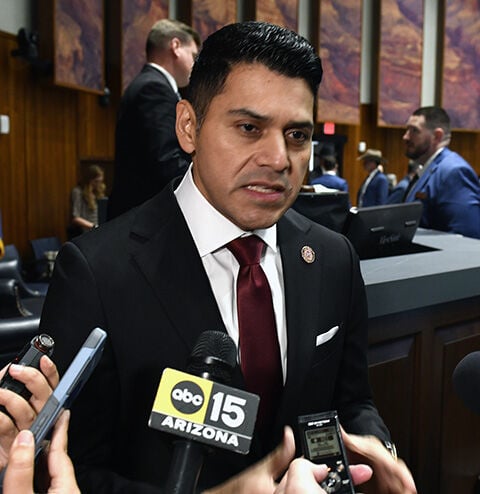
Montenegro
Mayes, who was named in the lawsuit, already sent her own lawyers to court to mount a defense. But the two GOP leaders told U.S. District Court Judge Michael Liburdi they also need to take an active role in defending the law.
"They cannot be assured — for multiple reasons — that Attorney General Mayes, the main defendant in this matter, will adequately represent their interest,'' wrote attorney Beau Roysen for Montenegro and Petersen.

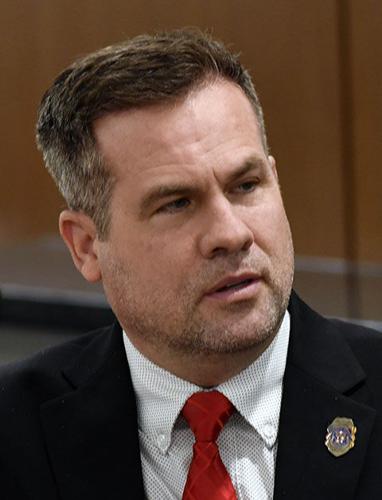
Petersen
He told the judge one reason is that Mayes has refused since taking office in 2023 to defend certain other laws. Those notably included a challenge to the state's prohibition against abortions after 15 weeks of pregnancy, after voters in 2024 approved putting a right to abortion into the Arizona Constitution. With Mayes siding with challengers, that left the two GOP legislative leaders to defend the 15-week limit, so far unsuccessfully.
The Republican legislative leaders are also calling this to the judge's attention: When lawmakers first proposed putting the border enforcement issue on the ballot in 2024, Mayes came out against the plan, which was then called HCR 2060.
"I believe HCR 2060 will have far too many unintended consequences that will negatively impact our law enforcement agencies and our communities,'' Mayes, an elected Democrat, said in a news release at the time.
Mayes said she recognized issues of drug and human smuggling, citing work done by her own office to combat them.
"But further straining law enforcement resources while implementing a measure that could very well lead to racial profiling is not the answer to creating safer communities, not to mention the havoc and harm it would do to our economy, as we saw fourteen years ago with the passage of SB 1070,'' Mayes wrote in 2024. "This referral is a political distraction that will sow seeds of bias and fear without fixing the issues it claims to address.''

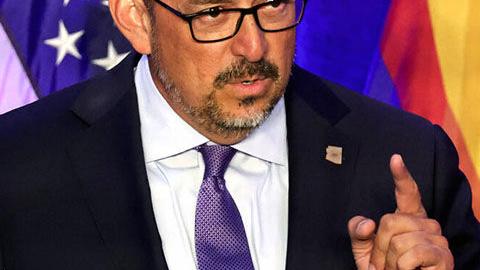
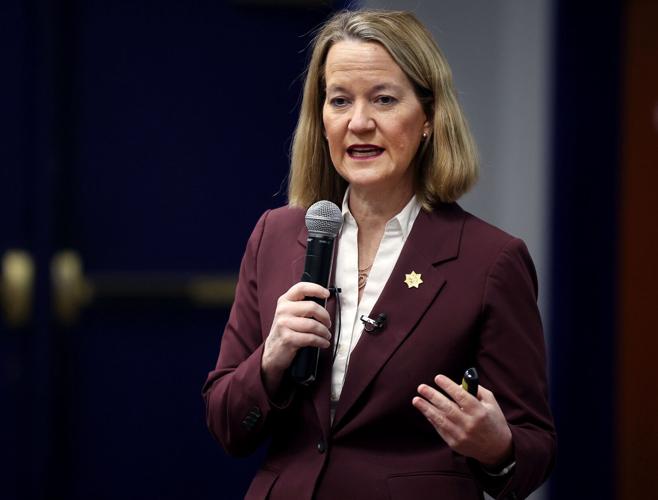
Mayes
Roysden acknowledged that Mayes, named as a defendant in an earlier challenge to Prop. 314, did successfully get that lawsuit thrown out, albeit not on the merits but over a question of whether the legal challenge was "ripe'' for litigation.
But even then, he said, a press aide to Mayes said her defense at that time "should not be seen as an endorsement of the policies and provisions in Prop. 314.''
"So the president and the speaker certainly cannot be assured that the attorney general will fully adequately represent their interest here,'' Roysden told Liburdi.
The judge, without commenting on whether he believes Mayes will or will not properly defend the law, granted the request by the GOP lawmakers to intervene.
But the judge has acknowledged the political position in which Mayes, running for reelection this year, finds herself.
"Your allies over at the ACLU have put your boss in a compromising position in an election year, haven't they?'' Liburdi commented to Assistant Attorney General Josh Whitaker at a preliminary hearing last week.
The ACLU, as a nonpartisan organization, does not endorse candidates. But Mayes has partnered with the ACLU on a number of cases.
In May this year, for example, the attorney general decided to side with the organization in its challenge of state laws that bar certain "advanced practice clinicians'' such as specially trained nurses from providing abortion services. Mayes is asking, as are the challengers, that Maricopa County Superior Court Judge John Blanchard declare the restrictions unconstitutional.
That left Montenegro and Petersen as the lone defendants. They hired their own private lawyers, at taxpayer expense, to ask Blanchard to toss the case, which is still pending.
Richie Taylor, press aide to the attorney general, told Capitol Media Services that Mayes' history — including unsuccessfully urging voters to oppose Proposition 314 — is legally irrelevant to the current litigation. He said Mayes is prepared to defend the voter-approved law in court.
"Warren Petersen and Steve Montenegro may not understand the difference between having a policy disagreement and defending the state when it is sued,'' Taylor said. "But that is the job of the attorney general, and it's one Attorney General Mayes is prepared to do.''
The key part of Prop. 314 is modeled after SB 4, a law approved by Texas lawmakers in 2023, during the Biden administration, amid claims the federal government had failed to secure the southern border. That also was a period in which many people entered the United States by going around or over border fences.
As approved by a 2-1 margin in 2024 by Arizona voters, the measure empowers state and local law enforcement to arrest those who entered the country illegally at somewhere other than a port of entry.
When questions were raised about racial profiling, Arizona lawmakers added a provision saying such arrests would require that the officer actually saw the person crossing the border, had video evidence of that entry, or "any other constitutionally sufficient indicia of probable cause,'' a phrase not defined in the law.
The same law also allows a judge to give those arrested a choice: face the Class 1 misdemeanor — with a possible six months in jail and the prospect after that of still being turned over to Border Patrol — or agree to voluntarily leave the country. That option is backed by provisions allowing a judge to order police to transport someone to the border; if they refuse to leave, they would face a Class 4 felony charge that can bring three years in state prison.
The 2024 Arizona law is subject to legal challenge right now, as opposed to when it was approved, because it was written so it would not take effect until 60 days after a court agreed to allow Texas to enforce its own law. That occurred on May 14, resulting in the ACLU, on behalf of the Florence Immigrant & Refugee Rights Project, filing suit last week and asking Liburdi to block enforcement while the case is litigated.
The judge declined to immediately issue a restraining order after it was noted that not everyone who could have an interest in the case, including Montenegro and Petersen, had been notified. All the parties are due back in court on July 24.
Howard Fischer is a veteran journalist who has been reporting since 1970 and covering state politics and the Legislature since 1982. Follow him on X, Bluesky and Threads at @azcapmedia or email azcapmedia@gmail.com.