A detainee in ICE’s Eloy Detention Center in Arizona has been deported with a urine-collection tube and bag still in place, more than three months after her medical record says a specialist was supposed to review whether the tube could be removed.
The Salvadoran national, Ana Granados Sanchez, 49, said ICE ignored the hospital’s discharge orders, which said she’d need to follow up with the urologist within one week of the April surgery that placed the tube — a failure that an independent physician said puts Granados Sanchez at risk of permanent complications.

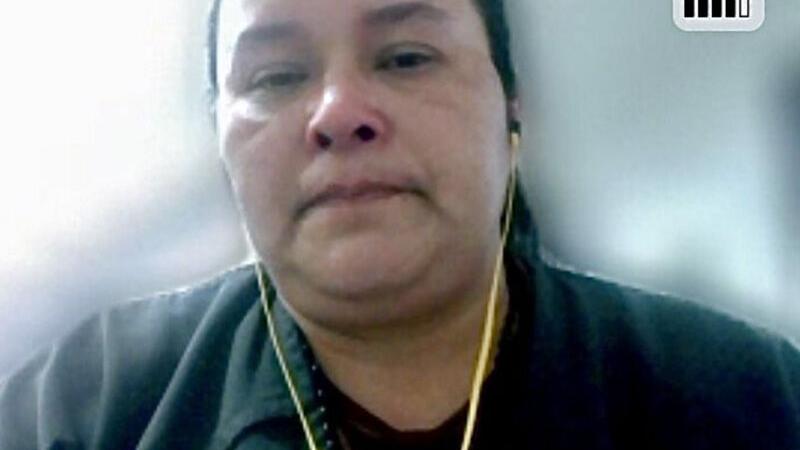
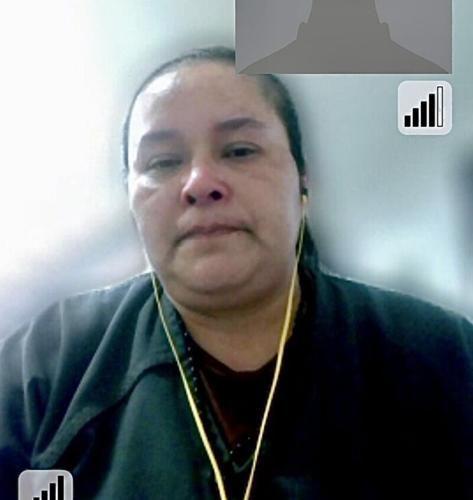
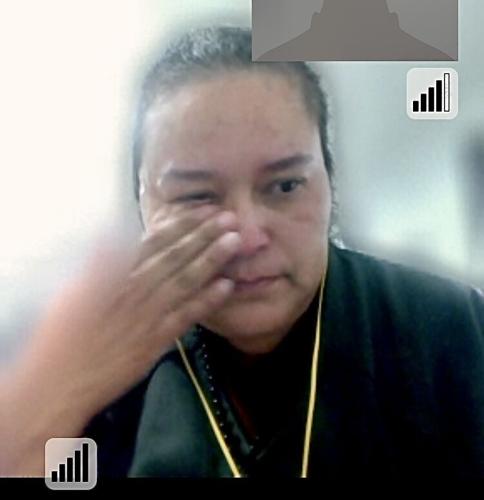
Salvadoran national Ana Granados Sanchez, 49, is pictured on a July 24 video call from ICE’s Eloy Detention Center. Granados Sanchez told the Star she feared being deported with a nephrostomy tube and bag — which collects her urine — still in place, three months after it was surgically placed, and despite not having received the recommended follow-up care while in ICE custody. ICE deported her July 28, with the tube and bag still in place.
“All she’s really asking is to see her specialist in person and hopefully get the nephrostomy tube removed, before literally being sent to a country that might not have those services,” Liz Casey, a social worker with the nonprofit Florence Immigrant and Refugee Rights Project, said in mid-July, when there was still hope U.S. Immigration and Customs Enforcement would respond to the medical concerns.
People are also reading…
Over the past month, the Department of Homeland Security, ICE’s parent agency, ignored the pleas from Granados Sanchez and the Florence Project, and proceeded to deport Granados Sanchez, with her nephrostomy tube and bag still in place, sometime between July 28 and July 29.
DHS has also ignored the Star’s questions on the matter: The Star submitted questions to DHS more than a week prior to the deportation, asking why the agency had disregarded the hospital’s care instructions.
DHS confirmed receiving the questions July 21 but never responded, despite the Star extending its deadline.
Granados Sanchez had been detained at Eloy since December 2025 and began experiencing painful kidney stone complications in early April that caused her kidney to swell, she said.
The urologist who installed her nephrostomy tube at Banner Desert Medical Center said the conditions she was held in after entering ICE custody last year could be the cause of her kidney problems, she said. Granados Sanchez said she was held in a processing facility with two dozen other people, and forced to use a shared toilet with no privacy, making it difficult to relieve herself.
She also wasn’t given any water at the initial processing center. Even at Eloy, the water tastes like chlorine, and detainees believe showering too much in the water is making their hair fall out, she said.
“They're not going to help me, honestly,” Granados Sanchez told the Star July 24. “They're going to send me away like this. That's what they want, to send me away with my bag.”
Casey of the Florence Project said Granados Sanchez’s treatment puts her health in real danger, and exemplifies the medical negligence detainees face in ICE detention.
Eloy Detention Center is operated by for-profit prison company CoreCivic. Medical care for Eloy detainees is handled by ICE Health Services Corps, or IHSC. ICE referred the Star’s questions to DHS, which didn’t respond.
The Florence Project is looking into filing a licensing complaint against the physician at Eloy who cleared Granados Sanchez for deportation, despite her medical needs, Casey said Wednesday.
“Our understanding is IHSC cleared her, despite not complying with hospital-discharge instructions, despite never taking her for specialty care to reassess her kidneys and the nephrostomy tube,” Casey said. “That's not medically ethical, in our opinion.”
Under the second Trump administration, ICE is detaining more people with severe medical conditions — such as cancer, kidney disease and cirrhosis of the liver — without offering release on parole, which ICE always has the discretion to do, she said.
"There’s still humanitarian parole," Casey said. “ICE just chooses not to use it.”
‘Dangerous’ kidney condition
On April 2 at Eloy, Granados Sanchez began experiencing “severe pain” in her lower back, she said. An ICE officer at first told her to sign up for an appointment with the doctor the next day.
Other detainees, seeing Granados Sanchez crying from the pain, pleaded with the officer to let her see a medic immediately, she said.
After a nurse saw her, Granados Sanchez said she was quickly taken by ambulance to a hospital, then transferred to Banner Desert Medical Center for surgery.
The urologist told her one of the kidney stones was blocking urine from draining to her bladder, causing her right kidney to swell with fluid, a painful condition called hydronephrosis. Severe cases can cause kidney failure.
The situation was “dangerous,” the urologist told her, and required surgical implantation of a tube to drain the urine, which would be collected in the nephrostomy bag.
“He told me I was going to have a second surgery to remove the catheter and the kidney stones,” but that never happened, Granados Sanchez said.
She was discharged from the hospital after three days. ICE never took her back for the follow-up that was supposed to happen within five to seven days, according to medical records shared with the Star.
At Eloy, “the doctor just kept saying they were going to take me soon, that they didn't have a date, that they didn't have a date,” Granados Sanchez said.
‘Irreversible complications’
Earlier this month, advocates with the Florence Project were still hopeful they could convince ICE to delay Granados Sanchez’s deportation until she’d received follow-up care.
On July 23, the nonprofit provided Eloy ICE officials with a letter from a Georgia-based physician who reviewed Granados Sanchez’s medical record and found her care “deviates significantly from the standard of care.” The Star also reviewed the letter.
“Ms. Granados-Sanchez is at risk of both acute and chronic complications if she does not have access to appropriate follow up for the nephrostomy tube,” wrote Dr. Amy Zaidan, associate professor in the Department of Emergency Medicine at Emory School of Medicine. “Ms. Granados-Sanchez should be evaluated by a urologist urgently and without appropriate management may experience irreversible complications.”

Ana Granados Sanchez said ICE officials threatened to “press charges” against her if she didn’t sign deportation paperwork — though it’s not clear what charges could have been filed against her. Breaking into tears during a July 24 video call, Granados Sanchez told the Star she “couldn’t bear it anymore” and finally signed last week. “It’s not good, this place,” she said, wiping tears from her cheeks. “You don't eat, you don't sleep, and the treatment is inhumane.”
Her medical records also suggest Granados Sanchez suffered a “partial rupture” of her kidney due to the obstruction, Zeidan said.
“It is extremely concerning that Ms. Granados-Sanchez has not seen a urologist since discharge,” she wrote.
A nephrostomy tube is supposed to be temporary, but if required for an extended timeframe, the tube should be replaced every two to three months, Zeidan said.
Granados Sanchez’s tube was not replaced for more than three months, she said. She’s suffered blood in her urine and urinary tract infections since the tube was placed.
“When a medical device is in place but is no longer serving a purpose, it represents no health benefits but retains all risks of the device,” Zeidan said. “... Most importantly, a nephrostomy tube must be managed by a urologist.”
On Tuesday, July 28, Granados Sanchez was transferred to a Louisiana processing center, known as a deportation hub, according to the ICE detainee locator. Her name has since disappeared from ICE’s online detainee locator.
Pressured to sign
Granados Sanchez, on a July 24 video call with the Star, said she’d been under pressure from ICE officers to sign documents needed to finalize her deportation.
She said she tried to resist as long as possible in the hopes of getting the nephrostomy bag removed first. But whenever she asked about the follow-up care, she was ignored, she said.
In recent days, she said ICE officials threatened to “press charges” against her if she didn’t sign the deportation paperwork — though it’s not clear what charges could have been filed against her.
Breaking into tears, Granados Sanchez told the Star she “couldn’t bear it anymore” and finally signed last week.
“It’s not good, this place,” she said, wiping tears from her cheeks. “You don't eat, you don't sleep, and the treatment is inhumane.”
Granados Sanchez has had a removal order since February, when her asylum appeal was denied, but ICE didn’t try to deport her until recently.
For the past 12 weeks, she’d struggled to manage the nephrostomy bag and received little assistance from Eloy staff, she said. The bag broke open repeatedly, spilling urine on her, and replacement bags seemed to be of lower quality, adding to her stress, she said. Other detainees had to help her install the new bags.
“The last time, one of the nurses told me, ‘This is the last one,’” Granados Sanchez recounted. “As if he's saying, ‘Don't come back, because we're not going to give you another.’”
‘I’m scared’
Granados Sanchez said she’s lived in the U.S. since 2015, when she crossed the border with her two children. She was living in Maryland when her asylum claim was denied in 2023. Her appeal of the denial was still in process when she was arrested at an ICE check-in appointment in Maryland in late 2025, before she was transferred to Arizona.
Granados Sanchez said she’d been working at a hospital in Maryland and was looking into becoming a nurse’s assistant before she was detained by ICE.
“They took away my hope,” she said. “I was trying to improve myself. … Ever since I came here, I've worked, I paid my taxes. I'm the head of my household. I'm the one who supports my two children.”
Granados Sanchez is leaving behind in the U.S. a 15-year-old daughter and a 20-year-old son who’s been attending college, but will now have to drop out, she said.
She doesn’t know what to expect in El Salvador, where she hasn’t lived in more than a decade. Her mother and siblings have all fled the country, she said. If she’s able to get the surgery to remove the urine-collection tube and bag, she worries about recovering alone.
“I'm scared, because I don't have family there,” she said. “I don't have anyone there in my country who can help me, receive me and take care of me while I'm in the hospital.”
Granados Sanchez said she doesn’t understand why ICE had to detain her last year, despite her having no criminal record and her asylum process still ongoing.
She said it’s even worse that ICE detained her in poor conditions that she believes contributed to her kidney problems, and then refused her medical care.
“It's not my fault I'm locked up here, because they have me here under their will, not by my own free will,” she said.
Contact reporter Emily Bregel at ebregel@tucson.com. On X, formerly Twitter: @EmilyBregel

Emily Bregel
Border reporter