The Hermosa critical minerals mine and UniSource Energy have agreed to pause work for a week on public land in the Patagonia Mountains, while a federal judge considers halting the mine's expansion altogether until a lawsuit against the project can be heard.
At the conclusion of a hearing in Tucson on Tuesday, U.S. District Judge Raner Collins said he needs the next week to decide whether to grant a preliminary injunction in the case brought by the Patagonia Area Resource Alliance and the Tucson-based Center for Biological Diversity.

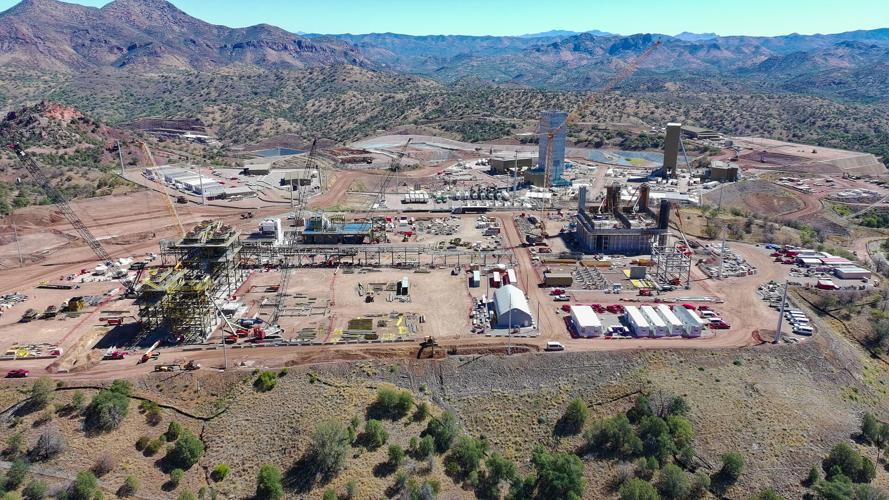
A July 2 aerial view of the South32 Hermosa critical minerals mine under construction in the Patagonia Mountains. The building going up on the left in the foreground is the on-site ore processing facility.
The plaintiffs are asking the court to block mine-related construction on Coronado National Forest Land during the litigation to prevent immediate harm to jaguar, ocelot and other endangered species with habitat in the area, said attorney Graham Rex from the Center for Biological Diversity.
People are also reading…
The lawsuit is expected to take at least a year to be decided.
Without an injunction, Rex said, construction could begin Friday in what he called “the last place where jaguars and ocelots can cross the border.”

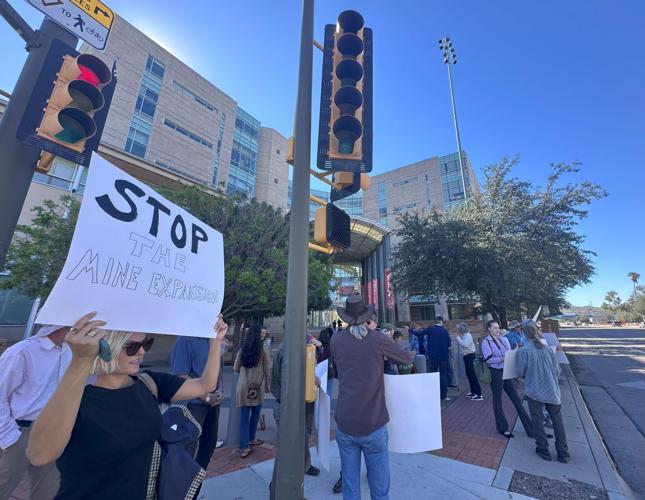
About 30 demonstrators gather in front of the federal court building in Tucson on Tuesday, Nov. 3, to protest the Hermosa critical mineral mine near Patagonia.
Australia-based global mining giant South32 is already building the underground mine on roughly 200 acres of private land about 75 miles southeast of Tucson. With production slated to start in early 2028, the $3.3 billion project could eventually churn out as many as four federally designated critical minerals, including zinc, manganese, silver and copper.
Nearby residents and conservationists sued the U.S. Forest Service in late September, after the agency approved South32’s plans to expand onto federal land, including a second tailings pile, a new transmission line to deliver power to the site, and a new 7-mile access road to keep mine traffic out of the town of Patagonia.
During Tuesday’s hearing, Kamela Caschette, a Justice Department attorney representing the Forest Service, argued that halting construction poses a national security risk because it would delay production of minerals needed for critical national infrastructure and defense applications, leaving the government at the mercy of foreign suppliers.
South32 Hermosa attorney Laura Granier said the work the injunction seeks to block in the coming months mostly involves small-scale geotechnical drilling to help design the access road and tailings pile, amounting to no more than 6 acres of new disturbance.
“That’s all that’s in front of you for this motion,” she said.
The same cannot be said for the power line.
That part of the project is already well underway, with UniSource Energy Services expecting to complete the 138-kilovolt overhead transmission line across about 7 miles of forestland by early next year, according to Adam Thomas Peterson, attorney for the utility.
He said the overhead lines will hang about 100 feet above the ground on single poles spaced roughly 1,000 feet apart, with reflectors and other devices to make them more visible to birds. The new electrical service, all paid for by South32, will allow the mine to mostly power down its on-site diesel generators, while also dramatically improving reliability for roughly 2,600 other UniSource customers in the area, Peterson said.

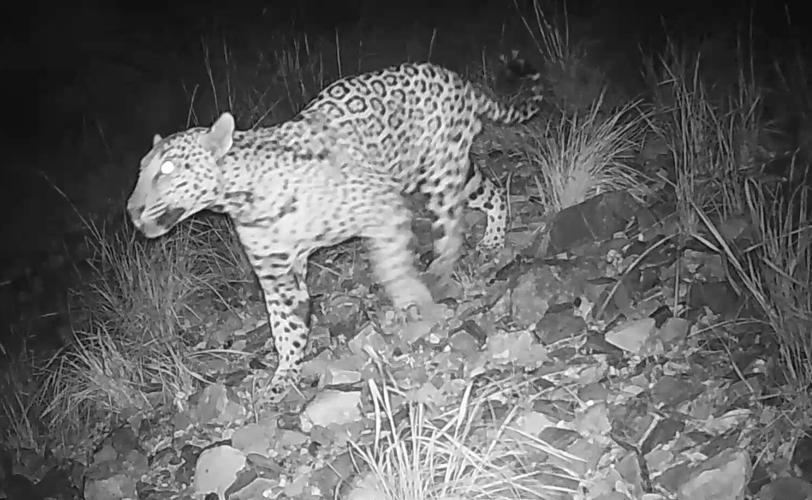
Plaintiffs in a federal lawsuit against the U.S. Forest Service argue that the Hermosa critical minerals mine in the Patagonia Mountains threatens the movement and critical habitat of rare endangered jaguars like this one.
All told, South32’s Granier said, the mine’s total expansion onto federal land would only impact a tiny fraction — something like 0.01% to 0.03% — of the total critical habitat in the area for jaguars and other endangered species.
But Rex argued that the government’s own biological opinion underpinning the Forest Service’s decision characterizes the planned mining infrastructure as a threat to jaguars, ocelots, yellow-billed cuckoos and Mexican spotted owls that could degrade critical habitat and alter a crucial wildlife corridor between the U.S. and Mexico.
“It’s not the acreage that matters; it’s the location,” Rex told the court. “This location matters.”
Judge Collins said he would take Tuesday’s testimony under advisement and issue his ruling on the preliminary injunction in a week. Until then, he said, South32 and UniSource agreed to stop any work and “maintain the status quo” on the federal land adjacent to the Hermosa Mine.



 Forest Service signs off on southern Arizona mine as cost skyrockets