

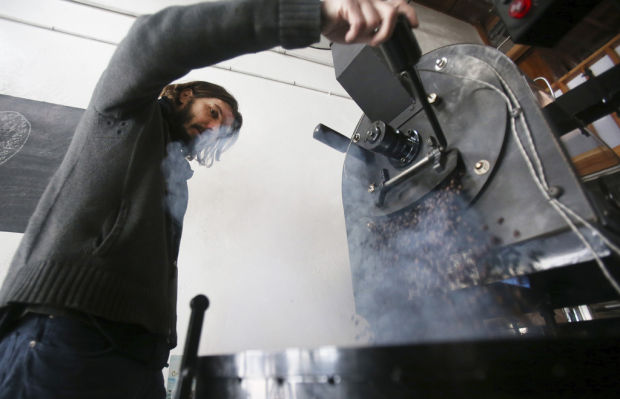
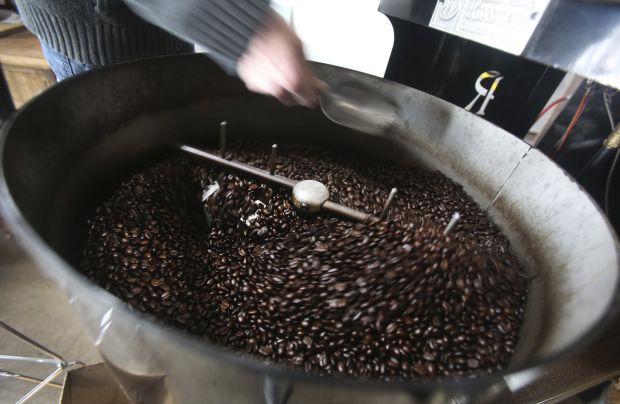
I figure this is how heaven smells when I walk into Oliver Ray’s workplace. It’s the aroma of coffee.
The 40-year-old Ray roasts coffee beans, writes poetry and plays guitar for the local rock band Saint Maybe. Poetry is his love and music pervades his life, but it’s roasting coffee beans from around the globe that brings me to this side of heaven.
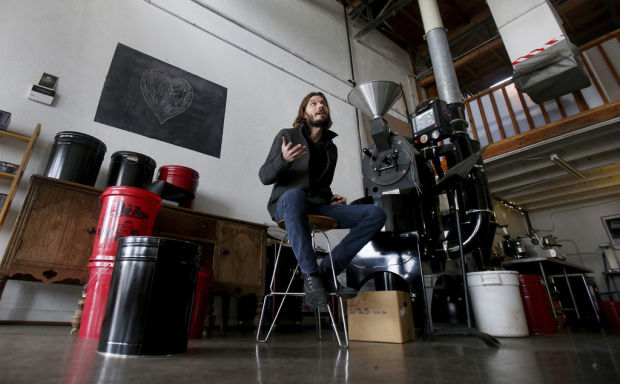
The storefront façade says coffee roaster and the inside has a hipster, live-in vibe. A black iron coffee roaster dominates the medium-sized room. There are large burlap bags of coffee beans against the wall. In the back is a small kitchen with, of course, an espresso machine. And toward the front is the “living room” with a round drum dressed as a coffee table, several chairs, a small red record player, albums, magazines and copies of the New York Times Book Review.
People are also reading…
It’s cheap chic but Ray’s roasting business, Café Aquí, is not downtown or near the North Fourth Avenue commercial corridor. He’s on South Sixth Avenue, across the street from a Pep Boys auto shop, on the other side of West 22nd Street.
Or in his words, “on the wrong side of the tracks.”
“When I decided to open this place, a lot of people asked me, ‘Why are going down there,’ ” said Ray, who started the roasting biz four years ago. “There’s a real dividing line,” he said, referring to 22nd Street.
The New York City-bred Ray is perfectly fine with his out-of-the-loop location. He enjoys the look and feel of the neighborhood, which includes Le Cave’s Bakery and Santa Cruz Catholic Church.
His place is not like most other coffee shops around town. There’s no cookie-cutter look. A designer didn’t come in and tell Ray where to put the sofa and how to light the setting. He’s proud that his customers don’t come in to sit, sip and surf the Internet.
“A lot of places say ‘free Wi-Fi.’ Here we’re Wi-Fi free,” said Ray. “I want people to come here and interact with each other.”
Like his friend, Marc Goodman, who stopped by to chat and drop off a couple of old Joao Gilberto bossa nova vinyl records. Ray put one on the turntable and placed the stylus on the first groove.
It’s that kind of easygoing place.
However, Ray is a wholesale coffee roaster. Five days a week, he roasts pounds of beans for his commercial customers, several local coffee vendors and restaurants including Mother Hubbard’s Cafe on West Grant Road; Café Desta, an Ethiopian eatery on South Stone Avenue; Food for Ascension Café off of North Fourth Avenue; and mail order.
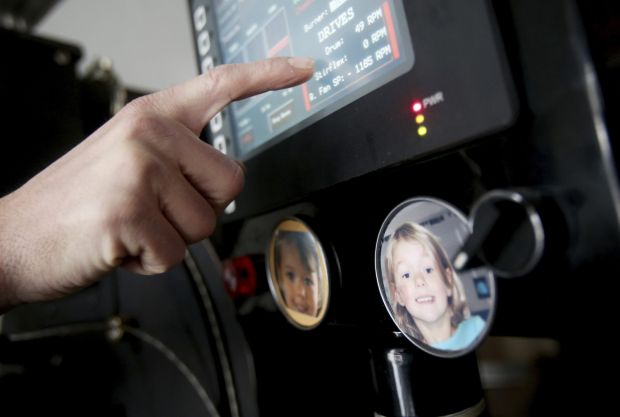
He roasts the beans in a $24,000 gas-fired roaster from San Diego. Ray learned to roast using his nose, eyes and intuition, which he still uses, but his roaster is computerized. It makes for more consistent roasting, said Ray, who prefers a medium roast to dark roast, which his customers most demand.
“It’s like cooking. It’s all about controlling the heat,” he said.
Really it’s more than that. It’s about the beans, which differ from year to year. He doesn’t roast large amounts. He is a single-operator. He’s not trying to get rich.
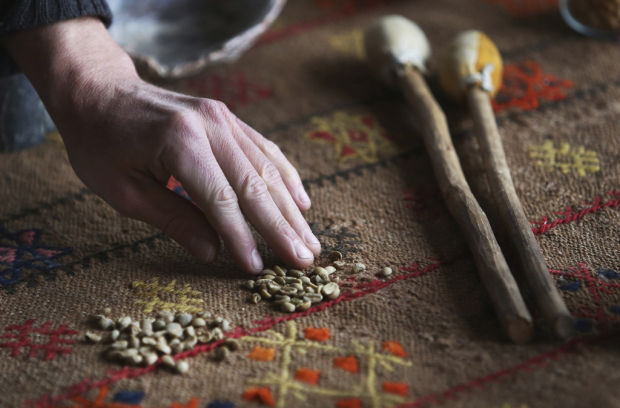
His calling to coffee came while on a trip to Guatemala in 1994. While the country was in the grips of political turmoil, he found tranquillity in the coffee-growing countryside. He also had a near-death experience while climbing a volcano.
Not long after he returned to New York City, Ray joined the band of punk rock superstar Patti Smith. He toured and recorded several albums during her re-emergence as a rock music icon. By 2005, Ray left that fast-paced life for something simpler in Tucson.
Ray continues to travel to Guatemala where he first learned about roasting. He learned more in Vermont where he earned his certification as a coffee roaster.
Roasting coffee fascinates him. He loves the art of roasting, extracting the maximum flavor of the beans.
“In the end, coffee is what you want it to be,” he said. “The trick is to make something that tastes good and still honor the place where it comes from.”
Ernesto “Neto” Portillo Jr. is editor of La Estrella de Tucsón. He can be reached at netopjr@azstarnet.com or at 573-4187.


 Tim Steller’s column: Council overreacts on Tucson park name rejection


