

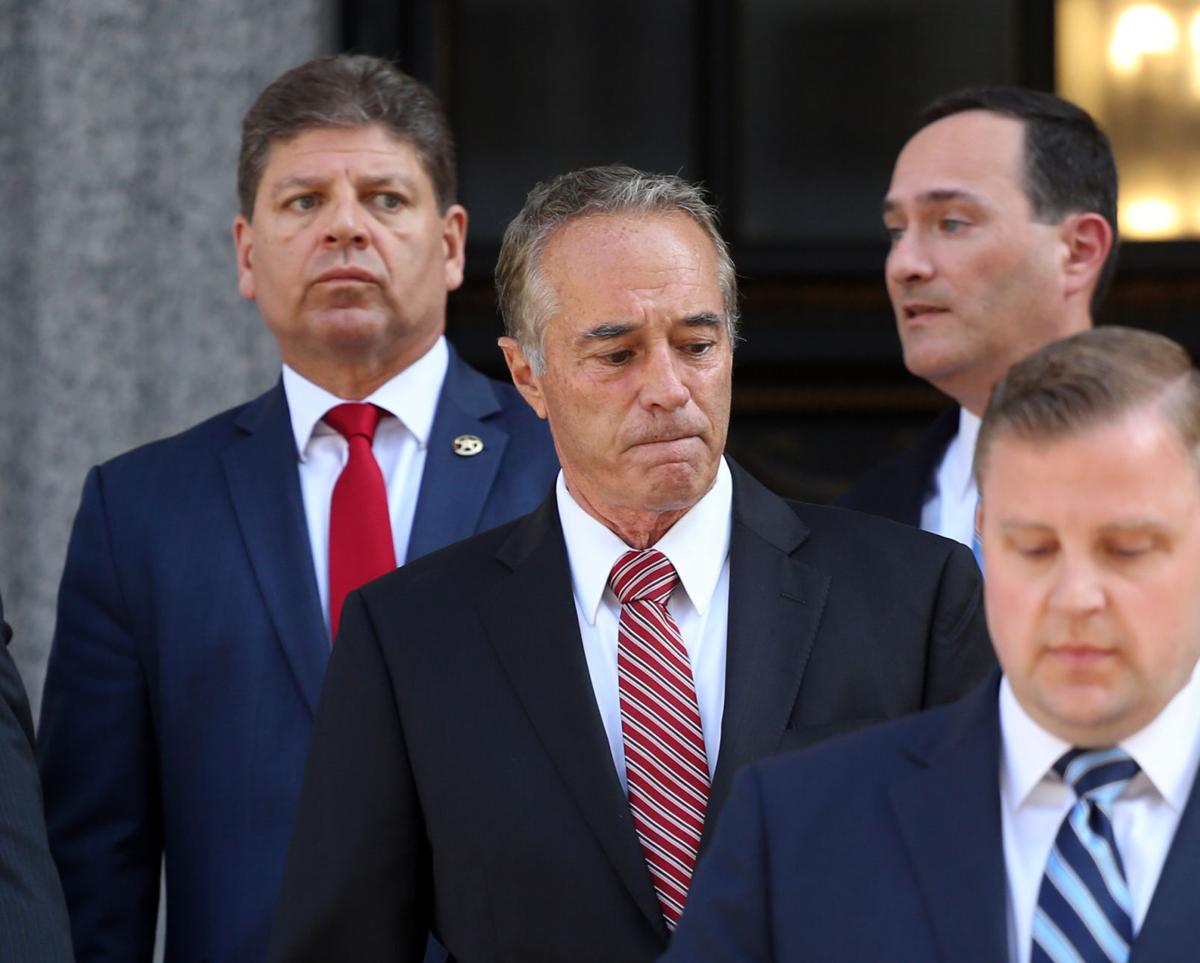
Former Rep. Chris Collins was sentenced last week to 26 months in prison after resigning from Congress and pleading guilty to two felony insider trading charges last October. His co-conspirators — son Cameron Collins and Stephen Zarsky, Cameron's prospective father-in-law — will be sentenced Thursday and Friday.
Chris Collins is scheduled to report to prison on St. Patrick's Day. Following Collins' sentencing on Friday, several questions emerged on Twitter.
Here are some of the answers.
From @HamburgGary on Twitter: @realDonaldTrump Are you going to pardon former Congressman Chris Collins after he is sentenced to prison? Just curious.
People are also reading…
From @oneill_greg on Twitter: How long before Trump pardons Chris Collins, his first (House) supporter?
From Philip James Jarosz: What if Trump can’t pardon him after Trump is impeached?
Zremski: As I wrote back in October, it's possible Trump will pardon Collins. As my piece pointed out, Trump has a history of pardoning controversial right-wing figures such as right-wing provocateur Dinesh D'Souza and former Maricopa County, Ariz., Sheriff Joe Arpaio.
But since I wrote that story, Republicans have increasingly told me that they don't think Trump will pardon Collins. The reason? It won't do Trump much good politically.
Trump's other pardons tended to go to figures with a genuine fan base of one sort or another on the far right; even his pardon of U.S. service members accused of war crimes appealed to some America Firsters who don't think we should be punishing our own.
Collins, who launched an insider trading scheme from the White House lawn, doesn't have such a constituency. Even Trump – the beneficiary of Collins' praise dozens of times before the lawmaker's August 2018 arrest – no longer seems to be an outspoken fan. The president, who tweets multiple times on most days, has tweeted about Collins just once since his arrest.
Combining those facts, it seems unlikely that Trump would pardon Collins. But if he does, top Republicans and experts in the pardon power don't expect the president to do so until after the November election — when, win or lose, Trump couldn't really be hurt politically by pardoning an inside trader.
And yes, Trump can pardon Collins even though the president has been impeached. There's nothing in the Constitution to prevent that.
• • •
From @HandicapperBill on Twitter: How many Trumpers are now in prison? Is it a dozen yet?
Zremski: ABC News did a good piece on this after Collins' sentencing. It notes that 14 people closely associated with Trump have been either convicted, pleaded guilty or indicted since he took office three years ago. That, the ABC piece said, is an unusually high number.
The question of "how many Trumpers are now in prison?" would produce a much lower but also imprecise figure. After all, Collins is not in prison yet and won't be until March 17. Similarly, former Rep. Duncan Hunter – the California Republican who was the second House member to endorse Trump – won't be sentenced until March on charges that he raided his campaign fund for trips to Disney World, parties and the like. GOP operative Roger Stone won't be sentenced until Feb. 20. Former National Security Adviser Michael Flynn is also awaiting sentencing, but he has recently proposed withdrawing his guilty plea.
On top of that, several other Trump associates find themselves at various earlier stages of the criminal prosecution process.
But former Trump campaign chairman Paul Manafort is locked up, and his aide Rick Gates got a 45-day sentence.
• • •
From @LeftistInsane on Twitter: Rep. Chris Collins sentenced to 26 months in jail for insider trading. How long was Martha Stewart locked up for insider trading?
Zremski: Stewart was locked up for five months, and the prison food was never better. (Kidding.)
In all seriousness, Stewart did serve five months in connection with her illegal inside trades of ImClone stock in the early 2000s, as I noted in this story that aimed to explain why Collins got only a 26-month sentence.
Lawyers say, though, that it's difficult to compare one inside trader's sentence with another's. So many unique factors influence each case, ranging from the amount of the ill-gotten gain to whether the case went to trial to the age of the inside trader.
• • •
From Jannaly Marie: Twenty-six months — that's it. Did they honor his request for the Pensacola one?
Zremski: Collins has requested that he do his time at Federal Prison Camp Pensacola, and U.S. District Court Judge Vernon S. Broderick said he would recommend Pensacola to the Bureau of Prisons. But it's up to the Bureau of Prisons to decide whether Collins goes there, and whether he does may depend solely on whether the 596-bed male-only minimum security prison has room for him.
I will be checking with the Bureau of Prisons regularly regarding Collins' status. A spokesman for the agency told me Tuesday that it will not announce where Collins will be serving his sentence until he arrives there, which is standard Bureau of Prisons policy.
• • •
From Pete Seger: Why two months to report [to prison]? He will weasel his way out of it in that time and won't serve a day.
From Rick Mcdermott: Why isn’t he in prison now and not two months down the road?
Zremski: In America, only violent felons typically get sent to prison immediately. Felons who are not considered to be a threat to society are routinely given time to get their affairs in order. Allowing them that time also gives the Bureau of Prisons the opportunity to deal with its highest-priority maximum-security prisoners first.
As for the notion that Collins won't serve a day, that's highly unlikely. As part of his plea deal, he agreed not to appeal a sentence of less than 57 months. That means his only legal recourse for avoiding prison at this point would be a pardon from President Trump — which, as I mentioned earlier, seems unlikely to occur before Collins heads to prison March 17.
• • •
From Kevin Powers: How much of the money did he have to give back? That’s just as important.
Zremski: It's important to remember that Chris Collins did not personally benefit from the insider trading scheme he hatched with a phone call to his son from the White House lawn in June 2017. So he didn't have any money to give back.
His stock in the company in question, Innate Immunotherapeutics, was held in Australia, where there was a trading halt — so the then-congressman couldn't dump his stock. But Cameron Collins traded on the inside information his father gave him, saving himself about $571,000. Cameron Collins' future father-in-law, Stephen Zarsky, traded, too, averting $143,900 in losses.
Those savings didn't last long. Collins, his son and Zarsky settled a civil case with the Securities and Exchange Commission in December. As part of the settlement, Cameron Collins had to cough up $634,299 in ill-gotten gains and interest, and Zarsky had to forfeit $159,880.
And while that settlement bars Chris Collins from serving on the board of a public company as he did at Innate, it didn't penalize him financially. His only financial penalty is the $200,000 fine the judge slapped him with when sentencing the former congressman to prison last week.
• • •
From Joshua Sawyer: How many of his sheep would still vote for him if he was on the ballot?
Zremski: It's impossible to know how many former Collins supporters would stick by him in an election today, even though he pleaded guilty and is heading to prison. But New York's 27th District, where he served, is the most conservative in the state.
I think I need to note, though, that the voters there are not "sheep." Democrat Nate McMurray almost defeated Collins in November 2018. Also, in my travels across that district that fall, I ran into a surprising number of voters in the most rural areas who didn't even know Collins had been arrested.
It's unfair to dismiss them as "sheep." It's fair to regard them as uninformed.


