
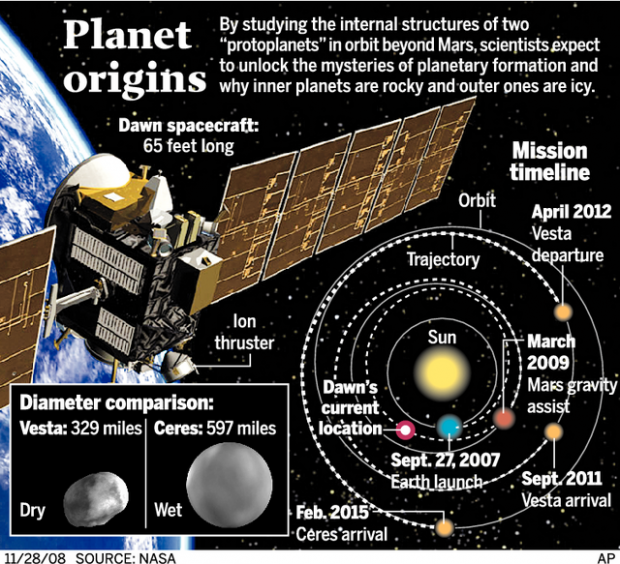
An unmanned spacecraft with ties to Tucson is on track to coast around the sun this winter before sling-shotting by Mars on its way to a rendezvous with an asteroid and a dwarf planet.
NASA officials working on the Dawn mission, which is designed to unlock secrets of how the solar system formed, shut down the spacecraft's engines last week as part of a planned maneuver during its 3-billion-mile journey to the asteroid Vesta and dwarf planet Ceres.
For Mark Sykes, director of the Tucson-based Planetary Science Institute and a Dawn co-investigator, shutting down the spacecraft's ion engines is just another sign that the mission is on schedule for its encounter with Vesta in 2011.
"All the systems are working extremely well, including the ion thrusters," Sykes said. "It's a good achievement for us to demonstrate that this technology can work in this context."
People are also reading…
Dawn's long journey began with its launch in September 2007. The ion engines help the spacecraft make the lengthy trip because they consume very little fuel. A day's worth of engine work uses less than a soda can's worth of xenon fuel, according to NASA figures.
The mission, which cost $357.5 million, is named Dawn in honor of its quest to learn more about the beginning of the solar system.
The fuel-efficient engines allow Dawn to travel light — as opposed to having to store thousands of gallons of traditional fuel — but mean the spacecraft is somewhat of a plodder.
The ions that gently push the spacecraft along have been likened to a car taking four days to go from zero to 60 mph.
The engines aren't likely to be fired up again until June, though they may be turned on again in January to correct Dawn's course before it heads by Mars, according to a news release from NASA's Jet Propulsion Laboratory.
Using Mars' gravitational pull to help, Dawn will then head to the asteroid belt to get its first glimpse of Vesta.
The asteroid, which Dawn co-investigator Sykes said has a surface covered by frozen lava, could give scientists an interesting view into how planets form — literally.
Because a huge chunk of Vesta was destroyed in a collision with another object, scientists might be able to see the layering of different elements that formed Vesta and draw conclusions about how planets form.
"That would test our theories of what's going on as these objects are forming," Sykes said.
After flying around Vesta, Dawn will head to Ceres, a former asteroid that has been re-classified as a dwarf planet.
Perfectly round, Ceres has a clay layer covering an ice-rich crust and possibly a subsurface ocean, Sykes said.
A previous mission detected what was possibly a cloud, so Sykes is interested to see what Dawn finds once it arrives in 2015.
"Both objects are unique: Vesta formed dry while Ceres formed wet," he said. "We're looking at things that are in the earliest stage of planet formation."
DID YOU KNOW
The Planetary Science Institute is a Tucson-based international non-profit research group dedicated to exploring the solar system.
Established in 1972, the institute has scientists in 15 states as well as researchers in foreign countries such as the United Kingdom, Switzerland, Russia and Australia.
Scientists with the institute are involved in several NASA missions as well as research into the origins of the solar system. The institute also is involved in science education through school programs and public outreach.
Source: Planetary Science Institute