A University of Arizona Arts initiative, in partnership with Counseling and Psych Services, has helped 60% of participating students feel less lonely and 76% improve their mental health and well-being through taking part in art and culture experiences in Tucson, questionnaires show.
The Arizona Arts Rx initiative is in the second year of its three-year, $300,000 pilot. UA’s Counseling and Psych Services, or CAPS, has partnered with SocialRx to pay for students to take part in such activities on and off campus in Tucson. SocialRx is an organization that connects people to arts, culture, nature, movement and community to better their mental and social health.
The focus is to create a “social prescription program” for students experiencing loneliness or mental health challenges to improve their social connection and coping skills in general. Students can choose to go to the arts and culture activities alone or with a friend or companion.
People are also reading…
UA student Harrison Bradley said participating in the initiative and getting to go out and do fun activities for free in Tucson helped him meet new people, have ways to express himself and find an outlet.
“For a while, I’ve been seeking help through therapy. I’ve had issues especially with, like, social anxiety and depression,” said Bradley, a UA graduate student in the Wyant College of Optical Sciences. “And so, at a certain point, my therapist recommended me this program and encouraged me to go outside my comfort level. Because especially anxiety, depression, they feed on each other, so it’s helpful to just be pushed to go to these kinds of events.”
Aaron Barnes, director of CAPS, called the initiative an “additive experience” for students seeking care from CAPS.

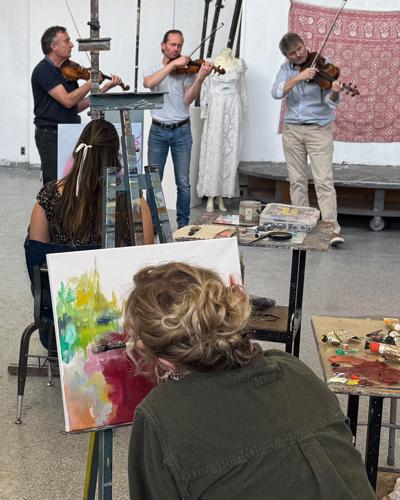
The Debussy String Quartet inspired University of Arizona students to paint and draw as part of the Arizona Arts Rx program.
CAPS counselors discuss the benefits of the initiative with students they work with and talk about its impacts in improving loneliness, social connection and coping skills, Barnes said. Through this, they find students interested in participating.
“We submit their names to SocialRx and the company reaches out to them to learn about their interests around arts and cultural experiences,” Barnes told the Arizona Daily Star in an interview. Then, “SocialRx works to find the right experiences for them and provide tickets to those experiences free of charge.”
The initiative is entirely funded through philanthropy. One of the lead donors, who asked that the amount of her gift not be shared, said helping young people deal with the many mental health issues in today’s world is of paramount importance to her.
“Based on my experience in health care and my appreciation of the healing power of the arts, I believe in its first year, the program has already begun to benefit the students at the University of Arizona and I am pleased to know my support helped to launch Arts Rx,” said donor Peggy Goulding.
UA officials started creating the program in the fall of 2024, with Andy Schulz, former vice president of the arts at the UA, David Salafsky, the executive director of Campus Health, and Amanda Kraus, vice president for student affairs. In summer 2025, before the program started in the fall, SocialRx came in and trained the entire CAPS staff on what “social prescription” means.
Chris Appleton, the CEO at SocialRx, described “social prescription” as prescribing the arts to people and connecting them with community-based activities in the form of arts experiences. He said SocialRx has been working since 2022 with higher education and healthcare partners to address challenges of loneliness.
“Loneliness is both an input and an output to people’s mental health, and we’ve been doing that work through this very structured, integrated social prescribing model,” Appleton told the Star in an interview. “We have experienced with other higher education partners that this issue of loneliness, disconnection, is a real challenge for colleges and universities.”
According to data from a February 2026 national study by the Lumina Foundation, as many as 57% of students say they feel lonely sometimes or always, 44% of students show signs of generalized anxiety disorder and 33% show signs of major depressive disorder. Among those who felt lonely, those two conditions were much more likely to appear.
The study also showed that students struggling with loneliness had low confidence that their university could help them.
A recent national survey by Active Minds showed nearly 65% of all college students reported feeling lonely, and the college students who feel lonely are over four times more likely to experience psychological distress. Within all college students, LGBTQ+ students were more likely to feel lonely than non-LGBTQ+ students.

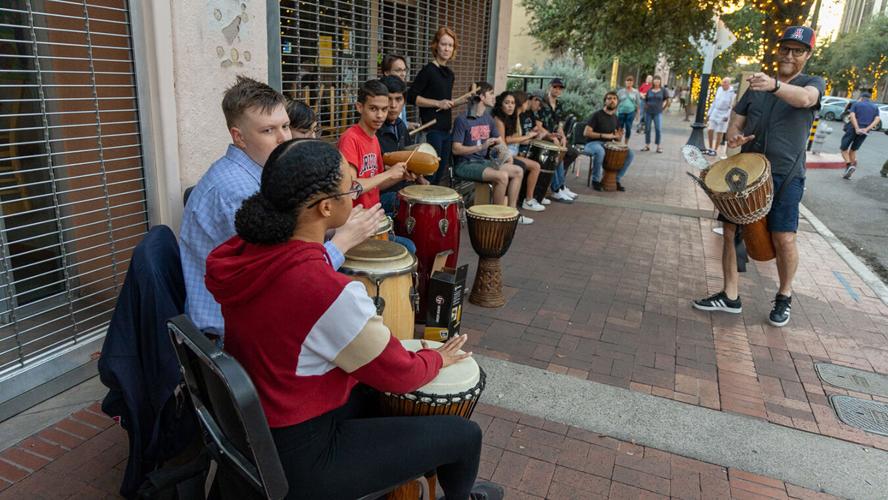
University of Arizona students make music in downtown Tucson as part of the Arizona Arts Rx program.
Appleton said that when assessing the support students may need when they’re struggling with mental health or at risk of experiencing mental illness, some of the care they need can be addressed outside as well as inside a clinic.
He emphasized that social prescribing isn’t intended to be a substitute for clinical interventions or treatment, but is another tool in students’ toolbox when seeking counseling and psychological services.
SocialRx works in 11 U.S. states and with a wide range of organizations such as hospital systems, community health clinics, public health agencies and insurance companies. Its team includes mental health professionals, licensed clinical social workers, peer support specialists and physicians who design the care model and oversee clinical operations.
The mission is to better connect clients to the “available medicine that is already in the community.”
Tucson community partners pitch in
Chad Herzog, associate vice president of Arizona Arts and executive and artistic director of Arizona Arts Live, an arts division at the UA, said the first year of the initiative has shown how much community partners are interested in contributing to such programs.
Herzog said more than 60 community arts and culture organizations locally have signed up to be part of the initiative, including on-campus centers including Arizona Arts Live, the Center for Creative Photography, the Poetry Center and the Museum of Art.
Off-campus organizations taking part include the Sonoran Glass School, the Tucson Museum of Art, the Tucson Symphony Orchestra, Rialto Theatre, Fox Theatre, La Rosa, which hosts live music and events, the Mini Time Machine Museum of Miniatures, and the Pima Air and Space Museum.
Herzog said when SocialRx works with other universities and institutions, it doesn’t usually have that “vast community buy-in and step-in.”
Barnes said, without initiatives like this, it’s so easy for an 18-year-old college student from Indiana, for instance, to come to the UA and just stay within the campus perimeter and never leave it. Programs like these get college students to go out and be involved in the community so they can feel more connected and make Tucson their “home.”
'You will feel terrified, but it is worth it'
Bradley, who was originally recommended to participate in Arizona Arts Rx in December last year, did his first activity in mid-January. He said students are given a list of activities and events to choose from and can do about one a month, ranging from low-commitment activities like art get-togethers or festivals to doing a full-guided lesson on a subject.
“You will feel terrified doing all these things, but it is so worth getting to expand on how you express yourself, being able to relax and just get out of this bubble you find yourself in,” said Bradley. “Because depression and anxiety feed off of themselves, they really do, and just to push yourself outside, even if it doesn’t get you out of your rut, it definitely helps and it is so worth just trying.”
Bradley said participants take a questionnaire at the beginning of the program as well as after each event or activity to gauge whether the events are helping and if that’s what they want to continue in the future.
The activities he did included learning how to paint flowers at one event and learning how to make a small keychain over glass at the Sonoran Glass School. He found the visual art-related activities to be very therapeutic.
He said the word “cathartic” describes his experience of doing these activities.
Herzog said many students want to do activities where they can get their hands dirty, such as making a piece of art at the Sonoran Glass School or at a drawing studio.
On the music side, students are choosing everything from contemporary to classical to dance and theatre experiences, he said.
SocialRx CEO Appleton said artists have been healers since the beginning of humankind and there’s nothing new about this idea that “art is medicine.” He said it might be framed, studied and understood differently now, but has always been the case.

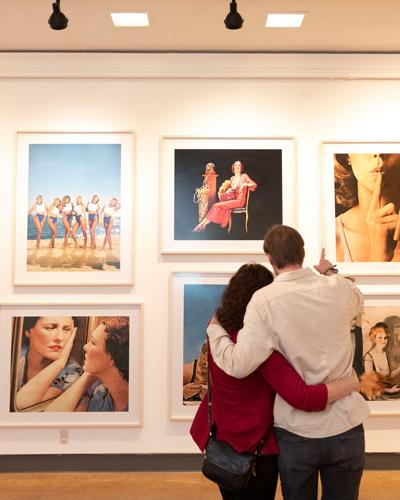
A couple enjoys the gallery of works by Hank Willis Thomas at the LOVERULES exhibit at the University of Arizona Museum of Art, as part of the Arizona Arts Rx Program.
“One thing to share is that social prescribing can be a way of relieving pressure on the health system, on counseling and psychological services, right?” he said. “There’s such demand, and again, certainly not trying to replace clinical care for those students and individuals that need it, but it can be a way of relieving pressure and getting individuals faster access to support.”
A part of SocialRx’s role is to remove existing barriers that hinder people’s access to resources in their community, including cost barriers.
Next year, with CAPS offering counseling sessions free of cost to UA students, the barrier of UA students having to financially afford counseling has also been taken care of.
91% of high-need students see improvement
Appleton said SocialRx uses a few metrics to measure or evaluate how social prescription affects students, including loneliness, anxiety, depression and overall well-being. He said they see across-the-board improvements in all.
According to UA’s first-year impact report for the program, among the students who enrolled and had really poor mental health, 91% showed an improvement in their mental health and well-being and 89% of those with “elevated behavioral health symptoms” showed reduced behavioral health concerns.
Among students who weren’t high need, 76% showed improvement in mental health and well-being; 60% of lonely students reported feeling less lonely.
In terms of participation, 80 of 131 students recommended for the program enrolled in it.
Arizona Arts Rx solved a pressing issue UA’s CAPS had been facing for years, which was how to support the increasing number of students who came in seeking help but didn’t meet the threshold for clinical care, according to the UA report.
Appleton said broadly speaking for universities and higher education institutions, 64% of all students who participate show improvement on their well-being scores, 60% on their loneliness scores and 61% on their depression and anxiety scores.
This is the improvement curve over the course of an average number of “doses,” which is between six to eight social activities experienced by the student.
A pandemic-shaped "doom cycle"
Barnes said for students in college right now struggling to make personal connections, “It becomes this doom cycle of avoidance of ‘I know that I’m lonely — I know that it would be helpful if I had friends — but that’s really scary — what if I get rejected?’” he said.
He pointed to the formative experiences many of today’s college students might have missed out on during the pandemic.
“Think about all the things that you learned in high school in terms of how the world works — our relationships, our first breakups, our first social disputes, the drama that plays out — and they missed all of that sitting at their computers, alone in their houses,” Barnes said.
Appleton said relationships are lifesavers and students benefit from investing in relationships with their fellow students, roommates, friends and family.
“Not everyone needs a social prescription to find purpose or strengthen their sense of community,” he said. “But many do, and if you are one of those people, you are not alone. Thousands and thousands and thousands of people across the country every day need support, and this is one of the many ways that you can access the support that you need.”
Reporter Prerana Sannappanavar covers higher education for the Arizona Daily Star and Tucson.com. Contact her at psannappa1@tucson.com or DM her on Twitter.

Prerana Sannappanavar
Higher Education Reporter