The University of Arizona is launching a Talent and Innovation Hub in Tucson and Taiwan to offer academic courses and internship opportunities related to semiconductor engineering.
The hub, a UA partnership with the National Yang Ming Chiao Tung University, will be launched in October and will welcome its first students in spring of 2027.
The UA is working with the Pima County Office of Economic Development, which will provide a physical space for the hub in Tucson, and with the Arizona Commerce Authority on this initiative. On the Taiwan end, the hub will be based at NYCU’s campus in Hsinchu, a city in northwestern Taiwan.
The hub will be jointly overseen by representatives of UA, NYCU, the Pima County Office of Economic Development and the Arizona Commerce Authority.
“This is for us to jointly develop training and research platforms that will greatly benefit the semiconductor ecosystem that’s already very well established in Taiwan and emerging in the state of Arizona, where for all practical purposes, Arizona has become ground zero for semiconductor manufacturing,” said Krishna Muralidharan, director of UA's Center of Semiconductor Manufacturing.
People are also reading…
"As the name suggests — talent, which is students, and innovation, which is research. And that’s where our focus is,” he said in an interview with the Arizona Daily Star.
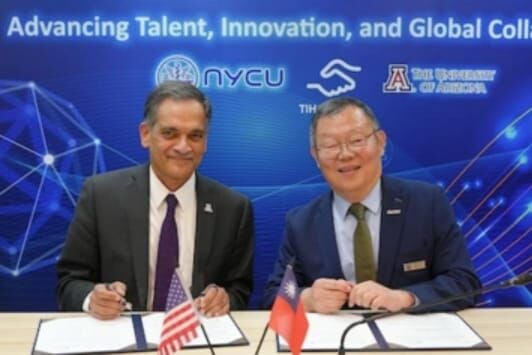
University of Arizona President Suresh Garimella, left, and National Yang Ming Chiao Tung University President Chi-Hung Lin. The UA formalized an agreement with that Taiwan university "to redefine workforce development in a high-tech, globally interconnected economy."
The hub is meant to serve as an interface between industry and academia, Muralidharan said. He said they’re trying to leverage the UA’s existing semiconductor and photonics portfolio of courses and training and develop specially designed learning platforms and pathways, which will help students be ready and hit the ground running as they enter the workforce.
UA students interested in participating in the hub will not need to pay anything in addition to their regular tuition and university fees, and will only need to apply through an online portal using their UA email accounts. Applicants will be expected to maintain a 3.0 grade point average to be eligible.
Students in STEM (Science, Technology, Engineering and Mathematics) disciplines, including the UA’s colleges of engineering, science and optical sciences, will be the initial focus of the hub.
“Ultimately, our vision is this would evolve into a global hub that brings in like-minded universities who are very keen on student success, who are very keen on students getting hands-on experience as they go through their learning,” said Muralidharan.
The UA has “strong relationships with India, Netherlands, Germany, Ireland, Vietnam," he said, "and so, what we’re trying to do is to ultimately create this network of universities and create global training modalities.”
As part of the Taiwan hub, in addition to taking courses from the UA and NYCU, participating students from both universities will have internship opportunities, based on industry partners' needs, said UA spokesperson Mitch Zak.
Community and international partnerships
Heath Vescovi, economic development director for Pima County, said the county's role with the hub is to help build it from the ground up and be a supportive partner by providing the physical space, which can eventually include the UA’s Center for Innovation, a start-up ecosystem, and more.
Vescovi said the county has been working with Taiwan for the last two years. The county has various building assets, and officials are figuring out which potential sites make the most sense for the hub. They're also still figuring out the financial structure between the UA and the county, he said.

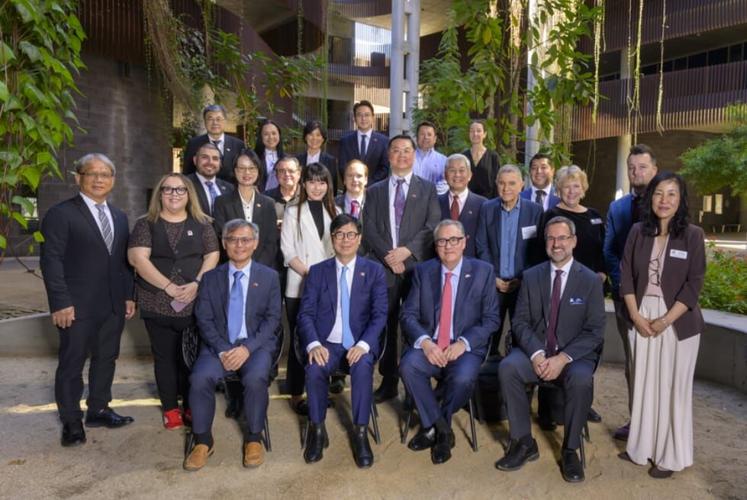
A delegation from Taiwan visited the University of Arizona campus March 13 for presentations, tours and networking.
County officials see the hub as an important opportunity due to the growth of the semiconductor industry and the quality of jobs and workforce available, and also because of the universities' specialties, Vescovi said.
Muralidharan, who is also a UA professor in the Department of Materials Science and Engineering, noted that over the years, Arizona has had a very strong presence of Intel, a U.S. semiconductor manufacturing company, in Chandler. He also said the Taiwan Semiconductor Manufacturing Company or TSMC in Phoenix is “growing exponentially" since coming to Arizona in 2020.
“The semiconductor ecosystem is vast — just to make a chip, you need a hundred different suppliers,” Muralidharan said.
“So, everyone’s moving into Arizona, and the University of Arizona being the land-grant university, it’s almost in our constitution to ensure that all our state’s stakeholders’ needs are met,” he said.
“And what we felt was, with TSMC moving in and the entire ecosystem getting revitalized, with a push towards revitalizing manufacturing within the U.S., the U of A wanted to make sure that we’re producing students who can hit the ground running, who are well-trained, who understand what it takes to work in this evolving semiconductor landscape. And that’s why we partnered with NYCU.”
NYCU is considered one of the leading technological and research universities in Taiwan, ranking consistently between second and fourth place nationally as well as in the top 50 universities in Asia, according to the QS World University Rankings in 2026. It also ranks among the top 200 in the world.
The university’s two main campuses are in Hsinchu and Taipei, which are also the hubs of Taiwan’s semiconductor industry, with the two cities dividing the industry’s operations into physical manufacturing and corporate and design operations.
Hsinchu is often called the “Silicon Valley of the East,” being the heart of the global semiconductor supply chain. Taipei is the financial, administrative and strategic center that connects Taiwan’s expertise to the rest of the world.
As part of the hub, UA students will be able to take courses in Tucson as well as in Taiwan, as will the Taiwanese students.
Muralidharan said the UA has had a very strong portfolio in semiconductor manufacturing dating back 50 years, including the Center for Semiconductor Manufacturing, which conducts environmentally sustainable microelectronics research and workforce development.
The partnership with NYCU comes nearly a year after the UA eliminated its four micro-campuses in China after a report by the Republican majority on the U.S. House Select Committee on the Chinese Communist Party criticized U.S. universities' partnerships in China. In letters and interviews, UA's students in China expressed dismay at the closures.
Vescovi, who is also an adjunct faculty member at the UA’s School of Government and Public Policy, said Pima County had a pre-existing partnership with Taiwan and pays attention to all levels of politics — federal, state and local.
He said while this hub isn’t being looked at as a replacement for the micro-campuses in China, the economic development it brings in job creation and teaching opportunities is a unique opportunity.
“When we talk about politics at the federal level and the global level, that’s where working with the Arizona Commerce Authority comes into play very significantly,” said Vescovi, “because they effectively understand more clearly the way the state can interact with those global partners based off of their interpretation of federal level policy and what global and international relations look like.”

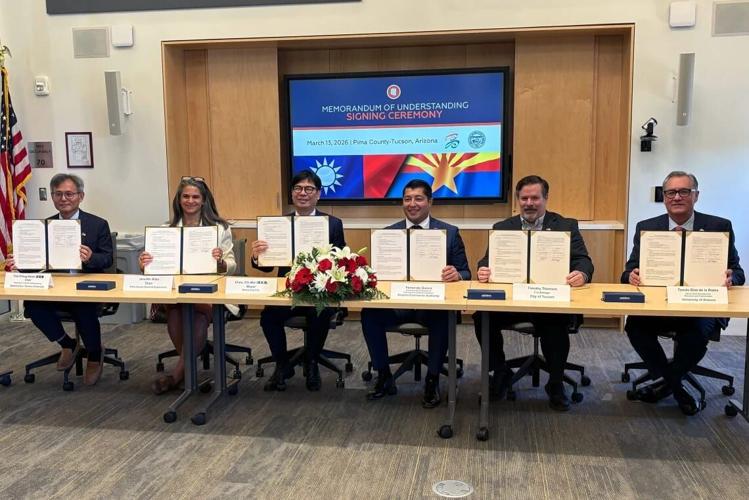
A six-party Memorandum of Understanding was signed by (from left): Yao-Ching Hsieh of National Sun Yat-sen University, Jennifer Allen of the Pima County Board of Supervisors, Kaohsiung Mayor Chen Chi-mai, Fernando Garcia of the Arizona Commerce Authority, Timothy Thomure of the City of Tucson, and Tomás Díaz de la Rubia of the University of Arizona.
Along with getting technical immersion into the semiconductor industry, hub students will also experience cultural immersion through courses such as “Mandarin for Industry," Muralidharan said.
“What we’re trying to do is to ensure that they get that experience working with students in Taiwan, (where) they get used to different ways of thinking and different ways of approaching a problem,” he said.
Reporter Prerana Sannappanavar covers higher education for the Arizona Daily Star and Tucson.com. Contact her at psannappa1@tucson.com or DM her on Twitter.

Prerana Sannappanavar
Higher Education Reporter



 U of A develops 'smart bandages' as AI transforms health care