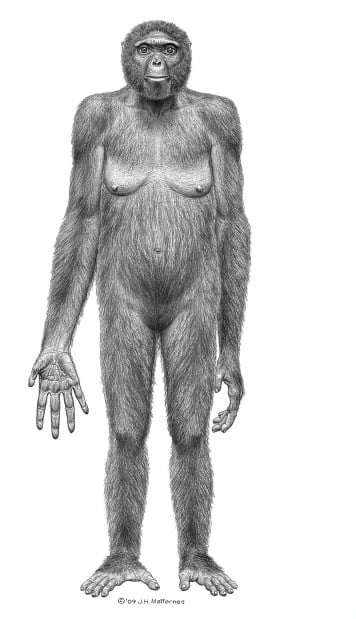
"Ardi," the earliest hominid fossil skeleton ever found, didn't live exclusively in the trees, according to a team of researchers who challenge an important conclusion of a discovery called the "most important scientific breakthrough of 2009" by the journal Science.
University of Arizona geology professor Jay Quade and seven colleagues argue that the geologic evidence shows "Ardi" lived in a grassland studded with trees, not in the forest proposed in the earlier study.
Their criticism was published Thursday in Science as a "technical comment."
Quade said the study restores credence to the "savanna hypothesis," which holds that our ancestors began walking upright when the topography of Africa changed from jungle canopy to more open grassland.
"It cuts to the heart of a fundamental question, a point raised by Charles Darwin," said Quade. "He speculated that the spread of grasslands 4 to 6 million years ago had an important or determining influence on human evolution.
People are also reading…
"As grasslands expanded, our ape ancestors were forced out of the trees," said Quade. "They didn't have a continuous canopy they could move around in. Energetically, it's more efficient to be a biped, and safer to stand up and look around and be on the lookout for predators."
That, in turn, freed the hands to carry things, Quade said. Our ancestors now could carry offspring, implements and water. They could make and use tools. "So it's profound," said Quade. "It's only an idea, though, and difficult to prove or disprove."
It wasn't disproved by the evidence cited in last year's study, he said.
Ardipithecus ramidus, or "Ardi," at 4.4 million years, is the earliest human ancestor for which anthropologists have assembled a nearly complete skeleton. Her find was announced with great fanfare in 2009, accompanied by 11 scientific papers, summing up 15 years of research by 47 scientists from 10 countries.
The "Ardi" team, led by Tim White of the University of California, said the discovery disproved the savanna hypothesis. "Ardi" lived in the trees, but had evolved to walk upright.
White stood by his study in a reply also published Thursday in Science.
In an e-mail response forwarded to the Star by the University of California press office, White said Quade and his colleagues "downplay and ignore the abundant 'Ardi'-associated evidence of sediments, enamel isotopes, anatomy, and fossil wood, snails, birds, and mammals. These ecological indicators uniformly demonstrate that her species preferred a woodland African habitat, rather than an open savannah."
Quade said the eight geologists and anthropologists from seven universities who examined the data from White's team found its chemistry consistent with grasslands, as did the team's study of nearby areas.
Quade has worked in the same geologic strata, analyzing soils where other, less complete Ardipithecus fossils were found just north of the Middle Awash site in Ethiopia where the "Ardi" skeleton was uncovered by White and his team.
As important, said Quade, he and his colleagues have studied the modern terrain of Africa and compared the chemical composition of the soils to the topography.
"We're not challenging the basic fossil evidence and their interpretation of the fossil evidence," said Quade. "We're addressing the issue of the environmental context of 'Ardi.' What did her world look like?"
Quade said the Middle Awash was "not a true savanna" 4.4 million years ago, but was much more open than the earlier study depicts. "It was a mix of grassland and open trees," he said. "This puts the savanna hypothesis back on the table."