
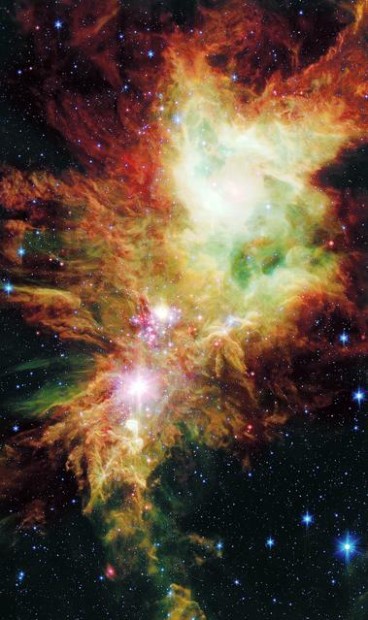
Astronomers have discovered a perfectly decorated "Christmas Tree" 2,500 light-years away.
New pictures from NASA's Spitzer Space Telescope give astronomers a remarkable first glimpse of newborn stars in a region known as the "Christmas Tree Cluster."
What's most important about the images is the spacing between the young protostars, said Erick T. Young, an astronomer with the University of Arizona's Steward Observatory.
"If you look at the very young stars in the cluster and the spacing between them, it isn't random spacing. They're all about the same distance apart," Young said.
The stars — less than 100,000 years old — are patterned geometrically like spokes in a wheel or a snowflake. The observation is just as scientific theory would predict: new stars in a cluster spaced according to density, temperature and gravity.
People are also reading…
In terms of understanding the formation of the star cluster, the images reinforce the basic theory that the gravity and density of the dust and gas cloud are determining factors in the collapse of the cloud into stars.
"This is the first really good demonstration that the theory works on something like a star cluster," Young said.
The "Christmas Tree Cluster" is in the Monoceros, or Unicorn, constellation, 2,500 light-years away and visible in the winter sky to the east of Orion.
The findings reinforce the gravitational collapse theory, formulated by British astronomer James Jeans in the early 1900s, and may hold clues to the formation of our solar system.
"We believe this process of forming stars in a cluster was exactly the same thing that happened with our very own sun 4 1/2 billion years ago," Young said. "It tells us a lot about the history of our own solar system."
The "Christmas Tree Cluster" is about 1 to 3 million years old, too new for planets to have formed.
"Stars we're looking at here are prior to the formation of planets, we think, but it's not going to be very much longer in astronomical terms before planets start forming," Young said.
By examining a lot of different clusters, astronomers will be able to build a more consistent picture of the planet formation process, Young said. Scientists can estimate the age of clusters and sequence them from younger to older, learning more about how stars evolve from formation to old age.
The observations were made a year ago and the astronomers have been working on the data since then, Young said. The results were just published in the Astronomical Journal.
Young is deputy principal investigator for Spitzer's Multiband Imaging Photometer, a UA-built infrared camera that's one of three scientific instruments on the Spitzer Space Telescope, launched in August 2003.
Astronomers combined light from MIP and Spitzer's Infrared Array Camera, developed by the Smithsonian Astrophysical Observatory, in constructing the pictures.