University of Arizona Police Chief Chris Olson says universities nationwide are enacting strategies to anticipate threats to students’ safety and address them, including having centers to coordinate real-time safety or risk information, communicating with students through their cellphones, and providing real-time mental health services to students during overnight hours when needed.
Olson didn’t specify which of these particular measures and programs are actively being used at the UA when outlining such strategies to the Arizona Board of Regents. But UA Police Department public information officer Andrew Valenzuela told the Star that the UA “implements forms of all these strategies, alongside support that the student affairs team provides.”

Olson
Real-time coordination centers “allow us to receive information, to analyze it, to share it quickly, and to enable our university leaders and our response teams to have the information to make critical decisions and minimize campus disruptions,” Olson told the regents at a session Thursday.
People are also reading…
“Mass communication devices — the cellphone continues to be the best way for us to reach our students, so leveraging our technology, allowing that technology to send out emergency notifications or university alerts, as well as providing our students resources through the widgets on their phones, where at the touch of their fingertips, they can get the resources that they need,” he said.
Olson cited efforts including:
Having co-responder or crisis mobile programs, where a mental health clinician partners with a first responder to provide students with “acute prevention therapy at a time that is needed,” especially during overnight hours.
Threat-assessment management teams that include the provost’s office, counseling and psychological services, and others.
Coordination between local and federal law enforcement agencies.

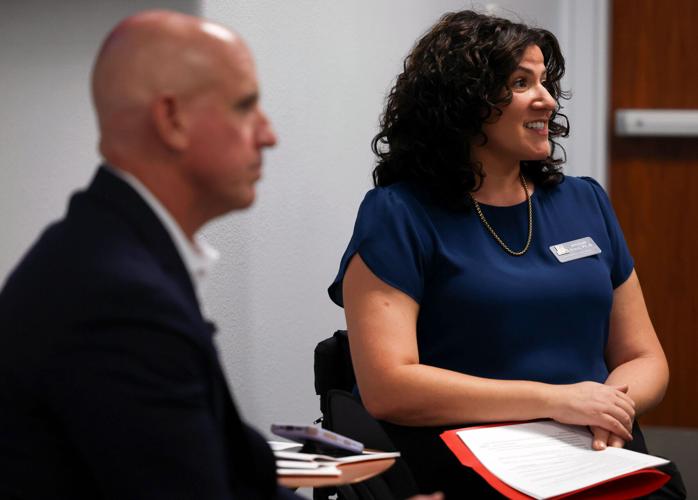
Steven Patterson, chief safety officer at the University of Arizona, and Amanda Kraus, vice president of student affairs, at the 2025 introduction of the schools SafeCats app to help boost campus safety.
“Universities continue to face complex challenges that are all affected by the geopolitical climate, acts of targeted violence, swatting and hoax threats, sexual violence, student mental health concerns and hazing,” Olson said.
“The overall shift from campus policing is moving from a primarily reactive model to a proactive, prevention-focused approach designed to identify risks, prevent harm and minimize disruptions to campus operations."
Amanda Kraus, UA’s vice president for student affairs, said that to effectively keep students safe, early intervention and prevention are necessary, and that includes understanding changing dynamics and trends.
“We’re seeing help-seeking is on the rise,” Kraus said. “Students are more interested in seeking mental health support, in seeking assistance through the Dean of Students Office at U of A. We’ve seen a 30% increase in care reports from this time last year, our CAPS (Counseling and Psychological Services) team has seen about a 20% increase in mental health support, and so, we’re taking this as a sign that outreach is important, education is important and trust-building with students is really critical.”
She said reporting on hazing is also increasing because of mandatory training and heightened national attention to the dangers of hazing. Students have more information and awareness of what “concerning behavior” looks like, and they know when to make a report, Kraus said.
Fraternities at the UA have recently come under criticism for what the Dean of Students Office called “multiple reports of misconduct” and “egregious” behavior.
Five fraternities are under investigation by UA: Delta Chi, Delta Kappa Epsilon, Sigma Tau Gamma, Zeta Beta Tau and Zeta Psi. Four fraternities, including Sigma Phi Epsilon, have been placed on probation until May next year; and one, Sigma Alpha Mu, has been placed on “interim loss of recognition” at UA for the next five years.
UAPD is investigating an alleged sexual assault of a sorority member on Aug. 26 at Sigma Phi Epsilon fraternity house. Sigma Phi Epsilon was suspended by UA after the report was filed; UAPD has said it cannot comment on the status of an open investigation, but there is no indication in court records that any charges have been filed or arrests made.
Brian Warren, CEO of the national headquarters of Sigma Phi Epsilon, has said, "Sigma Phi Epsilon does not tolerate sexual assault or sexual misconduct. The Fraternity has suspended the membership of those involved while the investigation proceeds. Any member found responsible will be expelled, and we will cooperate fully with law enforcement as it seeks accountability under the law."
Reporter Prerana Sannappanavar covers higher education for the Arizona Daily Star and Tucson.com. Contact her at psannappa1@tucson.com or DM her on Twitter.

Prerana Sannappanavar
Higher Education Reporter