

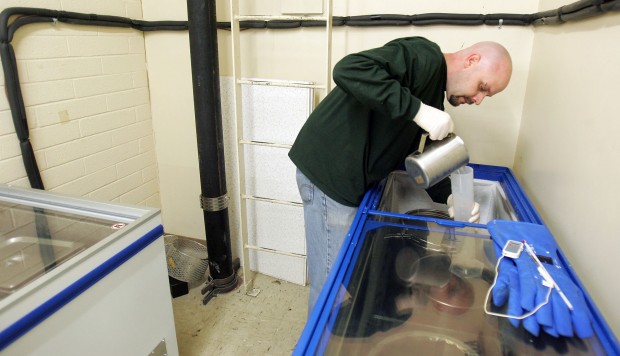
Joshua Lopez gently peels transparent covering from a metal tray in his lab. His actions are fluid, like he's undoing gift-wrap he plans to reuse. He has good reason to be careful: Inside the plastic bundle is a human head.
Lopez works at the University of Arizona's Plastination Lab, where body parts take on second lives for education. But these aren't average cadavers: Plastination - the same process used in exhibits such as Body Worlds - permanently preserves them, piece by piece.
The UA has long used cadavers to teach anatomy, but its work with plastinates is new. Lopez started at the College of Medicine seven years ago, and leaders at the Department of Cell Biology and Anatomy soon asked if he was interested in tackling plastination.
It's the only such lab in Arizona, Lopez said, and it's also full-scale, meaning it can preserve and plastinate various body parts, as well as dissect them to demonstrate anatomical structure. He said only three other universities nationwide actively plastinate.
People are also reading…
Lopez, who is also the director of the UA Anatomical Donor Program, mastered the fundamentals of the process at the University of Michigan, home of the nation's largest plastination lab.
Bodies are temporarily preserved for funerals, but it takes a different procedure to turn them from degradable to durable. The process starts with traditional formaldehyde preservation, followed by an acetone bath that takes the place of water and fatty tissues over a month's time. A vacuum is used to push out acetone while forcing in silicone polymer. The last step is exposure to a gaseous hardener, which cures the part and turns it into a finished plastinate.
Coming face to face with a plastinated human head is one thing for visitors, but it's a distinctive experience for Lopez, who describes his job as "a labor of love." Not only is he acquainted with donors in death, but he's known some while they were alive, too.
"There were, and will continue to be, times when I converse with or meet donors, and then 'reunite' with them later," he said. It sounds strange, but it's a good experience, he said. Lopez has a mortuary science background and takes pride in his work to ensure donors' wishes are met.
Working with plastinates can't reproduce the experience of working with cadavers, but there are benefits.
Plastinates don't require special ventilation and extra space like cadavers, and their durability gives decades of students the chance to study anatomy outside the cadaver lab. Also, students can examine organs such as livers and kidneys one by one.
Schools often use plastinates to demonstrate anatomy of parts that are difficult to dissect, such as the pelvis, head and neck, Lopez said.
And UA med students aren't the only ones benefiting - other schools can borrow items, Lopez said. He estimated that he creates one plastinate a week.
Dr. William Adamas-Rappaport, an associate professor of surgery and anatomy at the UA, said the lab is important despite its newness. Preserving uncommon body parts benefits students, he said.
"If we have a young person die, their anatomy is going to be perfect," he said. "You may not get another person like that. That's going to be a huge advantage."
Adamas-Rappaport said there's a big difference between pictures and hands-on experience.
"If we show a slide of hernia versus the real thing, it'll imprint much better with the real thing," he said.
Materials come from the Willed Body Program, Lopez said. Donors have two options: traditional donation, in which they'll spend two years or more in medical education followed by the return of their ashes to family, or permanent preservation, in which their use is indefinite. Plastinates come from these donors, Lopez said, noting that details of permanent preservation are discussed at enrollment, and the donor's choice is double-checked at death with next of kin.
Some may find body donation strange, but it hasn't stopped Jillane Coots from signing up. Coots, coordinator of anatomical services at the UA's Willed Body Program, said she never considered donation before working there. She wasn't interested until she talked to families and donors about their reasons for donation.
"There's nothing more humbling than to work on a person's body knowing they came here and put themselves out there," she said. "There's nothing bigger I can offer the world in my position here than to put myself out there for those students in hopes that they learn as much as they can."
Coots was raised as a Catholic and opted for traditional donation rather than permanent preservation because of her religious beliefs. However, she said there has been no shortage of interest in plastination.
"It's for people who feel they want to continue teaching forever," she said. "They basically become part of our faculty."
Despite recent controversy around popular plastination exhibits - whose bodies cannot always be linked to willing donors - the exposure has been good for the lab, Lopez said.
People are mesmerized by plastinated hearts and lungs. The experience makes them think about their whole body, he said.
Working here isn't monotonous for Lopez, who is still intrigued by anatomy. He plays the violin and said seeing his body produce "the slightest movement" to make a single note captivates him. He hopes others feel the same after visiting his lab.
"There's a huge sense of pride knowing that you can do something few can," he said. "That response, the 'I get it now,' is magic."
Contact NASA Space Grant intern Victoria Blute at vblute@azstarnet.com


