Pima Community College increased its first-day enrollment for the fall 2026 semester by 1.34%, its application numbers by 6% and its conversion rate of how many students register to enroll after putting in an application by 23%.
Chancellor Jeffrey Nasse says he's always thinking about how to deepen access to Pima County residents and reach more people.
“Around 30% of our students are ages 25 to 49, the working adult population … so how do we reach more of those?” Nasse said in an interview with the Star last week.
“Even graduating (high school) seniors, I think, about half don’t go to any postsecondary education in Pima County. Think about that, right?” he said.
“The University of Arizona has courses here in Tucson, Pima Community College (and) other providers, but I always think, ‘Wow, there’s 50 percent-ish of people who have graduated high school here locally who have not gone anywhere.’ So, even if that population is getting smaller, I’m always talking to my team: ‘How do we reach (them)?’ There’s still a bunch of people who aren’t taking advantage of those things.”
People are also reading…

PCC is bringing in nearly 4,400 first-time incoming students this fall, up from about 3,800 students in fall 2025.
PCC is bringing in nearly 4,400 first-time, incoming students this fall, up from about 3,800 students in fall 2025, 3,400 in fall 2024, 3,300 in fall 2023 and 3,400 in fall 2022.
The college’s total fall student headcount was recorded at about 19,500 students this year, up from 19,200 in fall 2025, 18,000 in fall 2024, 17,700 in fall 2023 and 17,400 in fall 2023.
First-day enrollment numbers don’t include dual enrollment students, however, who take classes in their high schools for PCC credit. In 2025, more than 6,600 high school students enrolled in the college’s dual enrollment classes, increasing the dual enrollment numbers by close to 25% from 2024.
Addressing the nationwide decline in enrollment at colleges and universities, Nasse said he reads what’s being reported in the media and sees that the perception of a college degree’s importance has certainly gone down. But he thinks that for community colleges, including PCC, while they do offer degrees, they’re more focused on orienting students to the workforce.
“We have a lot of certifications, we talk about the idea of a credential of value. So, I think always for prospective students, it is a value proposition,” he said.
“What are they going to invest in this process?” Nasse said. “It’s time, it’s some level of money, and then, what are they thinking they’re going to get out of it? So, I think community colleges in general, and certainly Pima may be benefitting from that consideration. You can go in and get a certificate in a particular field, or a two-year degree, or whatever it would be, and I know that you’re going to realize that benefit coming out of it.”
PCC’s application numbers are also up by 6% in comparison to last fall at nearly 13,500.
Nasse said PCC’s increasing numbers might also be a consequence of the flexible education the community college offers, where it also has classes starting later in September as well as in October. The number of students will continue to shift, he said, adding that some students may leave and more will come in.
While PCC’s traditional 16-week fall semester began Aug. 24, students can still go on to register for 14-week classes until Sept. 8 and for 8-week classes until Oct. 19.
The college’s first-day fall credit enrollment, which is measured by the number of courses students take, is up by 2.20% in comparison to last fall.
The number of credits or classes students are enrolled in on the first day of the fall semester has increased over the last five years: approximately 58,300 in fall 2025, 53,900 in fall 2024, 51,800 in fall 2023 and 50,800 in fall 2022.
PCC's trend contrasts with that nationwide at many universities, including the University of Arizona. According to internal UA data the Star obtained and reported last month, the UA's first-year undergraduate enrollment is expected to be approximately 5,800 students. This would be a drop of nearly 23% from the fall 2025 semester, which itself saw a 19% decline from 2024.
The internal data also showed that UA’s application numbers dropped significantly for the fall 2026 semester — by about 24% for in-state students, 33% for out-of-state students and 81% for international students. However, UA’s overall acceptance rate for applicants increased by about 5% in comparison to last year.
Addressing barriers
Nasse said PCC is always looking at retention numbers, as well.
“We look at what we call ‘persistence.’ That’s students going from the fall to the spring,” he said. "At community colleges, we typically will look at a four-year completion rate and that’s definitely an area of focus for us. We need to get better at our completion rates.”
PCC’s average five-year retention rate is nearly 45%, said Justin Kree, PCC’s media relations director.
PCC’s “vast majority are part-time students. They’re working, they have family commitments,” Nasse said.
“So, one of the strategic priorities next year is, how do we address those types of barriers for students to see them succeed?” he continued. “It’s hard to be persisting when you have an empty refrigerator. We have food insecurity, we have transportation challenges, healthcare challenges, family challenges, of course financial challenges, housing or home insecurity. Our students experience all those things. So one of the college’s strategic priorities is, how do we connect students to resources so they can maintain (their education)?"

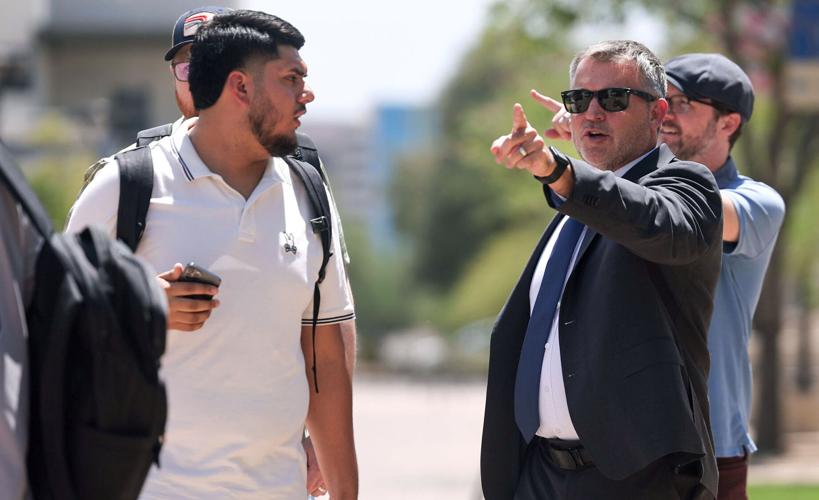
Pima Community College Chancellor Jeffrey Nasse helps direct students at the school's downtown campus on the first day of the fall semester.
PCC has an Aztec Resource Center and food pantry program, which is supported by the Pima Foundation and “provides non-academic support to PCC students by addressing campus food insecurity issues.” There, students have access to food bags, hygiene items and community resources through referrals, offered at the West Campus and the Desert Vista Campus, with a distribution site at the East Campus.
Nasse said in order to continue “deepening access” for students to its education, the community college makes sure it has strong partnerships with local high schools. He said PCC has a team dedicated to working with them, which goes into the high schools to connect with students and families.
In terms of fields and industries PCC wants to focus on training its students in, Nasse said the college has always been good at being multipurpose and meeting a wide variety of education and career needs in the community. He listed IT and cybersecurity, healthcare, teaching (PCC has a new bachelor’s program in teaching education), public safety, emergency technicians and paramedics, aviation technology, among other strengths.
'Roadmap for Resilience'
Nationally, a "demographic cliff" — the current decline in traditional-age college students after the reduced birth rates during the Great Recession of 2008 — is leading to enrollment declines.
“I think community colleges, just historically and I can say for Pima, are able to adapt quickly or more quickly perhaps than some of our larger colleges and universities to be resilient. In fact, the name of our strategic plan at Pima is ‘Roadmap for Resilience,’” Nasse said.
“There’s a lot of changing things. There’s the value of a college degree, there are resource pressures always, there’s political uncertainty, economic uncertainty,” he said. “There’s all kinds of things happening and I think community colleges and Pima has always been well-positioned to be resilient in those.”
Nasse said even though PCC doesn’t get regular funding from the state of Arizona, it has support from the community, with families appreciating having access to “a high-quality experience that’s accessible, that’s affordable, that meets them where they are.”
He said PCC has a history of supporting undocumented students, including those in DACA (the Deferred Action for Childhood Arrivals program), who are allowed to pay in-state tuition under voter-approved Arizona law. The college wants everyone to have an opportunity and doesn't ask applicants to verify their status, Nasse said.
PCC has a Monarch Student Resources team that supports immigrant and refugee students, and the college has long proudly been a minority-serving institution and a Hispanic-Serving Institution, he added.
Reporter Prerana Sannappanavar covers higher education for the Arizona Daily Star and Tucson.com. Contact her at psannappa1@tucson.com or DM her on Twitter.

Prerana Sannappanavar
Higher Education Reporter