

Even though school funding is getting harder to come by, parents from Collier Elementary School rebuffed thousands of dollars that could have been generated by a cellphone tower lease, citing health concerns.
Such leases, already in place at nine Tucson Unified School District campuses, have brought in nearly $355,000 a year — the majority of which goes directly to the school sites.
Santa Rita High School alone takes in more than $57,000 a year. There are very few areas of the east-side school that are not touched by those lease funds, with money being allocated for custodial supplies, field trips, college visits, transportation, textbooks and technology.
On Tuesday, the TUSD Governing Board will vote on three other new cell-tower leases designated for Palo Verde and Rincon high schools and Utterback Magnet Middle School.
People are also reading…
Unlike the Collier deal, those three agreements are backed by the campuses and are expected to be approved, each bringing in $19,000 a year — more than $11,000 of which will go directly to the schools.
Shortly after Collier parents came out in droves to a January Governing Board meeting, citing concerns about cancer and threatening to remove their children from the northeast-side school, T-Mobile withdrew the offer, likely because of the negative publicity, said district spokeswoman Stefanie Boe.
The American Cancer Society has said there is very little evidence to support the claim cellphone towers cause cancer, saying the energy level of radio frequency waves is relatively low, especially when compared to the types of radiation known to increase cancer risk like gamma rays, X-rays and ultraviolet light.
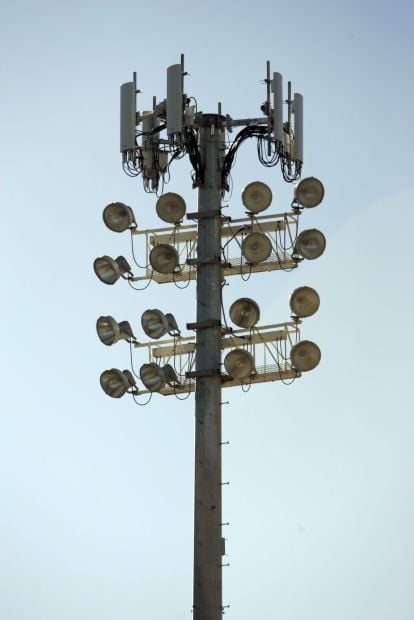
There are already 20 cell towers on a combined nine campuses, some on light poles, smokestacks and in parking lots. Each lease agreement generates between $12,000 to $22,000 a year, depending on the age of the equipment.
Collier would have gotten 60 percent of whatever that lease generated. The remaining 40 percent stays at central administration to defray the cost of leases and rentals. It also pays for the TUSD clothing bank, which is utilized by children across the district.
Cholla High Magnet School has had three towers installed between 2002 and 2007 on the football and baseball fields. The leases bring in more than $56,000 a year — about $34,000 of which goes to the southwest-side school.
Cholla Principal Frank Armenta is not aware of any opposition to the towers, which he said provide an extra benefit.
The funds have previously covered the cost of mariachi guitars and uniforms, and at one point were used to put technology like projectors and SMART boards into classrooms. The money has also been used for teacher training.
Most of the time, however, it is used for upkeep — replacing blown-out lights in the auditorium, keeping the sound system up to par, carpet cleaning and painting.
At Valencia Middle School, which has had one tower since 2006, the additional funds were essential to provide a summer academy for soon-to-be sixth-graders and extra tutoring for departing eighth-graders before making their way to high school, Principal Patricia Acosta said.
The school’s portion of the $18,000 lease also covered pay for office staff and assistant principals who were on duty over the summer when they were technically not on contract but were assisting with the summer program.
Now that summer school efforts are coordinated by the district, Valencia is finding other ways to use the funds, Acosta said, including purchasing an ice machine for the nurse’s office.
In the future, the site council will take into consideration requests from clubs, community and staff on how to use the funds.
“I think it’s been amazing for us because we are so far out,” Acosta said, referring to the school’s remote, southwest-side location.
“We don’t have any other way to have extra funding to support activities and programs at the school. Mansfeld Middle School being right across from the University of Arizona has the ability to charge people to park for games, but we can’t do that.”
Santa Rita’s five towers are the most at one TUSD site.
They were installed between 2002 and 2007, and bring in $95,760 annually. The school’s cut of that is more than $57,000.
“I’m glad we have this fund because we are able to create special opportunities for our students and staff,” said Santa Rita Principal James Palacios. “Education moves so fast — faster than the funds that are available — and this helps us keep up with that.”
Other campuses with towers include:
- Catalina Magnet High School, with one tower installed in 2000.
- Rincon High, with two towers installed in 1997 and 1998.
- The Sabino High campus, which installed four between 1998 and 2001
- Sahuaro High, with two towers installed in 2004 and 2006.
- Tucson High, with one tower that was installed in 2002.
- Whitmore Elementary School, with one installed in 1998.
In TUSD’s case, the offer to lease land has always come from cell providers. The offer goes through the district, which then approaches the principal and site council to determine the level of interest.
While most sites accept the offer, there was one other instance in which a school, Robins Elementary, turned it down for similar reasons cited by Collier parents, said Bryant Nodine, TUSD’s acting director of planning and student assignment.
While such refusals cost the district, it is more of a benefit to the school sites themselves, Nodine said.
“Those that don’t have it don’t know what they are missing,” he said.
Contact reporter Alexis Huicochea at ahuicochea@tucson.com or 573-4175. On Twitter @AlexisHuicochea

Alexis Huicochea
Team leader


