Some 17,000 Arizona children in the Head Start program face safety risks, diminished quality of education and a change in the way they can learn English under sweeping changes proposed by the Trump administration, a Tucson leader of the program says.
Health and Human Services Secretary Robert F. Kennedy Jr. announced earlier this month that his agency is pursuing a sweeping rollback of federal rules, putting more than 1,400 specific regulatory provisions on the chopping block governing the multibillion-dollar program.

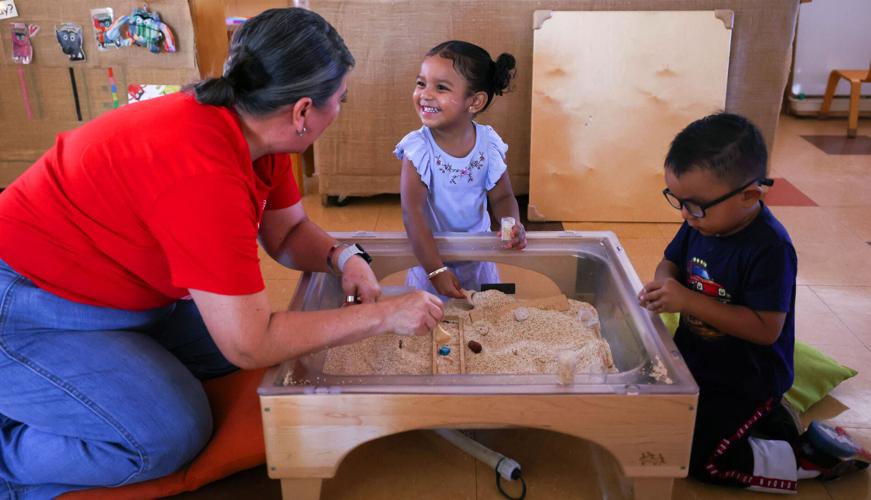
Esmeralda Snyder, an instructor at Southside Head Start in Tucson, works with Julia Campas, center, and Angel Ortiz during an afternoon class time.
Head Start, created under President Lyndon B. Johnson as part of the "War on Poverty," is a federal program that provides free early childhood education, health, nutrition and parent-involvement services to low-income children from birth to age five. It aims to prepare students for kindergarten and build their social and emotional skills, according to the federal website.
People are also reading…
Among the program requirements on the chopping block are small class sizes, student-teacher ratios and disability screenings for children; those rules would be left up to the states. The proposed changes would also require that instruction be conducted in English, mandate that nutrition and health programs serve nutrient-dense whole foods, and lower the cap on administrative spending from 15% to 5%.
Child Parent Centers, the main Head Start organization in Pima, Cochise, Santa Cruz, Graham and Greenlee counties, serves about 2,500 students every year. Erin Lyons, the organization’s CEO, said the biggest impacts in southern Arizona if the proposed changes go through would be to education quality, student safety, instruction for English learners and administrative spending.
"Head Start has the highest level of quality in terms of standards," Lyons said, adding that removing the cap on class sizes "would be very detrimental."
Class sizes and safety
If Head Start programs deferred to Arizona standards, they could legally place more children per adult in a classroom. Federal rules currently cap classrooms serving mostly 3-year-olds at a group size of 17 children with two teaching staff — roughly one adult for every 8 or 9 children. Arizona law, by contrast, allows one teacher for every 13 3-year-olds. For 2-year-olds, federal rules require two teachers for every eight children, or one adult per four, compared with one teacher per eight under Arizona law.
“That would significantly compromise the level of attention that they could give to the children in their classroom,” Lyons said.
Caps are especially important for very young children, some of whom are still being potty-trained, she said, to ensure they can be cared for at a high level of quality. Expanding class sizes would also raise safety concerns, since young children need constant supervision to keep them from putting objects in their mouths or wandering off.
According to the Harvard University Center on the Developing Child, more than a million new neural connections are formed every second in a child’s first few years of life. Many early experiences and influences, including high-quality care and education programs, interact with children’s genes to shape brain architecture.
“There's a recognition that high quality early-learning experiences help mitigate the challenges that come from growing up in in poverty,” Lyons said.
She said what sets Head Start apart from general child care is that it addresses a child's whole well-being: nutrition, family support, referrals to community resources and mental health services. That comprehensive approach, she said, is what has made the program successful for six decades.
English-language instruction
Of the families served by Child Parent Centers, 49% come from families whose home language is not English, and 35% are dual-language learners, meaning the predominant language they speak is something other than English.
Lyons said that under the current system, if a student doesn't speak English, lessons are taught in the student's native language, with English introduced gradually throughout the year to prepare them for kindergarten. If a staff member doesn’t speak a student's native language, the program brings in an interpreter.
“The goal already in Head Start is to support families in maintaining their native language and also learn English,” she said. “So it's a concern because we don't know what that requirement would look like in practice.”
The federal proposal also bars programs from using any materials that are not in English.
“That would be a change because we do use those materials to help facilitate the learning of English during the course of the year,” Lyons said.
Administrative spending
Child Parent Centers currently spends about 10% of its budget on administrative costs, meaning it would have to cut those costs in half to meet the proposed 5% cap.
Administrative spending covers IT, human resources and fiscal staff, Lyons said, as well as facility needs such as kitchen appliances, HVAC systems and playground maintenance.

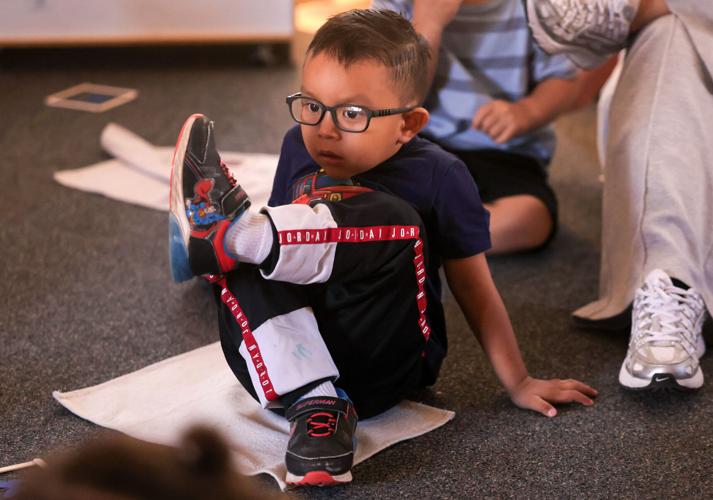
Angel Ortiz, 3, takes part in a Friday afternoon yoga session at Southside Head Start, 317 W. 23rd St.
“All of those things are facilities related, and those are classified as administrative expenses,” she said. “So going down to the 5% cap absolutely would mean cuts, and I think that's across the board for Head Start programs.”
Nutritional standards would not change for Child Parent Centers, Lyons said, because the organization already serves whole foods, employs cooking staff, builds menus with parental input and has a registered dietitian on staff.
“I think that's called out in this proposal just because of the administration's focus on health and nutrition, which we agree with and already exists,” she said.
Screenings and disability services
Another proposed change would eliminate requirements for developmental, medical, dental and disability screenings. Currently, programs are required to complete screenings for every enrolled child within 45 days of their first day of attendance.
If the mandate was cut, Arizona’s child care licensing rules would govern the centers. State rules don't require child care centers or preschools to screen every student; under Arizona Department of Education rules, only local public school districts are legally required to screen for suspected disabilities.
Families who don't use Head Start currently rely on the Arizona Early Intervention Program, which uses a 50% developmental-delay threshold in areas such as speech, motor skills and social-emotional development for children under 3. Children with mild or moderate delays who currently qualify for support through Head Start might not qualify under the state's stricter limit.
The proposal would also remove a specific rule barring programs from turning away children because of a disability or chronic health condition; however, programs would remain subject to federal and state anti-discrimination laws.
'I see what happens if we don't give kids a chance'
Gabby Berryhill, a mom of four and probation officer, became a Head Start parent in 2024 when she sent her then three-year-old to the program in Graham County. She said without the program, her second-oldest son “would not be walking into Kindergarten with an IEP.”
“I had such a bad experience and my rights weren't explained to me when I went in for my oldest child's IEP,” she said. “I don't think I would have done it again.”
Berryhill said the process of applying for an IEP was a “nightmare” for her oldest, but Head Start employees helped her throughout the process for her second-oldest, Lincoln, and even advocated for her when it wasn’t being held to standard. When Lincoln started working with a speech therapist, they told Berryhill he was doing fine.
“'I’m going, ‘He can't say the sound. He may have memorized how to say the six words that you gave him, but that skill's not transferring,” she said. “But you have to keep the IEP in place; otherwise, you have to completely start over when he goes into kindergarten.”
She said Lincoln’s Head Start teacher noticed zero improvement, and went with his father to his IEP meeting in May to advocate for him.
“She got us from 15 minutes once a week to 20 minutes twice a week, or one session of 40 minutes, which is huge,” she said. “A big thing in kindergarten is also sight words. You have to be able to say 50 sight words, and she made sure to put in that IEP that as long as the teacher knew that Lincoln knew the word, even if he couldn't pronounce it correctly, he would get credit.”
Berryhill said without the federally required disability screenings, families like hers might not get the right kind of help early enough, interrupting students’ ability to learn in their early elementary school years.
“If my kid has a deficit, I'm going to fight tooth and nail to do everything and give them everything I can,” she said. “But not every kiddo has that, and Head Start gives them that advantage.”
She said she also worries about the class sizes and student-teacher ratios.
“On the Republican side of me, I love having a small federal government, I love lower taxes (and) I love not being in an amazing amount of debt,” she said. “If we lower the ratios in the classroom, (Head Start) can serve twice as many kids. In theory, I would like it in an area with hardly any preschools, but the budget isn't increasing, so we're gonna run into some problems there and with basic infrastructure.”
As a staunch advocate for funding early education in an area with “very limited early childhood education, and even less daycare options,” she said she often tells people “we can build daycares and preschools now, or we can build prisons in 20 years.”

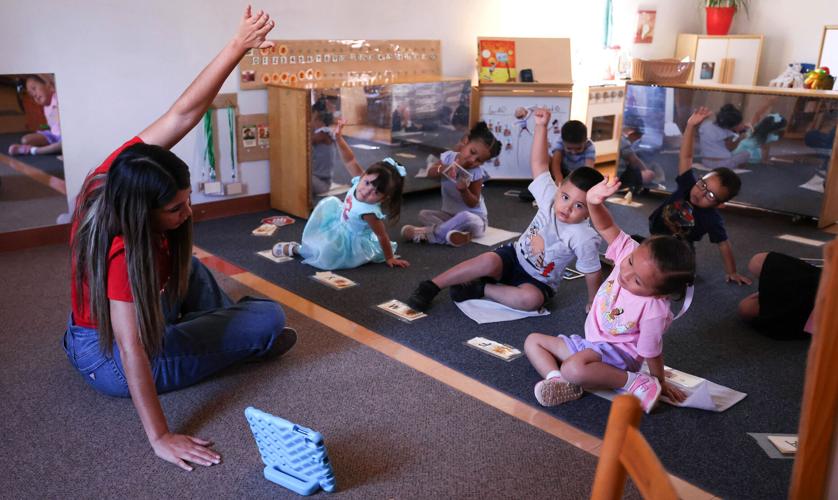
Esther Galaz leads a class of 3-year-old students through yoga moves during a Friday afternoon session at Southside Head Start.
“I see what happens if we don't advocate for kids,” she said. “I see what happens if we don't give kids a chance. They end up on probation and in prison, and so I get to speak both on a personal level as a mom and in a professional capacity.”
Looking at the situation from a Republican lens, Berryhill said, “the cost savings is investing in children so that they're productive adults 20 years from now. And if you want to look at it through a democratic lens, there is nothing better than taking care of your weakest, most vulnerable members of your society, and that's children.”
The proposal is meant to advance "President Donald J. Trump's vision to expand access, reduce red tape, and refocus the program on its core mission of preparing America's most vulnerable children for success," according to the Health and Human Services website.
“We're still trying to sort through and understand the potential impacts,” Child Parent Centers’ Lyons said.
While it's reasonable for federal agencies to review regulations and update them to reflect current research and best practices, Lyons said many of the proposed changes could undo "the standards that have made Head Start the high-quality program that it is."
The proposal, "Reducing Federal Burden for Head Start Programs," is open for public comment through Oct. 6.
The federal government will review public comments before making a final decision. Visit tuc.life/2m4 for more information or to submit a comment.


 Resiliency key to Vail educator's journey to become Arizona Teacher of the Year