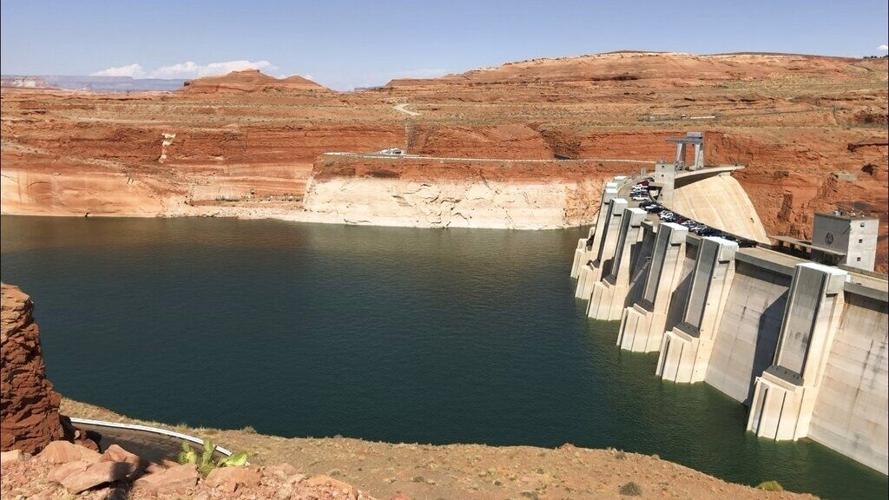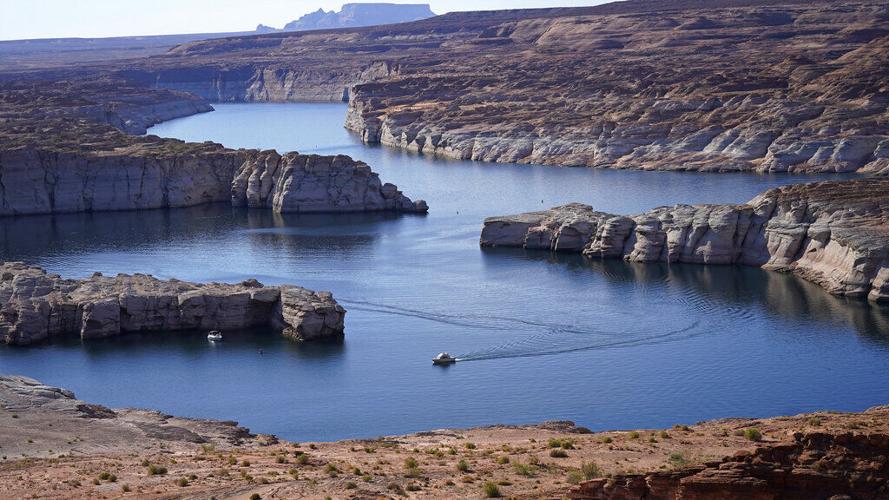
To keep Lake Powell from falling to dangerously low levels, the U.S. Bureau of Reclamation will release extra water into the lake from reservoirs upstream and slash releases to Lake Mead downstream this year.
The bureau's efforts, confirmed in an announcement Friday, are aimed at preventing Lake Powell at the Arizona-Utah border from falling below 3,490 feet in elevation, or 36 feet lower than the lake stood that day.
If the water level in the lake falls below 3,490 — a possibility that water officials and outside water experts have dreaded for years — the turbines of the adjoining Glen Canyon Dam could no longer generate electric power.
And if the lake fell further below 3,490, the authorities' ability to send water through the dam to the Grand Canyon and to Lake Mead would also gradually diminish. That's because at lower elevations, the water would have to pass through steel "outlet works" instead of the turbines — steel pipes that aren't designed to carry heavy water flows for extended periods.
People are also reading…
So on Friday, in the face of record low snowpack and forecasts of potentially record low stream flows into Lake Powell from upstream, the bureau announced two steps aimed at keeping the reservoir above 3,490 for as long as technically feasible:
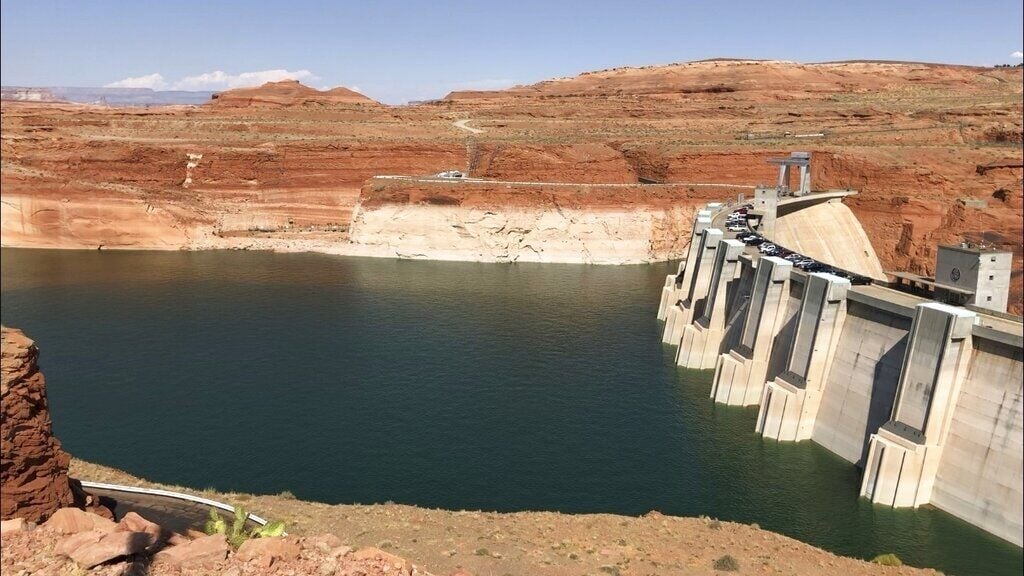
Glen Canyon Dam and Lake Powell in Page, Arizona. The U.S. Bureau of Reclamation announced Friday it will release extra water into Lake Powell from reservoirs upstream and slash releases to Lake Mead downstream this year. They're doing so to prevent Powell from falling so low the turbines at Glen Canyon Dam could no longer generate electric power.
• It will release 660,000 to 1 million acre-feet of water from the Flaming Gorge reservoir at the Wyoming-Utah border to increase the drought-depressed river flows into Powell.
• It will reduce releases from Powell to Lake Mead, south of Las Vegas at the Arizona-Nevada border, by nearly 20%, from a previously planned 7.48 million acre-feet to 6 million acre-feet.
The bureau and Arizona officials have already said the cutback in releases from Powell to Mead won't reduce the amount of water Mead delivers to cities and farms in Arizona, California and Nevada during the current "water yaer," covering the period October 2025 through September 2026. That includes Tucson, which gets virtually all its drinking water from the river.
“Given the severity of the risks facing the Colorado River system, it is imperative that we take action quickly to protect a resource that supplies water to 40 million people and supports vital agricultural, hydropower production, tribal, wildlife, and recreational uses across the region,” said Assistant Secretary — Water and Science Andrea Travnicek. “As we weigh current conditions and prepare for future operations by working with states, tribal nations and stakeholders, the Department of the Interior and Reclamation remain fully committed to taking the actions necessary to reduce impacts on water deliveries, safeguard critical infrastructure, and preserve as much operational flexibility as possible.”
But the lesser releases are likely to slash electric power generation at Hoover Dam, which forms Lake Mead. And if the Colorado River basin's unusually warm, dry conditions continue, next year could see additional cutbacks in releases to cities and farms in these three states, water experts have said.

Lake Powell near Page, Arizona. To keep the lake's water levels from falling to dangerously low levels in the face of long-term drought and climate change, the federal government is changing the amounts of water it releases from the Colorado River's reservoirs — water that cities and farms rely on.
In a news release Friday announcing its plans, the bureau stressed it's still getting input from the seven river basin states, including Arizona, as well as from tribal leaders and other partners throughout the basin. A final decision on its plans "will be coming next week," the bureau said.
The agency announced its plans after U.S. Interior Secretary Doug Burgum met Friday with governors and governors' representatives from all seven river basin states, the bureau's news release said. Arizona Gov. Katie Hobbs attended the virtual meeting, her press secretary Liliana Soto said.
“I am grateful for the governors and their teams working diligently to find a solution to the complex challenges created by these unprecedented drought conditions, which require immediate action,” said Burgum in a written statement. “Interior and Reclamation continue to coordinate with the basin states, tribes, Mexico and basin stakeholders as we make the decisions necessary to operate and protect the system.”
The agency's announced plans come as the seven basin states' representatives continue to negotiate, with no signs of success yet, to try to come up with a compromise agreement over long-term management of the Colorado River. They've been deadlocked over long-term plans for two years, and Burgum has said that without a compromise, the bureau and Interior will have to produce their own plan later this year, likely by summer.
The bureau's announcement also came as its own forecasters once again warned conditions are worsening for the river and its reservoirs due to what Arizona officials have called "abysmal" winter-spring weather.
In its monthly Colorado River conditions forecast released Friday, the bureau projected that, absent an artificial boost in river flows such as releases from Flaming Gorge, Powell could fall below 3,490 by August. That month, the scenario the bureau calls the lowest probable forecast, said to have a 10% chance of occurring, predicts the lake will be 3,482 feet. That's six feet lower than the forecast was a month ago.
Behind the series: The Star's longtime environmental reporter Tony Davis shares what inspired him to write the investigative series "Colorado River reckoning: Not enough water."
Under better weather conditions, the bureau's "most probable" forecast, which it says has a 50% chance of occurring, says Powell could fall below 3,490 by September. That's three months earlier than the agency predicted in its previous forecast, released in mid-March.
In its news release Friday, the bureau said the agency's combined actions will essentially keep Lake Powell at 3,500-feet elevation by April 2027. Without those actions, the lake could fall to as low as 3,446 feet by then, the forecast shows.
At the same time, the bureau cautioned that reducing releases from Powell to Mead so much could reduce Hoover Dam's capacity to generate electricity by 40%.
The dam's turbines generate power that's sold to customers serving 8 million people across the Southwest, including power to pump river water uphill to Phoenix and Tucson, via the Central Arizona Project's canal system. CAP delivers drinking and irrigation supplies to the Tucson and Phoenix areas and parts of Pinal County.
Bureau officials have already said that if Lake Mead falls below 1,035 feet, the agency will have to shut down seven of Hoover Dam's 12 turbines. Its announcement Friday, however, didn't specify how many turbines would be shuttered under the bureau's current proposal.
The bureau predicts in its most recent monthly forecast that Mead could fall below 1,035 by July 2027. But it presumably would fall below that level much earlier if releases to Mead from Powell are cut significantly in the meantime.
The initial proposed drought response actions may also impact recreation across multiple sites, the bureau said.
At some Upper Basin reservoirs, boating access may be reduced earlier in the season than normal. In the Grand Canyon, lower flow rates will affect rafting conditions, and fishing may be more challenging.
At Lake Mead National Recreation Area, reduced water levels may further limit boating access. Reclamation is working with reservoir recreation management partners now, and as the summer progresses.
Contact Tony Davis at 520-349-0350 or tdavis@tucson.com. Follow Davis on Twitter@tonydavis987.

Tony Davis
Reporter


 Lake Mead's drops raise prospect of unaffordable Hoover Dam electricity