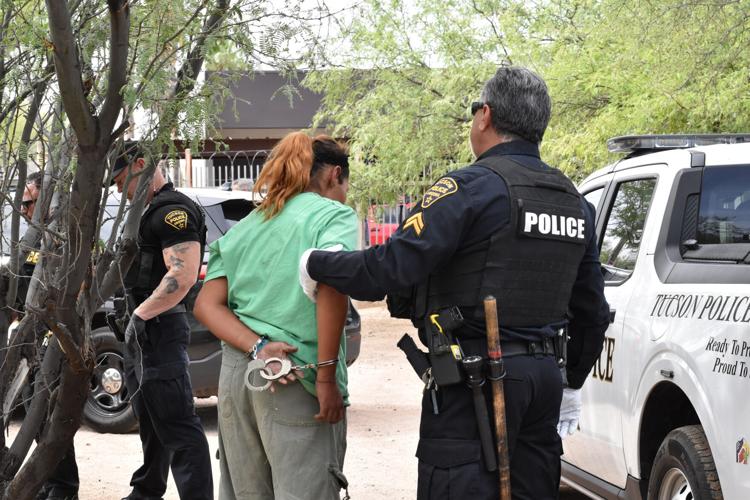
Fifteen people were arrested on Tucson's east side during a recent mass deployment of police and service providers aiming to curb homelessness, issues with fentanyl and crime.
Normally, they'd be cited and released, or booked into jail before receiving a court date several weeks away. Instead, they saw a judge via video on-site and were sent to a community court focused on providing resources.
The so-called video alternative to jail program and community court are efforts by the city of Tucson to decrease the impacts of arrests on homeless people who are taken into custody on suspicion of committing misdemeanor crimes. The effort has seen an increase in the number of people who accept services, according to the city.
Chris Chavez is the regional manager of community programs at Hope, Incorporated, a service provider that has representatives at community court. He described community court as "welcoming" and a place where anyone brought in fits in.
People are also reading…
"It breaks the stigma and that fear so that hopefully these individuals will come back for their next following court date," he said about community court. "Any kind of incentives or encouragement really goes a long way on that misdemeanor level so that they don't have to reach the felony level."
The mass deployments that incorporate the video court for initial appearances are part of the city's new Safe City Initiative. They are also part of why Tucson is seeing a 67% increase in arrests compared to the same period over the last three years. These numbers include misdemeanor and felony drug arrests, and do not include drug paraphernalia charges.
The increase in arrests has been criticized by mutual aid groups that say the city cannot arrest its way out of homelessness. They argue the effort criminalizes poverty and worsens the root cause of homelessness.

Tucson and Pima County conducted a Safe City Initiative deployment last month along Alamo Wash, offering social services and virtual court for people arrested with misdemeanor charges.
Brian Corcoran, a lieutenant with the Tucson Police Department, oversees the department’s Community Outreach, Resource and Education unit. He agreed that not all homeless people need to go through the justice system. That often creates a financial burden, he said, because they might be charged with fines they can’t afford, and they often miss their court dates either due to a lack of transportation or suffering from substance abuse issues, among other reasons.
Community court is where his opinion differs, he said.
“We just use the enforcement part as a tool to get them in front of those people,” he said.
Sharmane Murphy graduated from community court after struggling with addiction for 21 years. She began working at Hope Inc. as an outreach specialist in April and noted that there is no one-size-fits-all solution when it comes to addiction recovery.
Murphy said a big factor in getting sober is that a person has to want it for themselves. If they do it for somebody else, the effects might not be lasting.
“For me, my kids were one of the reasons, but it was about me being tired,” she said. “I was tired of using drugs and just in and out of jail. Just not living up to my full potential.”
Arrests and community court
At the last two deployments, staff from the city prosecutor’s office and the public defender’s office were present to help explain community court and the process to the people arrested, Corcoran said. He noted that pretrial services staff are also on-site to help reset court dates of people with active warrants.
The most recent deployment took place on April 29. Dozens of police officers, city and county department staff, and shelter and medical nonprofits conducted efforts on parts of Alamo Wash on Tucson’s east side. The 15 people arrested were offered snacks, services and went through video court.
Some of the services included receiving an ID voucher, transportation to a shelter or a hospital. One person received a haircut in preparation for a job interview, and five people were transported to an addiction rehabilitation center.
They were also given a date for later that week to appear at community court.
City Magistrate Ryan Bleau said the community court serves as a treatment court and a resource center where people can just walk in. They don't need a citation to access services.
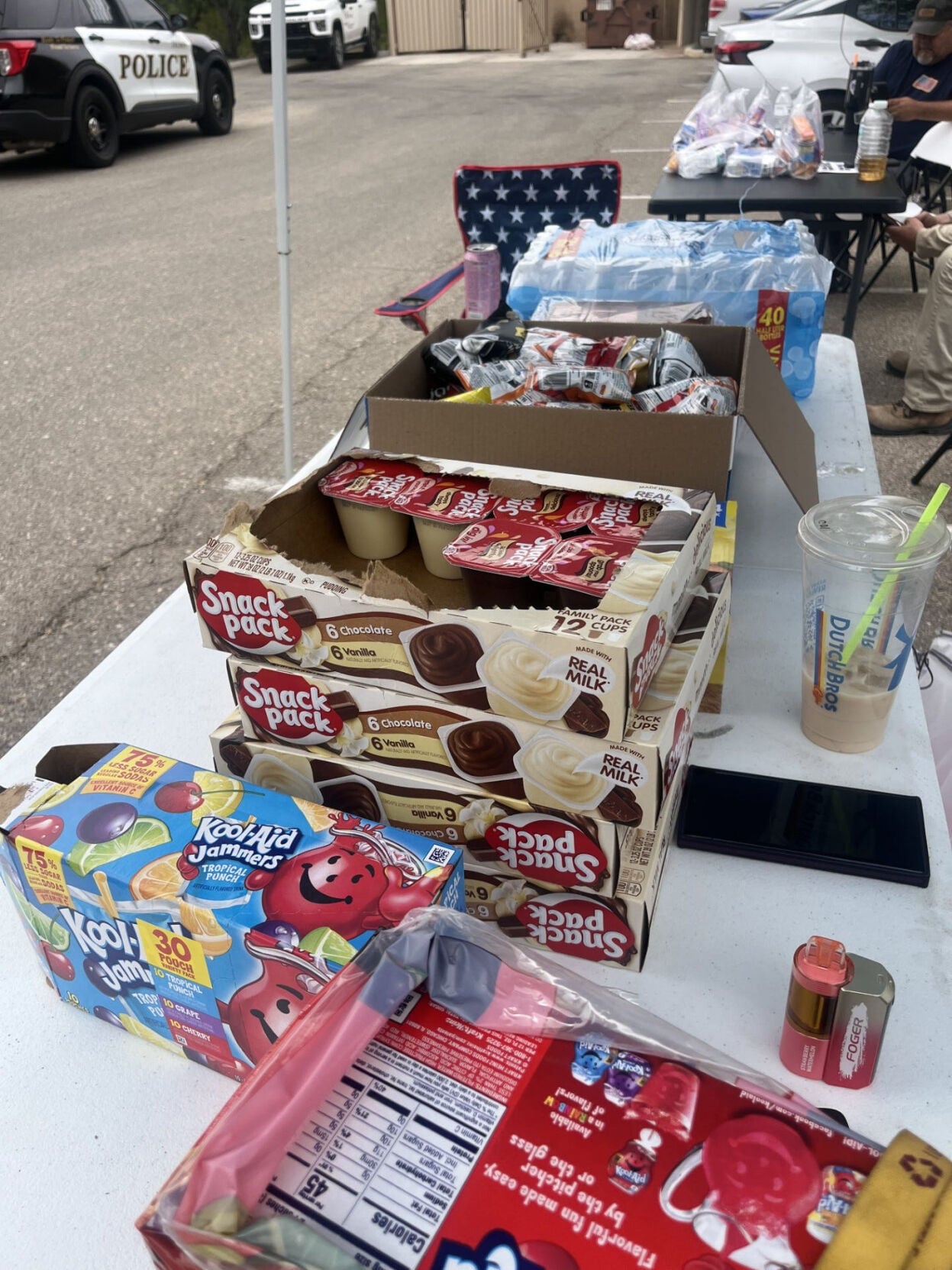
The city of Tucson and Pima County conducted a Safe City Initiative deployment late last month on Tucson's east side.
The presence of the service providers in the court, Bleau said, is one of the "shining stars" of the program.
"It helps with individuals investing in the program when they see familiar faces week after week or however frequently they're coming to court," he said. "I think it's a supportive environment to allow individuals to address the concerns or needs that they have while simultaneously addressing the criminal court misdemeanor case.
He also credited the impact attorneys have in community court.
“It's really the lawyers, the public defenders and the city prosecutors that are getting creative and putting together a program … to address not only the criminal charges but also reduce the recidivism for a particular individual,” he said.
Video alternative to jail is seeing success
While the video alternative to jail program is not brand new, its results have improved under the Safe City Initiative.
The initiative began in November 2025 and creates targeted strategies and measurable key performance indicators to the programs the city is already implementing to combat homelessness and crime, Corcoran said.
In the Safe City Initiative draft action plan, the city lays out numerous goals it wants to meet with the initiative. For diversion and treatment services, the goal is to increase the percentage of people deflected to treatment instead of jail by 20%. Another goal is to improve the service acceptance rate of individuals contacted through regular outreach, encampment decommissioning, and targeted enforcement by 10%.
The city is also aiming to reduce the impact of gun-related incidents and violence in certain high-incident areas by 50%.
Before December 2025, police conducted eight deployments. Out of 400 people, only 26 people accepted services. After December 2025, the city conducted nine deployments. Out of 175 people, 107 of them accepted services off-site.
“That’s a 59% acceptance. So, we're thrilled with that,” Corcoran said.
Corcoran noted a big challenge to get people to accept services is the various barriers required to use those services. Shelters often won’t accept people with multiple dogs, or partners who want to stay together, he said.
Community court is also seeing an increase in people showing up to their court dates.
When the police had their first major deployment prior to December 2025, they had 15 people processed through the video alternative to jail, but just one person showed up to their Friday court date.
During a March 2026 Safe City deployment, 20 people went through the video alternative to jail, and 17 showed up to their court date.
Corcoran said the success of the Safe City Initiative is due to the collaboration between police, the housing department, the courts and other agencies.
The different departments act as one team, which is not typically seen in law enforcement, he said.
During a recent community court afternoon, people sat in groups either talking with service providers or public defenders while the judge called people up one by one to talk to them about their cases.
Murphy recalled sitting in the room and witnessing community court in action.
"When I would sit there and hear other people's cases ... they were really trying to make a difference, give people as many chances as possible and exhaust every avenue before they have to exit someone out of the program," Murphy said.