

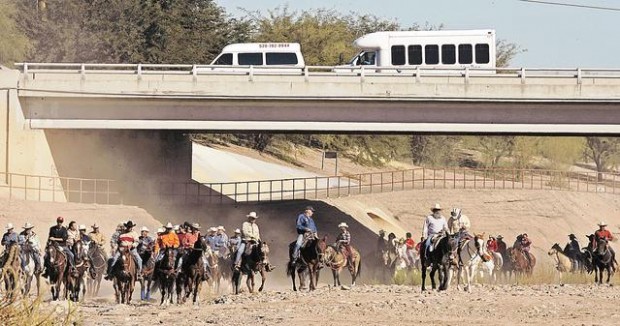
With a firm tug, Stan Maliszewski tightened the saddle strap around the belly of his horse. Others around him were in similar stages of preparation. A few were already mounted on their horses in a small clearing on the west bank of the Santa Cruz River on South Mission Road at the base of Sentinel Peak.
When the group had saddled up, they guided their mounts off the uneven riverbank and onto the soft riverbed. The horses kicked up grains of sand, which left tiny clouds of dust. The small band joined a larger group of horse riders on the bone-dry río near the West 22nd Street bridge.
The group, about 80 in all, including several young riders, turned south and began its three-hour pilgrimage to Mission San Xavier del Bac on a recent Saturday.
They went on a manda.
"This is another form of prayer for me," said Maliszewski, a retired clinical associate professor in the University of Arizona's educational psychology department.
People are also reading…
For the fourth time this year a group of riders has made its pilgrimage on horseback.
In the folkloric culture of the border, the manda is a promise of intentions in exchange for spiritual intercession. For many who remain faithful to the belief that mandas are a life-changing force, they ask God or the Virgin Guadalupe or a favorite santo for divine help.
For some of the riders like Maliszewski, the Oct. 18 morning horse ride was his private way to give thanks. His wife, Judy, is cancer-free.
Maliszewski, a native of Omaha, Neb., said he is not a religious person but a spiritual one. The horse ride on the unusually warm fall morning gave him the opportunity to contemplate all that he is thankful for.
"It is probably one of the most here-and-now experiences in my life," he said after the ride, his second one this year.
Often the plea is made while the peregrino, or pilgrim, treks on foot to the elegant late-18th-century mission on the Tohono O'odham Nation.
But in a land where horses and faith were inseparable in creating the fabled mission and later Tucson more than 200 years ago, faith and horses remain part of the landscape of cell-phone towers and laptop computers.
Tucson residents Josefina and Luis Cárdenas, who own a small stable by the river at the foot of "A" Mountain, began the pilgrimages in January. They invited their horse-riding friends to join in thankful prayer for their son Daniel Cárdenas, who recovered from brain surgery two years ago after a fall.
Riders from as far as Phoenix and Douglas have joined the pilgrimages.
"It's thanking the man above for taking care of people," said Richard Escalante, a welder with the Union Pacific Railroad. His daughter Jenna Escalante and fellow welder Merardo "Marley" Ontiveros took part in the pilgrimage.
Ramón Alvarez, a cowboy who raises cattle near Sahuarita, rode in the pilgrimage to help the less experienced riders. He was at the front of the column carrying the yellow and purple Tohono O'odham flag as the group of riders emerged from the river and onto the green irrigated agricultural fields north of the mission.
But he had another reason to ride.
"I prayed for the health of my family," said Alvarez, 36.
And Raúl Ramirez, who rode for the first time, joined the group to recall a group of horse riders led by Father Eusebio Francisco Kino, the Jesuit priest explorer who first visited the O'odham village of Wa:k in 1692.
"I have a new appreciation for what he and others accomplished," said Ramirez, the family-service coordinator of the state Department of Juvenile Corrections.
The Cárdenas family said it will plan future pilgrimages, with permission from the San Xavier District of the Tohono O'odham Nation. They do it as a way to preserve cultural history and to preserve the soul.
The group hopes to make the river horse ride in January whether it's for spiritual convictions or for other intentions.
"Everybody has their own reason to ride," said Maliszewski, "including having fun."
DID YOU KNOW
Italian-born Jesuit priest Eusebio Francisco Kino arrived in the Tohono O'odham village of Wa:k in 1692. In 1700 the first adobe bricks were placed for the first mission building named after St. Francis Xavier, the Jesuit "Apostle of the Indies."
The original mission did not survive. The present "White Dove of the Desert" was built over 14 years by the Franciscans and Tohono O'odham, and completed in 1797.
Kino was known for his cartography and agricultural practices, bringing wheat and citrus to the Sonoran Desert.
The newly formed Patronato de Kino, a non-profit organization, will celebrate an international festival in Kino's name next month.
La Entrada de Kino will be held at 9 a.m. Nov. 15 on West Congress Street on the west bank of the Santa Cruz River.
La Entrada, which means the entrance, will re-enact the arrival of Kino to the Tucson area. Following the Entrada, a symposium on Kino's legacy will be held in the Sentinel Building, 310 N. Commerce Park Loop.
The Patronato's Web site is patronatodekino.org or call 237-3790 for more information.


