“Dear members of the TUSD governing board, is the district using ChatGPT and AI to decide which schools will be closed and why?”
The question was read aloud by Tucson Unified School District governing board clerk Natalie Luna Rose on behalf of local education advocate Betts Putnam-Hidalgo. It drew laughs from the crowd at Tuesday’s board meeting.
The laughs turned to gasps as board member Sadie Shaw responded that the district’s consultant, De La Cruz Leadership Solutions, had used ChatGPT to analyze feedback collected during community meetings on potential closures.
“Our consultant, Mr. De la Cruz, and his company did mention to me that the information collected at the (community engagement) sessions was collected and synthesized via ChatGPT,” Shaw said.

TUSD hired consultant Bill de la Cruz for $75,000 to advise district officials and collect community feedback on potential closures. The analysis was developed through a mixture of community participation and feedback, and “electronic analytical tools that helped organize and examine the information collected,” he said in an email this week.
TUSD hired consultant Bill de la Cruz for $75,000 to advise district officials and collect community feedback on potential closures. The district has proposed closing seven schools.
People are also reading…
Shaw said the price tag was “absolutely not” worth the work. “I don't know if consultants are ever worth what they charge,” she said.
Governing board, district thoughts on AI use
De la Cruz led four community engagement sessions in September, three in person and one online. During the meetings, he walked participants through district data before asking them to discuss their concerns and opportunities for the district.
The use of ChatGPT concerned Shaw, who said she attended every meeting and took her own notes.
“I think a lot of people are using ChatGPT now, unfortunately, for work that is usually done by a human. I know it makes things easier,” Shaw told the Star after the meeting. “There was a lot of data, but I went to every meeting. I had my notes and after the third meeting was over, I took all the information from my little notebook, and a lot of it was repeats … it wasn't difficult for me to pull the information, so we can do it. It's just unfortunate that they did it that way.”

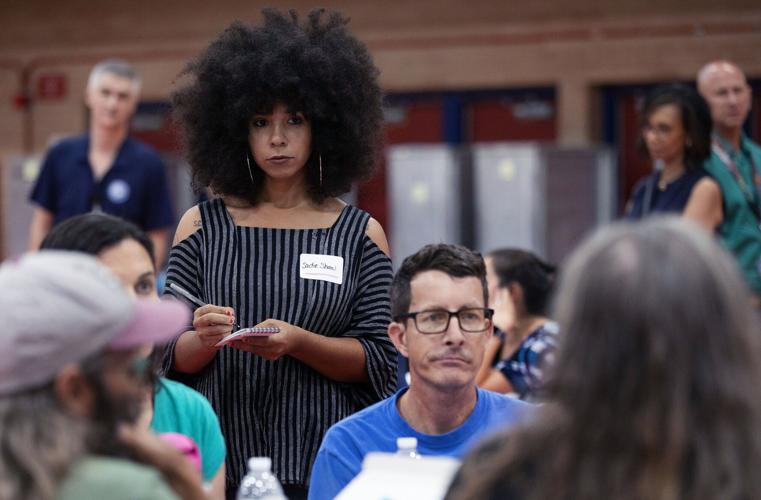
Sadie Shaw, a Tucson Unified School District board member, takes notes as she listens to parents and community members at a recent meeting to discuss proposed school closures. Shaw has raised concerns about the use of ChatGPT by a consultant hired by TUSD to analyze community feedback on potential closures.
Shaw was also worried the ChatGPT synthesis might have left out negative feedback, something board member Jennifer Eckstrom pointed out during the Oct. 27 board meeting.
ChatGPT and other AI chatbots are widely documented to be overly validating and agreeable, which critics say can lead to skewed responses.
In the October meeting, De la Cruz presented his analysis of community feedback. He told the board five key concerns included maintaining quality instruction, school safety and culture, specialized programming, such as special education services, transportation services and student support services, including counselors and interventionists.
Eckstrom told De la Cruz the presentation seemed to only provide positive feedback, and she wanted to see all of it, even if it was negative.
“I just want to know all of the information that was given to you all by the families and the people that were there. That it’s not just positive,” she said. “I appreciate your opinion. I'd like to see more data of what was actually said.”
In an email to the Star on Thursday evening, De la Cruz said the analysis was developed through a mixture of community participation and feedback, and “electronic analytical tools that helped organize and examine the information collected.”
“Electronic tools, including AI, helped manage the substantial volume of written feedback, recognize recurring topics, compare comments across engagement sessions, and develop preliminary thematic summaries,” De la Cruz said in an email. “These tools supported the analytical process; they did not replace the professional judgment and human understanding necessary to interpret the community's perspectives.”
Board president Ravi Shah told the Star Friday he was comfortable with the use of AI in the process, emphasizing that ChatGPT was used solely for synthesizing feedback from hundreds of participants during community forums.
“It seems like an appropriate use of AI. We had hundreds of people come to those community forums, which was a lot more than I anticipated would come,” Shah said. “I don't see that as a negative per se. I think with that much feedback we were getting, (it was a) good use of human time and a good use of technology to really help synthesize some of the themes that came out of the community forums.”
He also said the use of AI did not change his mind on whether the contract was worth the $75,000 price tag.
Superintendent Gabriel Trujillo said he saw it as an assistive tool for efficiency more than content creation.
“I support Bill's use of the technology in terms of helping him be more efficient and deliver a work product,” Trujillo said.
Trujillo also said De la Cruz hasn’t gotten to “the meat” of what’s written in his contract yet, with more work planned after the Dec. 8 closure vote.
Once there is a vote, De la Cruz will meet with “staff members of sending and receiving schools, setting the goal of creating culture and climate in advance of the upcoming school year,” Trujillo said.
“So there's an entire other piece for Mr. De la Cruz, which I'm excited to get started on, but obviously that second piece doesn't happen unless there is a vote,” he said.