A swarm of daily drone flights could fill the sky over Tucson, under a delivery company’s proposal now under review by federal regulators.
California-based Zipline International is seeking approval from the Federal Aviation Administration for up to 65,000 delivery flights a day from as many as 65 drone docking towers and 1,300 pickup locations it plans to build across the Old Pueblo.
According to the FAA, the service would operate 24 hours a day, seven days a week, including holidays, though approximately 95% of flights would take place between 7 a.m. and 10 p.m.
Zipline already uses electric-powered drones to pick up food, prescriptions and other products from retailers and restaurants and fly them to residential customers in several major cities, including Cleveland, Dallas-Fort Worth, Houston and Salt Lake City.
People are also reading…
Now the San Francisco Bay-area company wants to bring its autonomous airborne delivery service to Tucson and Phoenix as part of a $1.5 billion nationwide expansion in partnership with Walmart, Uber Eats and others.

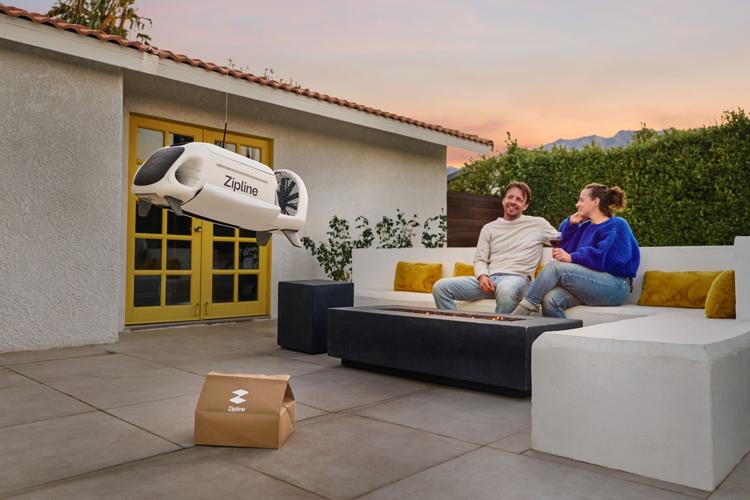
An image provided by Zipline shows a tethered delivery pod being lifted back into the air after leaving its package for two waiting customers.
Earlier this month, the FAA released a draft environmental assessment of Zipline’s plans in Arizona’s two largest cities. Regulators conclude in the 171-page document that the proposed drone operations will not result in significant noise or visual impacts or pose a substantial threat to migratory birds, bats or federally listed species.
The FAA is accepting public input on the environmental assessment through Dec. 7.
It’s unclear how soon the company hopes to start operating in Tucson. Zipline did not immediately respond to questions from the Star on Monday.
So far, the proposal seems to be flying somewhat under the radar.
Pima County Supervisor Jen Allen said the first she heard of Zipline’s plans was when a reporter called to ask her about them on Monday afternoon. The potential scale of the operation seemed to catch her off guard.
Allen said there are rural parts of the county only reachable on rough dirt roads that might benefit from aerial deliveries, but she worries about introducing thousands of fights to urban areas crowded with multistory apartment buildings, trees, powerlines and other obstacles — not to mention other air traffic.
Zipline can also expect to hear from Tucsonans concerned about the potential impacts of delivery flights on local wildlife, privacy, quietness and our famed dark night skies, she said.
“I think we’ve all had drones buzzing overhead, and they’re irritating,” Allen said. “We’ll definitely have to look further into it.”
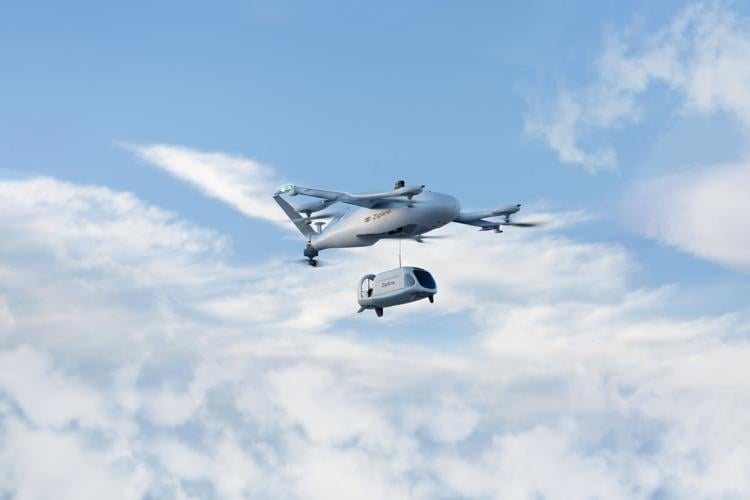
Zipline’s home delivery service uses an 8-foot-long unmanned aircraft with five propellers, an almost-8-foot wingspan and a range of roughly 20 miles between battery charges. It weighs about 55 pounds and can carry an 8-pound payload.
When an order is received, a drone disconnects from a docking tower known as a charger, climbs vertically to an operating altitude of about 330 feet above the ground and flies at around 70 mph to a designated dropbox to collect its cargo.
Deliveries are picked up and dropped off using a delivery pod on a tether that is lowered and raised while the drone hovers overhead at 330 feet.
A video from Zipline shows a Popeyes Chicken order being picked up from a dropbox by the tethered delivery pod of an aerial drone.
According to the FAA’s assessment, the chargers and dropboxes would be located in “established commercial areas whose use is consistent with local zoning and land-use requirements, such as retail stores, warehouses, laboratories and other locations operated by customers.”
Their distribution would be determined by “a plan to be developed with Zipline’s partners and through outreach to local communities,” including city and county officials, wildlife groups, schools, airports and airspace users, the assessment states.
The document includes a rendering of a 12-drone charger, but some of the freestanding docking towers are designed to hold as many as 36 of the delivery vehicles.

An image provided by Zipline shows one of its automated unmanned aircraft carrying a delivery pod. The California company is seeking approval from federal aviation regulators to expand its delivery drone service to Tucson.
Though Zipline’s plans contemplate a maximum of 65,000 deliveries a day, the total number of daily transits could reach as high as 195,000, since each delivery involves flying from a charger to a dropbox, then to the delivery location, and finally back to a charger, though not necessarily the same one the drone started from.
Occasional repositioning flights also may be necessary to stage drones in areas with greater demand.
The FAA notes that Zipline’s aircraft are equipped with safety lights and strobes designed to be visible from at least 3 miles away. They will fly pre-planned routes designed to avoid terrain, obstacles, sensitive areas and established flight corridors, with onboard sensors, flight-control systems and reporting protocols to avoid conflicts with other aircraft.
If a drone strays off course, the flight can be terminated by a remote human pilot or by the aircraft itself, which is designed, in the event of a malfunction, to automatically return to the nearest charger or hover in place and then drop to the ground under an emergency parachute.
Zipline’s plans for Phoenix also include up to 65 chargers, 1,300 dropboxes and 65,000 daily deliveries, but with a service area roughly triple the size of its proposed 554-square-mile Tucson flight zone.
Amazon has operated drone delivery service in the southwestern Phoenix suburb of Tolleson since November 2024. In October 2025, a pair of Amazon Prime Air drones collided with a construction crane on the roof of a Tolleson building and crashed in two nearby parking lots. No one was injured in the accident.
Zipline refers to itself as “the world’s largest drone delivery service,” with nearly 150 million autonomous miles flown on multiple continents and in a wide range of weather conditions, resulting in a safe delivery made every 15 seconds.
The company touts its service as faster, more efficient and easier on the environment than using “a 3,000-pound car to deliver things like a takeout order or your medication.”
According to the Zipline website, its drones have logged more than one million accident-free deliveries in the Dallas-Fort Worth metroplex alone over the past year.
The company said it also serves more than 5,000 hospitals and health facilities, regularly delivering everything from supplies and gauze to blood, vaccines and other medicines.
In addition to Tucson and Phoenix, the FAA is currently reviewing plans for new Zipline drone operations in Austin, San Antonio and Seattle.