Chiricahua National Park finally got its frogs back.
A population of threatened Chiricahua leopard frogs has been reintroduced to the newly designated national park in southeastern Arizona, after disappearing from the area decades ago.
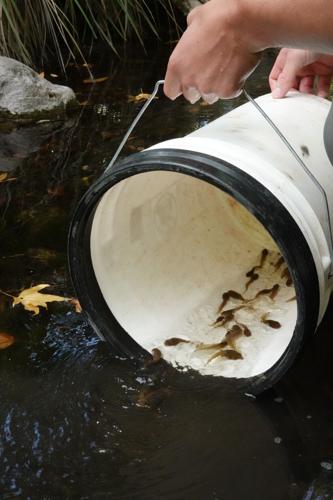
Roughly 900 tadpoles were released at two undisclosed locations in Bonita and Rhyolite Canyons on Sept. 15 as part of a larger effort to restore the species in parts of its historic range that can still sustain it.
“It was pretty exciting to suddenly see all of this life and to see this keystone species back where it should be,” said National Park Service ecologist Andy Hubbard. “It was cool.”

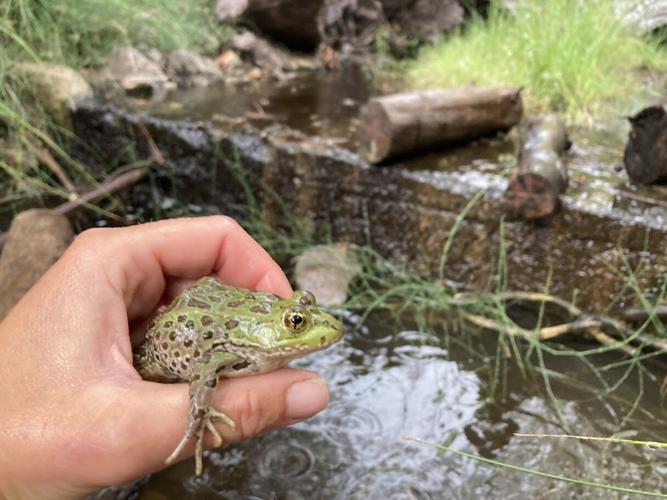
A recovery team member holds an adult Chiricahua leopard frog before its release at Chiricahua National Park on Sept. 15.
The release was led by staff members from the Arizona Game and Fish Department, in partnership with the Park Service, the U.S. Fish and Wildlife Service, the New Mexico Department of Wildlife and the Tucson Bird Alliance, a nonprofit conservation group.
People are also reading…
To hedge their bets, Hubbard said, they also set free a handful of adult frogs and froglets still showing signs of their tadpole tails.

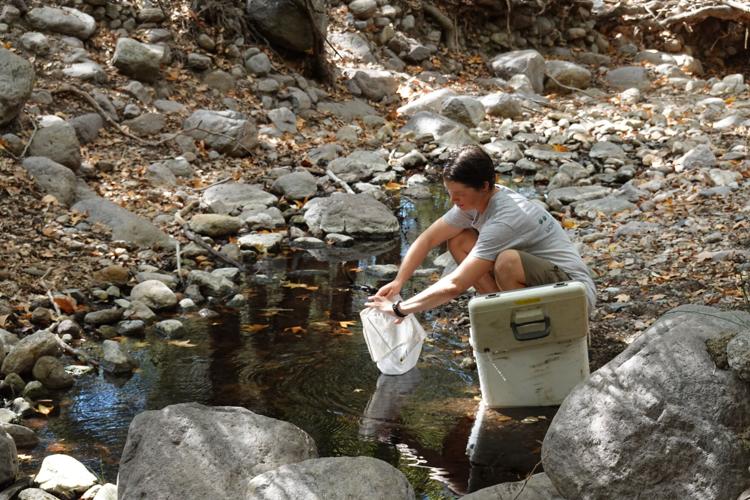
Aquatic biologist Kenzi Stemp from Tucson Bird Alliance counts tadpoles during the reintroduction of threatened Chiricahua leopard frog to Chiricahua National Park on Sept. 15.
Since then, members of the recovery team have made several return trips — most recently this past week — to check on the frogs at the 12,000-acre sky island park 120 miles southeast of Tucson.
“We were very concerned, with the (recent) hurricane and flooding that happened, particularly in Bonita Canyon, that maybe they got flushed out,” said Hubbard, who heads up the park service’s Sonoran Desert Network, a team of scientists that collects and analyzes ecological data from 11 national park sites in Arizona and New Mexico. “But things are looking good. We're hopeful.”
The recovery team was in the middle of one of its follow-up surveys on Oct. 20, when the park’s promotion became official and Interior Secretary Doug Burgum and Congressman Juan Ciscomani dropped by Chiricahua to celebrate.
Hubbard said he also attended the designation ceremony on his way out to help check on the frogs.
Another count will be conducted in the coming weeks.
To keep these new colonies going, Hubbard said, the team will likely need to keep releasing frogs at various stages of development, including eggs by the hundreds in jellylike masses.
“We anticipate it could take five years of continuing to put animals out and surveying … to make sure that these populations take, if you will,” he said.
'True frogs'
Chiricahua leopard frogs have bumpy green skin like an underripe avocado and dark spots that give them their feline name. They can grow to more than 5 inches long, making them one of the larger native frogs in the Southwest, Hubbard said.
He described their call as raspy and “pretty loud.”
“If you hear leopard frogs calling, you're hearing them in the middle of the monsoon. They're calling for a mate. They're telling everybody where their territory is,” Hubbard said. “That's the sound of the monsoon if you're in a spot where they are, which is not too many spots anymore.”
At one time, the species could be found along parts of the Mogollon Rim and in high-elevation marshes and streams across southeastern Arizona almost to central New Mexico. Hubbard said its decline can be traced to several factors — many of them linked, and linked to humans — including habitat loss, drought and the spread of invasive bullfrogs, viruses and fungal disease.
Like other species of “true frogs,” Hubbard said, Chiricahuas need to “always have their feet wet.”

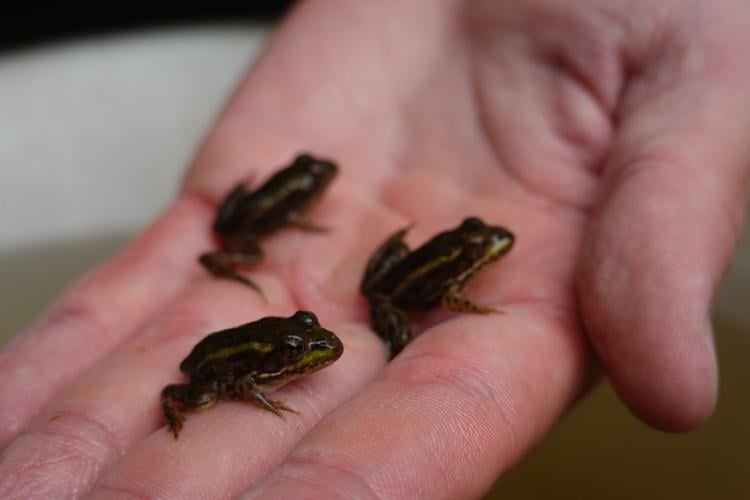
A recovery-team member holds three Chiricahua leopard froglets before they were released at Chiricahua National Park on Sept. 15.
“They need surface water year round,” he said. “They can obviously be out of water for short periods if they're hunting or if they're avoiding being preyed upon, but they really can't be out of the water for very long.”
It’s unclear how long the frogs had been gone from their namesake park, but Hubbard believes they died out sometime before 1979, when famed University of Arizona herpetologist Charles “Chuck” Lowe conducted a detailed survey of Chiricahua and Fort Bowie National Historic Site to the north but found no trace of them.
“They never entirely disappeared from the Chiricahuas. Certainly some leopard frogs existed on the east slope, like the Portal area and a few other locations,” Hubbard said. “But the major decline throughout the region, including the mountain ranges, starts in the 1970s and really accelerates in the 1980s.”
The frogs were listed as threatened under the Endangered Species Act in 2002. Efforts to save them have been going on for longer than that.
Since 1995, the Phoenix Zoo has bred, raised and released more than 29,000 Chiricahua leopard frog tadpoles, froglets and adults back into the wild, helping to increase the number of occupied sites in Arizona from 38 to a high of 155 over the past two decades, according to a 2022 journal paper by zoo researchers.
An informational video about the threatened Chiricahua leopard frog by the Phoenix Zoo, which has been breeding and raising the frogs since 1995.
Hubbard said the Phoenix Zoo has played a crucial role in bringing the species back from the brink, even pioneering a way to clear the tadpoles of fungal disease through controlled exposure to higher temperatures of water.
“They do some really cool stuff there. It's very impressive,” he said.
Interstate amphibians
The refrogging of Chiricahua National Park actually began in 2023 with a detailed inventory across the species’ historic range to confirm their current distribution and assess the conditions at potential release sites.
That meant looking for bullfrogs and sampling the water for genetic traces of them using state-of-the-art environmental DNA testing that can also detect the presence of deadly — to leopard frogs, anyway — chytrid fungus and ranaviruses.
The sites in Bonita and Rhyolite Canyons turned out to be “perfect, ready to go. We just had to show up with the animals,” Hubbard said.

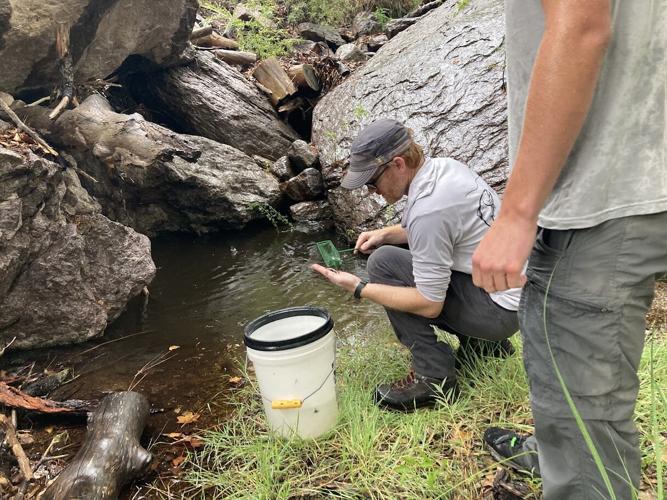
Ian Latella, Chiricahua leopard frog project leader for the Arizona Game and Fish Department, examines a net full of the threatened frogs during their Sept. 15 reintroduction to Chiricahua National Park.
First, though, came what he called “the compliance piece,” which basically involved making sure the work they were doing on behalf of one endangered species wouldn’t negatively impact another or disturb any natural or cultural resources in the area.
The final step was consultation with more than a dozen affiliated tribes with ties to the Chiricahuas.
“We wanted to make sure that our tribal partners were informed and had a chance to give us their thoughts and opinions on the approach,” Hubbard said. “There are a lot of tribes that have connections to these places. We want to be good neighbors, good partners and we want to be respectful.”
The tadpoles and frogs selected for release into the park came from genetic lineages that “have a connection to these sites,” he said.
About half of the specimens came from the American Museum of Natural History’s Southwestern Research Station on the eastern slope of the Chiricahuas, where tadpoles are hatched in indoor aquariums and frogs live in an old swimming pool on the property.
The other half were reared at Ladder Ranch, a 156,000-acre preserve in southwestern New Mexico set aside by the late media mogul Ted Turner.

A bucket of Chiricahua leopard frog tadpoles is released at Chiricahua National Park.
Hubbard said New Mexico Wildlife personnel met their counterparts from Arizona Game and Fish on the road between New Mexico and the Chiricahuas to hand off coolers filled with frogs and tadpoles from Ladder Ranch.
Once they reached the park, the release itself took less than an hour. It basically involved a few biologists emptying amphibians from buckets and nets at preselected locations, while park staff members and other interested parties stood nearby “watching the animals go back in,” Hubbard said.
Frog funding
The recent work on behalf of the frogs at Chiricahua and elsewhere has been funded with about $1.2 million from the Biden-era Inflation Reduction Act. Hubbard expects that money to also pay for a portion of the next phase of the recovery project: fixing up potential habitat at Chiricahua, Fort Bowie and Coronado National Memorial near Sierra Vista and releasing leopard frogs there as well.
“Working with Game and Fish, we identified another subset of sites that, with some restoration, would be suitable,” he said. “We're probably a couple years from that.”

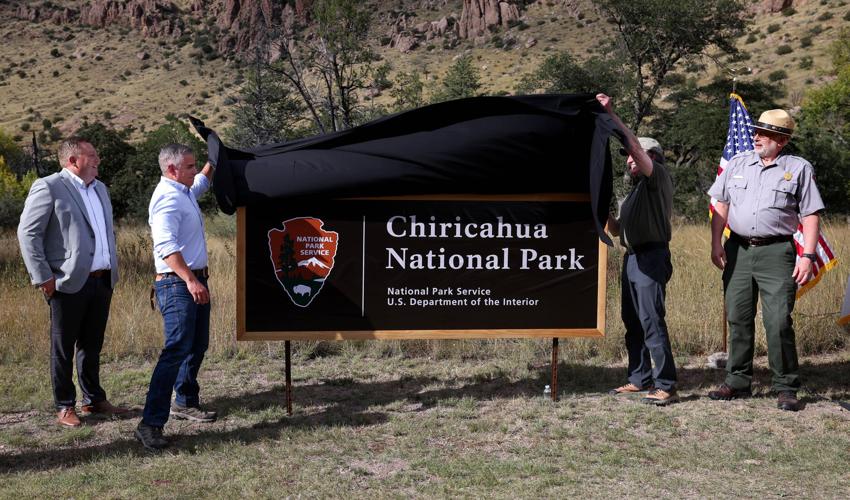
Rep. Juan Ciscomani, left, and Secretary of the Interior Doug Burgum unveil the first official signage for Chiricahua National Park on Oct. 20. President Donald Trump signed the Chiricahua National Park Act into law that day.
Some sites will require engineering work to make them amphibian-friendly and to firm up their water sources. Others will need a bullfrog hit squad, trained to wipe out what Hubbard described as highly resilient “super predators” that are not native to the Western U.S. and tend to eat “everything they can,” including their native cousins.
Whatever is done on behalf of the Chiricahua leopard frog will require continued monitoring and maintenance, as long as the primary threats to its survival remain.
“It may well be that we're always going to be in active management mode, where we're going to have to have some level of assistance to keep these animals viable across a whole landscape like this,” Hubbard said.
For the time being, the most dependable places to see these rare frogs are in controlled environments such as the Arizona-Sonora Desert Museum near Tucson or The Nature Conservancy’s Ramsey Canyon Preserve outside of Sierra Vista.
As for natural populations, the closest to Tucson are probably the ones in isolated springs on the east side of the Santa Rita Mountains and at Las Cienegas National Conservation Area near Sonoita.
Or now, if you’re lucky, you might just spot a Chiricahua leopard frog during your next visit to Arizona’s newest national park.
“This is one of the things I'm going to look back on at the end of my career and feel really good about. To be able to reintroduce a native species into its namesake park? I mean, that's your dream if you're a conservation biologist,” Hubbard said. “So, yeah, it feels great, and we're not stopping there.”