

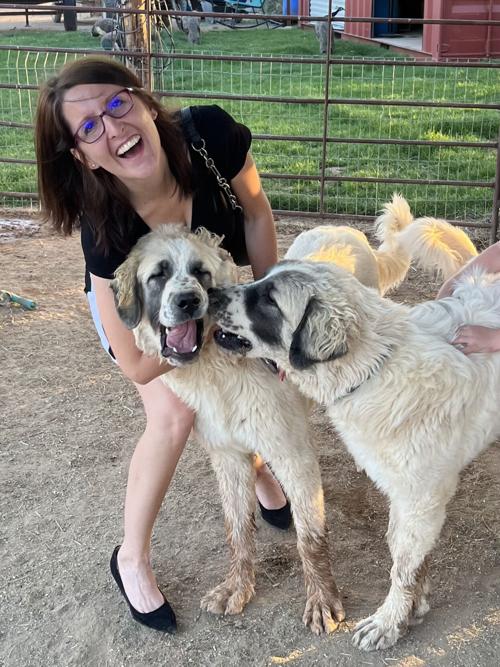
Hospitalized ICE detainee Andreea Marin has regained consciousness and begun breathing on her own, but she is not verbal and is still in critical condition, according to her family, who say they are "traumatized" by what's happened to Marin since she was found unconscious in her cell at Eloy Detention Center last month after an apparent suicide attempt.
Meanwhile, U.S. Immigration and Customs Enforcement has offered to release Marin from federal custody, according to Marin's brother, who fears her release from custody now could end up helping ICE avoid accountability for what happened to her.
Marin's brother arrived at Banner Desert Medical Center in Mesa Nov. 6 to find Marin thrashing in her hospital bed with her eyes open but "unfocused," as hospital staff restrained her to remove the feeding tube Marin had tried to rip out, her brother wrote in a message Thursday to the Arizona Daily Star.
People are also reading…
Marin was gagging on the tube, making sounds, vomiting and unable to communicate, said her brother, who has asked the Star not to publish his full name as he copes with his grief.
On Friday, Marin appeared more alert and seemed to respond to her name, her brother said. Though Marin's body successfully fought off the sepsis and pneumonia that doctors initially expected to be fatal, she has significant brain damage from going without oxygen for at least 10 minutes at Eloy, said her brother, a naturalized U.S. citizen.
"We're on this roller coaster," he told the Star in a Friday phone call. "We thought we'd lost her, and we don't know what to think anymore. We’re just taking it day by day. ... There’s a little hope there and we’re all hanging on to it."
Marin's family said they were told Marin tried to hang herself in her cell at Eloy Oct. 23, citing what doctors said they were told by ICE officials who transported her to the hospital the same day.
Marin's family said they still don't believe they're getting the full story about what happened to Marin, who had long struggled with bipolar disorder and post-traumatic stress disorder. They are demanding a full investigation.
The Star obtained the 911 call Eloy staff made in the minutes after Marin was found in her cell, through a public records request.
"I have a detainee hanging in one of the housing units, a female detainee," the Eloy staffer told the dispatcher in the 40-second call. "They're currently doing CPR on her."
Marin's family has retained Laura Belous, managing attorney at the nonprofit Florence Immigrant and Refugee Rights Project, to assist with preparing for an investigation to hold ICE accountable for the circumstances leading up to Marin's hospitalization.
"Andreea Marin's family is devastated by what happened to her and is demanding an independent investigation into her treatment while she was detained at Eloy Detention Center, as well as full accountability for anyone who may have contributed to medical neglect or mistreatment while she was detained," said Belous, part of the Florence Project's advocacy team, in an emailed statement Friday.
While Marin is no longer on a ventilator, her brother said doctors re-placed a feeding tube on Nov. 9, as she hadn't eaten in days.
Doctors want to transfer Marin to hospice care, her brother said, but the hospice won't accept Marin if she's still in federal custody.
Though ICE has now offered to release Marin on parole, the family is reluctant to agree to the release from ICE custody if that could allow ICE to avoid accountability for Marin's death, if it should happen, her brother said.
Over the summer, ICE rescinded a rule that required the agency to track and report deaths of detainees that occurred 30 days after their release from custody. Advocates say the rule existed to prevent the agency from releasing someone who was near death, in order to avoid counting their death as an in-custody death and conducting a full investigation.
"The release is not just mercy. It is also ICE stepping away from accountability," Marin's brother said Thursday.
ICE has not responded to the Star's Thursday request for comment.
Deaths in ICE custody have soared under President Donald Trump's second term, as ICE officials have largely stopped using their discretion to release people with a removal case pending in immigration court. The Trump administration has also sought to prevent immigration judges from granting release on bond.
Instead, ICE has detained tens of thousands more people, who are mostly held in for-profit detention centers like Eloy. More than 70% of people in ICE custody have no criminal convictions on their record, ICE data show.
While ICE handles medical care at Eloy through its healthcare arm, Eloy is operated by CoreCivic, a for-profit private prison company.
In a Nov. 4 earnings report, CoreCivic CEO Lucibeth Mayberry attributed increased third-quarter revenues to "increased demand for our services from U.S. Immigration and Customs Enforcement (ICE), including higher utilization of recently activated facilities."
Brother calls ICE actions 'disgusting'
Marin, who is from Romania and turned 39 on Nov. 14, was handcuffed to her hospital bed after she was airlifted from Eloy to a Mesa hospital Oct. 23. She was "chained" to the bed for four days, before her restraints were switched to plastic ones considered more humane, her brother said.
Marin's brother called ICE's treatment of Marin and his family "disgusting." ICE never notified the family that Marin had been hospitalized; it was hospital staff who tracked down her family, her brother told the Star last month.
He said the armed ICE officer guarding his unconscious sister tried to stop him from photographing her and tried to make him delete images from his phone, until hospital staff intervened.
"They did everything they could to get her off the grounds (of Eloy) alive and keep her identity hidden — with zero communication to her family," he said. "They wanted this family quiet. Instead, they tortured us at the hospital. The federal government, armed, breathing down your neck, yelling at you to put your phone away, otherwise you get kicked out, watching over your shoulder while you grieve for your loved one."
Marin, who spoke five languages and had a master's degree in education, spent years traveling and teaching English in France, before moving to the U.S. to be closer to her Arizona-based family members, who had immigrated from Romania years earlier.
Marin entered the U.S. legally through Phoenix Sky Harbor International Airport in 2022, according to ICE. An agency spokesperson claimed Marin's authorization to stay in the U.S. expired in March 2023.
Her brother said Marin was in the process of obtaining lawful permanent residency through her mother, also a naturalized U.S. citizen.
But during a manic episode in October 2025, Marin allegedly struck a corrections officer, resulting in an aggravated assault charge that was later dropped. The interaction with the judicial system led to her being detained by ICE in October 2026.
Marin was detained at Eloy Detention Center for 10 days before she was hospitalized. Her family had communicated to ICE that Marin's mental health was fragile and she needed her prescribed medication for bipolar disorder.
Marin's family said they felt dismissed by ICE officers and do not believe Marin was receiving the appropriate care.
ICE spokeswoman Yasmeen Pitts O'Keefe said in an Oct. 28 statement to the Star: "ICE provides safe, secure, and humane conditions for all individuals in custody, consistent with the Performance-Based National Detention Standards. ... Facility staff treat all detainees equally, respectfully, and with dignity."
Her brother said Marin's family is clinging to hope for Marin's condition to improve. But even in the best best-case scenario, all of their lives are "completely altered," he said. They've created a GoFundMe page to receive donations for Marin's ongoing care and legal expenses.
"She’s a fighter," her brother said Friday. "If she does pull through, she is bound for long-term disability."
Doctors said Marin's brain injury "goes deep into her thalamus," her brother said.
"The rest of her brain can fire neurons, but once the signals reach her thalamus, they dissipate, because it is damaged," he wrote to the Star. "She may still die. ... No one can tell us."
Her brother said he "locked eyes" with Marin soon after doctors restrained her on the day she woke up, Nov. 6, which was his birthday.
"It felt like we looked into each other's souls — except I could not feel her presence in her eyes, the presence I have known my whole life," he said. "I held her hands, massaged her arms, ran my hand through her hair, so that in whatever capacity she can feel anything, she might feel comfort."
Contact reporter Emily Bregel at ebregel@tucson.com. On X, formerly Twitter: @EmilyBregel

Emily Bregel
Border reporter


