Tucson Water and other cities and tribes that take Central Arizona Project water will be spared deep cuts in their supplies — at least for now — if the U.S. government approves a two-year water-saving plan for the entire Lower Colorado River Basin, officials say.
Cities and tribes that take CAP water will face cuts of 14% and 10%, respectively, in 2027 and 2028 under the proposed Lower Basin plan that's now pending before the federal government, officials said at a public meeting held Tuesday in Phoenix. Those cuts are much lower than the U.S. Bureau of Reclamation has been proposing.
Arizona Department of Water Resources Director Tom Buschatzke presented the plan's details and fielded questions from the audience about it.
Cuts on that scale would mean Tucson Water customers inside and outside city limits would not have to take any actual reductions in their water use. That's because those customers already use significantly less CAP water than the city gets every year.
People are also reading…

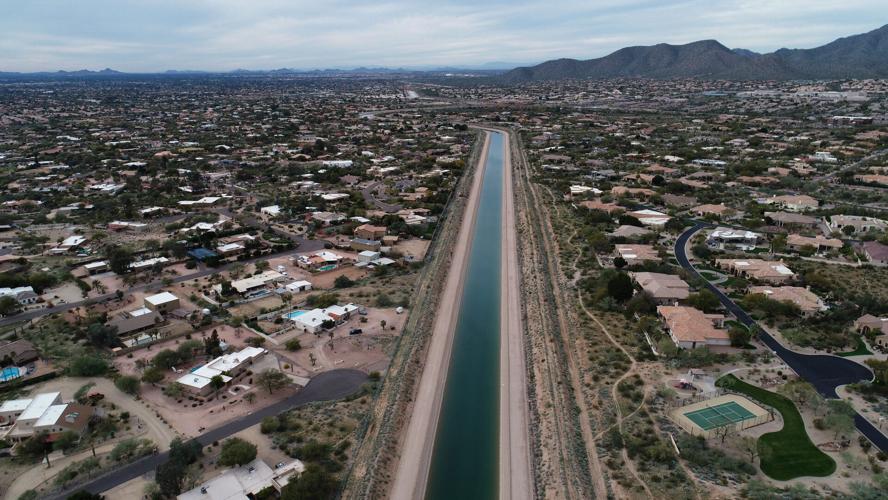
The Central Arizona Project Canal runs through Scottsdale, carrying Colorado River water. The CAP canal also brings water to Tucson for drinking.
But it's possible those cuts could go deeper or be more widespread across the Lower Basin states of Arizona, California and Nevada, because the three states are trying to find additional conservation measures.
A key Republican legislator and an Arizona State University water researcher both say they're concerned the cuts now proposed by the plan may not be adequate due to increasingly arid conditions along the Colorado River. A Tucson Water official and another water expert said they support the proposal, however.
The Lower Basin proposal calls for cuts in water use by all three Lower Basin states in 2027 and 2028.
The proposal would commit the three states to conserving a total of about 1.5 million acre-feet of water a year for those two years. The 1.5 million acre-feet matches what the CAP is legally allowed to take from the river every year, although in recent years it's used much less.
Beyond that, the three states are trying to find ways to conserve another 700,000 acre-feet a year between them, with Arizona and California splitting 600,000 acre-feet and Nevada conserving the rest. If the states do agree to save that much, that could add to the cuts that need to be taken by CAP or require cuts from water users along the river, including possibly Yuma-area farmers.
The Lower Basin states' plan comes as the U.S. Bureau of Reclamation prepares to make a decision on a broader plan covering river water use in the entire seven-state Colorado River Basin. The bureau originally wanted to approve a 20-year plan, but now it's looking more closely at approving a 10-year plan that would be renegotiated every two years, to take into account the river's rapidly changing conditions.
Over time, it wants the Lower Basin to cut up to 3 million acre-feet a year. The bureau is expected to release a final environmental impact statement for its plan by the end of July and issue a final decision by the end of the summer, Arizona Department of Water Resources officials said at Tuesday's meeting.

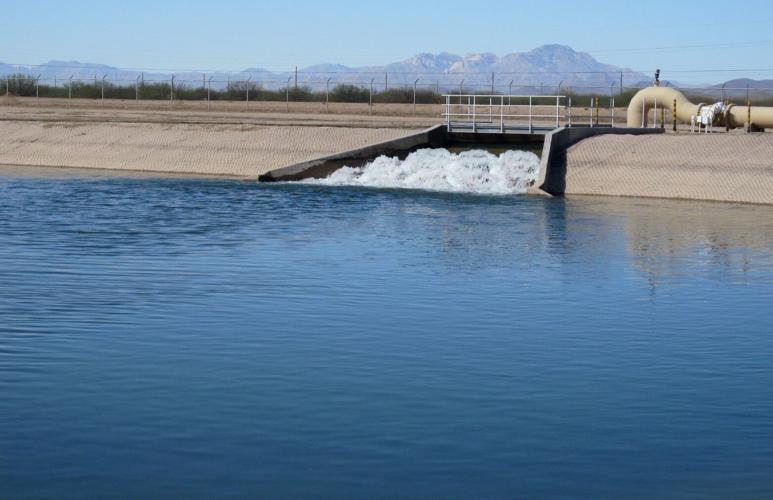
One of the nine Central Arizona Project water recharge basins located at Tucson Water's 226-acre Southern Avra Valley Recovery Project site. The photo shows the Colorado River water being delivered into the basin in 2013 to be recharged into the aquifer.
As the plan originally stood, CAP would have had to cut its deliveries to the cities and tribes by 20% and 16%, respectively, CAP Assistant General Manager Patrick Dent said at the meeting. The project delivers drinking water from the Colorado River via canals and pipelines to cities and farms in the Tucson and Phoenix areas and in Pinal County.
But CAP was able to reduce the scale of the cuts because it recently found it could get access to some extra water from wells in the Yuma area and from Lake Pleasant, a water storage reservoir north of the Phoenix area, Dent said.
Either the lower or higher range of the cuts proposed by this plan would hurt Arizona and the CAP far less than several proposals put forth by the U.S. Bureau of Reclamation early this year. Those proposals, found in the bureau's draft environmental impact statement on the river, would have slashed CAP deliveries by 77% or more, with one proposal for a cut of 98%.
Such cuts would have devastating impacts on Arizona's water supply and its economy, costing the state trillions of dollars in economic benefits and millions of jobs by 2060, CAP officials said at the time they were released — adding they would "flatten" Arizona's economy.
But now, as far as Tucson is concerned, neither a 20% cut nor a 14% cut in CAP deliveries will reduce residents' access to the project's Colorado River water, Tucson Water officials told the Star.
Today, the residents and businesses lying within Tucson Water's service area are using a little less than 100,000 acre-feet of water a year. The city annually received 144,191 acre-feet in CAP water, which it recharges into the ground and pumps out later for people's use. A 14% cut would take the city's supply down to 124,000 acre-feet a year, while a 20% cut would lower the supply to 116,000 acre-feet.
But state Sen. Tim Dunn, a Yuma Republican, said he's concerned the Lower Basin proposal may not conserve enough water over two years, given the poor state of the river today.
The Colorado's flows are now running at least 20% below their 20th-century average at this time. Lake Mead and Lake Powell have fallen far enough that they're both getting close to levels at which the dams that created them — Glen Canyon Dam and Hoover Dam — won't be able to generate electricity or will have significantly reduced generation sometime next year.
"The Lower Basin plan is a good attempt to keep everybody at the table," said Dunn, vice chair of the Arizona Senate Natural Resources Committee. "But if next year’s hydrology (on the river) is as bad as this year, we need a 2.5 million acre-feet a year cut," Dunn added.
He also criticized the proposal for planning to allow the three Lower Basin states to withdraw more water each year from Lake Mead than they do now under a program that lets states store some water in the imperiled lake and withdraw it later under certain restrictions. The program is called Intentionally Created Surplus, or ICS for short.
He said the proposal should be focused on saving "wet water" instead of the ICS savings that can be removed, although he acknowledged that the program is needed "to keep California at the table" in the river negotiations because that state makes more extensive use of the ICS program than Arizona does.
But Dunn also says Congress shold pass another, broad budget bill to include money to compensate water users in the Lower Basin who voluntarily agree to save water.
Federal funds provided by the 1922 Inflation Reduction Act is being used this year for conservation purposes, and "this (extra money) would be to achieve the needed 1 million acre-feet for an additional several years, to stabilize the system," Dunn said.
Sarah Porter, an Arizona State University water researcher, said, "There’s no question that there is a risk that if the next couple of years are bad, that even with these cuts the system will still crash. Even if they are mediocre years, the system could still crash.
"If next year is very good, it just buys us a year or two. To have a string of very good years is very unusual," said Porter, director of ASU's Kyl Center for Water Policy.
Her preference would be for the state to push cities to adapt to having less river water than they have now, she added. "We don’t have a reason to think the Colorado River will be a reliable supply for central Arizona for the long term."
University of Arizona water researcher Sharon Megdal agreed with Porter and Dunn that more conservation should be pt into the Lower Basin plan.
"The water levels look so bad, is what was presented on Tuesday sufficient?" asked Megdal, director of UA's Water Resources Research Center. "We do have to be prepared for deeper cuts and how those cuts are identified or assigned, that’s a big question. Given the magnitude of water use in the Yuma area, I think there would have to be some reduction on their part.;
But longtime water expert and activist David Wegner said the Lower Basin proposal offers a framework for what he believes is the only step forward for the region, given the ongoing pressures to cut water use across the river basin and the lack of a full, seven-state agreement to curb water use.
"What Tom Buschatzke presented Tuesday was a good set of both the challenges that are being faced and options that the state can take to live within" what the federal government is likely to approve for the river, said Wegner, a retired Bureau of Reclamation official. "It was an appropriate set of options based on what tools Arizona has in its toolbox right now."
"Will we have to make changes in the plan if the hydrology goes south? You bet," he said.
Tucson Water supports this proposal as it now stands, said its attorney Chris Avery.
"We think it’s unlikely the Lower Basin would have been able to negotiate a better deal with the Upper Basin," said Avery, referring to the four Upper Basin states of Colorado, New Mexico, Utah and Wyoming. "We think those who negotiated this plan did a good job representing Lower Basin interests."
Asked if he thought the cuts outlined in the Lower Basin proposal will be enough, he said, "It’s enough of a contribution from the Lower Basin. I think the Lower Basin contributions to the river need to be matched by the Upper Basin. So far, the Upper Basin hasn't done that."
ADWR declined to respond to Porter's or Dunn's concerns about the Lower Basin plan.
But at Tuesday's public meeting, ADWR director Buschatzke said, "We are facing huge challenges, with potential reductions in Colorado River supplies. There's a large degree of uncertainty going forward through the end of 2028," under Reclamation's potential preferred plan for a 10-year conservation program that's renegotiated every two years.
Despite that uncertainty, "It is time for us to come together and take advantage of the resources we have," including the state's Water Banking Authority, which has recharged CAP water into the aquifer across Central and Southern Arizona for use later, he said.
Asked by an audience member what he thought the chances are that Reclamation will approve the Lower Basin proposal, Buschatzke said, "We're getting closer and closer to that adoption. We know the Upper Basin states had some heartburn about the plan. We're trying to work through that with the federal government.
"Based on a (recent) meeting I had with the Lower Basin states and the federal team, I think we're getting closer to that adoption. I can’t say at this time it will be adopted in a form that is acceptable to us," said Buschatzke, Arizona's chief negotiator on Colorado River issues.
When asked by the Star to confirm Buschatzke's comments about the status of the Lower Basin plan, a Reclamation spokesman was noncommittal.
Since receiving the Lower Basin states' proposal on May 1, the Interior Department and Reclamation "have been working with the Lower Basin States to better understand the proposal and provide feedback. In addition, Reclamation has received input from the Upper Basin States regarding the proposal," the spokesman said in an email.
"As part of this ongoing process, the Department and Reclamation have provided several adjustments to the proposal," the spokesman wrote. "The Department of the Interior and Bureau of Reclamation remain committed to a continued dialogue and interaction with the Lower Basin States, the Upper Basin States and Tribal Nations."
Contact Tony Davis at 520-349-0350 or tdavis@tucson.com. Follow Davis on Twitter@tonydavis987.

Tony Davis
Reporter



 'Zero flow' recorded at key spot on Arizona's drying San Pedro River