Rep. Juan Ciscomani is making a strong pitch these days about his performance: He’s the most bipartisan, aisle-crossing, effective member of Congress from Arizona. He’s even been courageous.
That’s what he says, in a new ad, in the recent debate, on his website, and every chance he and his supporters can. The bipartisanship claim is backed up by independent rankings that measure things like bills he’s sponsored and the rhetoric he’s used.
As a person who’s known and watched Ciscomani for a long time, especially this term as my congressman under President Trump, I find those rankings intriguing but misleading.
People are also reading…
That’s because when it has mattered most, Ciscomani has fallen in line with Trump, supporting his most consequential and damaging policies. Even when other Republicans dared to break ranks on key issues, Ciscomani toed the Trump line.
Arizona Daily Star columnist Tim Steller
On the One Big Beautiful Bill Act, on tariffs and on the war in Iran — votes that have defined the last two years — Ciscomani even raised concerns at times, but in the end voted with Trump anyway.
He would have you believe he has been courageous in his dealings with the president, who is now extremely unpopular and considered a liability to Republican candidates.

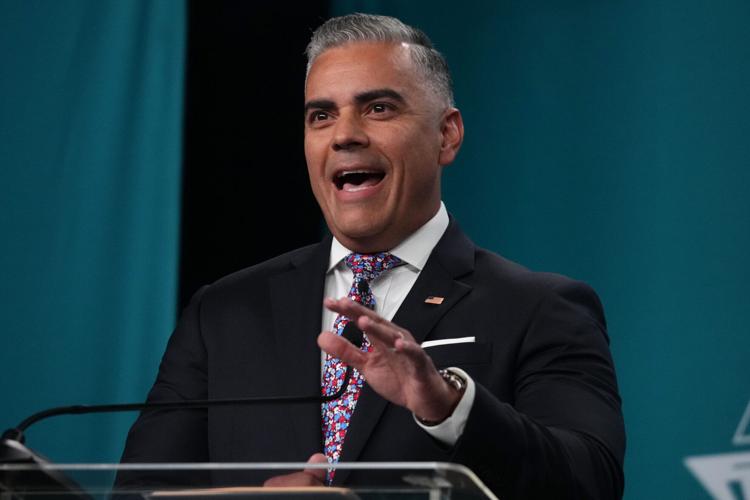
Incumbent Republican Juan Ciscomani at his recent debate with Democratic challenger JoAnna Mendoza.
“I was part of a handful of Republicans who voted to override the president’s veto,” Ciscomani said during his Sept. 11 debate with Democratic opponent JoAnna Mendoza. “That takes some courage to be able to do that and stand up to your party.”
But what was that vote about? Ciscomani was one of 35 Republicans who voted to override a presidential veto of a bill funding a water pipeline in southeastern Colorado, a veto apparently motivated by Trump's unhappiness with the imprisonment of an election official there, Tina Peters.
Anyway, the override failed. But the episode served as a good example of Ciscomani’s bipartisanship: Brave when it didn’t matter as much, timid when it did.
Examining the rankings
Let’s give these bipartisanship and effectiveness measures their due, though.
One of the rankings Ciscomani’s campaign touts is by a group called Bridge Grades. They gave Ciscomani a 98 out of 100 — a strong A — for bipartisanship.
That group uses five measures to rank “bridgers,” like Ciscomani, and “dividers” who are the more partisan members. Ciscomani’s strong grade comes especially thanks to a record of introducing bills with Democratic sponsors and of publicly discussing bipartisanship.
Contrast that with Rep. Andy Biggs, the Republican nominee for governor. Bridge Grades gives him an F grade of 8.4 out of 100, dinging him especially for rarely participating in cross-partisan bills and for engaging in personal attacks.
The Lugar Center also has a ranking of bipartisanship among members of Congress, although the most recent data is from the 2023 session. It shows Ciscomani as the highest ranking among Arizona’s nine-member House delegation.
This ranking is based on how frequently a member sponsors a bill introduced by a member of the other party, or receives co-sponsorships of their own bills by a member of the other party.
Ciscomani also received the highest ranking among Arizona’s delegation for effectiveness. This is a different measure, designed by the Center for Effective Lawmaking at the University of Virginia and Vanderbilt University, which takes in the number of bills a member introduces, how substantive they are, and how far they advance.
To show how hard it is to get anywhere in Congress, Ciscomani achieved the 13th highest among all Republicans despite having only one bill become law.
So, Ciscomani achieves his bipartisanship ranking largely by co-sponsoring Democrats’ bills or getting them to co-sponsor his, and his effectiveness laurels by advancing bills that by and large didn’t become law. Good but perhaps not that consequential in an era such as Trump’s second term.
The most important issues

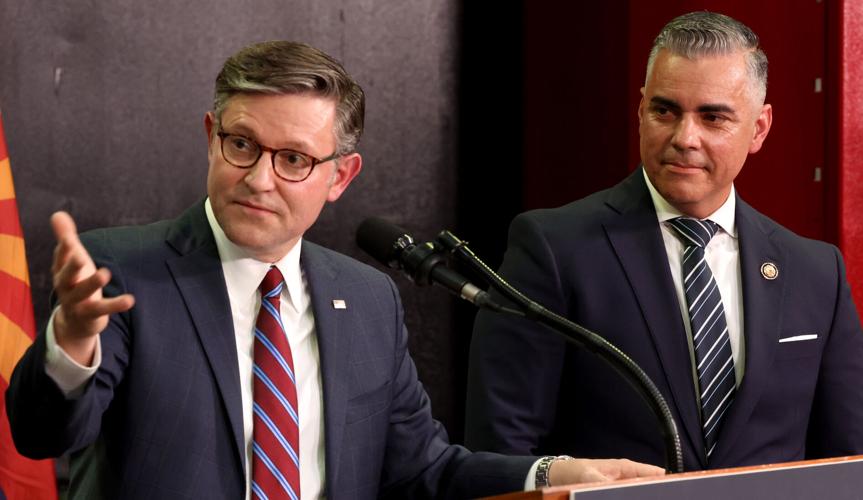
In this August file photo, Speaker of the House Mike Johnson, left, gestures while answering a question form the media as Congressman Juan Ciscoman, R-CD6, stands nearby at an event in Casa Grande.
What has been consequential are his votes on the key issues of the last two years.
— One Big Beautiful Bill Act (HR 1)
In the months before the One Big Beautiful Bill Act passed, Ciscomani penned letters demanding that Medicaid be protected. When it wasn’t, and the bill included more than $900 billion in cuts over 20 years (beginning after this November's election), he voted for it anyway. The bill passed the House by one vote, 215-214.
The bill also imposed new paperwork requirements and changes in eligibility for food-aid recipients in the SNAP program. The result: About 461,000 Arizonans, including 180,000 children, have lost food assistance since the bill was signed into law, largely because the new procedures are too onerous, and because the bill penalizes states for enrolling ineligible people, but not for failing to enroll eligible people, so they err on the side of saying no.
The mammoth bill carried many of the Trump administration’s top priorities, including vast new spending on immigration detention and enforcement. That $170 billion in new spending brought us fewer illegal crossings on the Mexican border, but also the many ICE surges, the killings of American protesters, and unconstitutional detentions and deportations to third countries.
With all these big downsides, you would think it at least helped cut the deficit, an issue Ciscomani has claimed as a top priority. But no, it is projected to add $4.2 trillion to the national debt by 2034.
— Tariff support
President Trump’s tariffs, imposed unilaterally by him until the Supreme Court struck them down, have been the cornerstone of his economic policy. I would not have expected Ciscomani, a business Republican by nature, to support heavy-handed market interventions like this, but he adapted quickly after Trump’s early tariffs on Canada and Mexico.
“While tariffs may not be anyone’s first choice, we have a duty to prioritize public safety, and President Trump is using every tool at his disposal to do so,” Ciscomani obsequiously intoned in a statement in February 2025.
The Constitution clearly gives Congress the power to levy tariffs, not the president, but past Congresses have transferred some of that power to the president. As the Trump term became an orgy of tariffs, some Republicans became uncomfortable either with the tool used or the power taken from Congress.
In February this year, six Republicans joined Democrats and voted to rescind tariffs on Canada. Ciscomani was not one of them. In fact, Democrats say he has voted nine times to support Trump’s tariffs, although some of those votes were on symbolic motions.
The explanation may lie in a statement Trump posted at the time: “Any Republican, in the House or the Senate, that votes against TARIFFS will seriously suffer the consequences come Election time, and that includes Primaries.”
— Iran War
From the beginning, Ciscomani has been an enthusiastic supporter of the Iran War and continues to defend it even as Americans’ support has dwindled. He has repeatedly memory-holed, as he did during the Sept. 11 debate, the fact that the United States, Iran and other world powers came to a deal for limiting and monitoring Iran’s nuclear program in 2015 and that Trump withdrew from it in 2018.
“Iran cannot have nuclear weapons,” he said at the debate. “Every president before this president has known that, and nobody has done anything about it.”
This, of course, is not true, and the current war is showing why a patient, arduous negotiation was the right path to choose.
Ciscomani said in May that the conflict “is very close to being over.” But as Americans have grown restive over the war, Ciscomani has stuck with it. When it’s come up for a vote in the House, he has voted repeatedly against bills aiming to end the war, most recently on Sept. 15. That day, seven Republicans voted for the bill aiming to end the war, but Ciscomani didn’t.
Not when it mattered most
Co-sponsoring a Democrat’s bill, or getting a Democrat to co-sponsor your own bill as a Republican — those are good things and something of a tradition in the district Ciscomani represents. It’s more or less the same district represented by Republican Jim Kolbe and Democrat Gabrielle Giffords after all.
Our House members should be working with the other party to get important things done. It’s also good to vote to override a veto of a necessary water-infrastructure bill threatened by a petty presidential tantrum.
But none of that requires much risk-taking or courage. When courage was required to represent the district well and resist Trump’s worst policy excesses, Ciscomani didn’t have it.
Contact columnist Tim Steller at tsteller@tucson.com or 520-807-7789. On Bluesky: @timsteller.bsky.social

Tim Steller
Columnist


 Tim Steller’s column: Air Force, not golf course, should solve Tucson water pollution