Make this make sense.
The U.S. Air Force polluted Tucson’s groundwater with PFAS chemicals that are gradually spreading north underground into midtown, forcing us to shut down wells.
The Air Force ranks Tucson as a low priority among the places it has polluted with PFAS because we’re not currently drinking the stuff.
Arizona Daily Star columnist Tim Steller
We have sued the Air Force and 3M, the maker of the chemicals, over the pollution, but have gotten nowhere so far.
The only immediate solution presenting itself is to allow a developer to build a golf course complex on the condition that the developer cleans up the PFAS.
People are also reading…
Have I got that right?
This, as my colleague Tony Davis has ably reported over the last week, is a very unusual deal, certainly not one that we should rush into. It apparently began emerging during a private meeting on Sept. 11 and is part of the council’s agenda for the Sept. 22 meeting.
The deal is by no means done — it’s just in the early discussion stage. And there’s no harm in entering talks with the developer, Warbird National Course. But the fact that we’re even considering it shows how uncertain Tucson’s water position is becoming as the Southwest’s hotter climate becomes a long-term reality.
Tucson has relied on Colorado River water, brought to us via the Central Arizona Project canals from Lake Mead, since the early 2010s. That has allowed us to move away from pumping the groundwater that sustained us for decades, and to bank water for the future in Avra Valley.
But now, the hotter climate — powered by the greenhouse gases humanity is pumping into the atmosphere — has reduced the snowpack so much that there’s not enough water to go around. So we’re taking a much reduced supply of Colorado River water and even plan to tap into our banked river water next year.
At the same time, the creeping PFAS is gradually forcing Tucson Water to shut down wells in its central well field. So we’re being squeezed by reduced Colorado River supplies and also by Air Force groundwater pollution, along with its system that punishes responsible water utilities.
“Tucson’s efforts to protect its customers from PFAS are not recognized by the Air Force’s current PFAS policy,” city officials told me in written answers to questions. “Water utilities like Tucson Water, which have taken measures to not serve PFAS in drinking water to their customers, are placed at a lower priority than communities that are serving PFAS compounds to their customers.”
No wonder City Manager Tim Thomure told the council the area’s long-term water supply “is in significant danger” if we don’t get the PFAS cleaned up.
Idea is a destination golf course
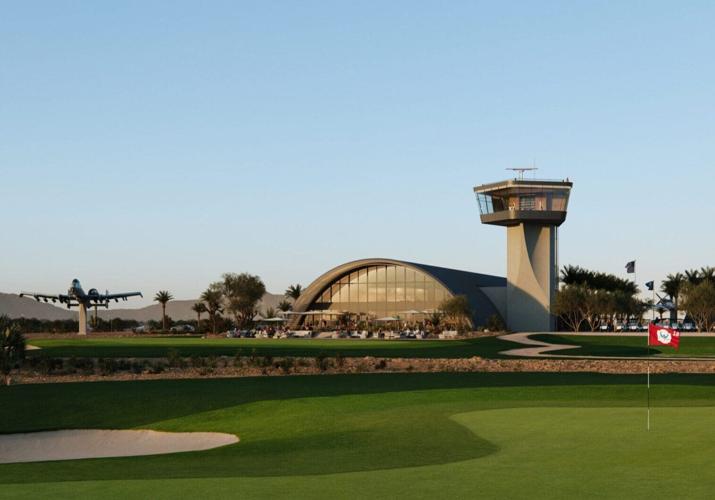
The golf complex idea has its attractions. The idea is that it would be a destination course, on east Irvington Road east of the boneyard, featuring displays of Air Force jets at each tee box.
A B-1 bomber, for example, might be displayed at the first tee box; an A-10 at the 10th, and so on, said Jay Hedley, who is spearheading the project. He is a former A-10 pilot once stationed at Davis-Monthan.
The course would be designed by Rees Jones, a famed designer, and initially operated by Troon, he said. It would attract people from around the country but also have times reserved for people stationed at the base. It would also have a STEM-focused “Center for Learning and Winning” for airmen and their families.
In that sense, the idea is a throwback to when Tucson was more of a golfing destination than it is now. From its peak of 33 golf courses, Tucson is down six to 27, Star columnist Greg Hansen reported in August.
Among those that closed was the Blanchard course on the Air Force base, in 2018. In a sense, this course could be viewed as replacing that one, which closed in part due to a decrease in use.
“It’s way more than a golf course. We’re replacing a golf course. This model is designed to bring a lot of money to the city of Tucson,” Hedley said.

Rendering of an A-10 Warthog, the 10th tee and the 18th green, with the Center for Learning and Winning that would be built at Davis-Monthan under a proposal from the nonprofit group Warbird National. Tucson's city manager says the city won't approve the golf course unless private and/or federal money is raised to clean up PFAS compounds in groundwater under the base.
Doesn't make much sense
But, when you think about it, it doesn’t make much sense to build a golf course as a solution to our water problem. Golf courses, of course, use a lot of water, and the cost and difficulty of obtaining water is one of the reasons courses have been closing.
The way Hedley envisions the deal, his group would pay to clean up the water and then get access to it, though the project would probably not use all the water. Some could go to the city’s nearby Fred Enke golf course, for example, or other agreed-upon destinations.
Over decades, the plume of contaminated water would gradually be cleaned up, and closed city wells could come back into use.
The deal can also be viewed as a bit of leverage the city has to encourage action by the Air Force.
“The City has largely exhausted any options to force the Air Force to remedy PFAS contamination at the site,” officials said in their written answers. “However, if a partner (like Warbird) brings solutions to the table, we are hopeful that the Air Force will engage on a remedy sooner.”
On Monday, the Air Force dashed a little cold water on the Warbird proposal, emphasizing in a reply to questions from the Star that it was an “unsolicited” proposal that would have to go through federal processes.
“Davis-Monthan’s PFAS remediation efforts are entirely independent of the unsolicited proposal from Warbird National,” the statement said.
But that’s an annoying response from the Air Force, because at least Warbird is proposing to do something about PFAS in the short term. The Air Force, by contrast, has us so low on the priority list that it could take many years for them to start cleaning up the groundwater that we need access to soon, as Colorado River supplies dwindle.
What do we have to do to make those responsible for our groundwater contamination do something about it? We have to start drinking the water they polluted, apparently.
Contact columnist Tim Steller at tsteller@tucson.com or 520-807-7789. On Bluesky: @timsteller.bsky.social

Tim Steller
Columnist


 Tim Steller’s column: Council overreacts on Tucson park name rejection