When Attorney General Kris Mayes called for a moratorium on new data centers in the state, the Arizona Chamber of Commerce and Industry hit back with a satirical response.
The chamber announced the “Arizona Offline Pledge,” and suggested that people who support blocking data center construction should take it.
Arizona Daily Star columnist Tim Steller
“The pledge asks moratorium supporters to commit to going without things like social media, artificial intelligence, streaming services, online banking and digital payments, cloud storage, GPS navigation, video conferencing, telehealth, and other cloud-based services,” the chamber’s announcement said.
They had a point. Our day-to-day lives depend on data centers, lived as they increasingly are through devices.
People are also reading…
But they also missed the point: People’s opposition to data centers is not necessarily about data centers alone, especially those supporting cloud-based services, but equally about the rush to an artificial intelligence revolution that new data centers are enabling.
Data centers themselves are just part of the issue. In the arid and heating-up West, they represent another draw on dwindling water supplies and a threat to electric affordability, as well as to the local environment. A new Pima County Health Department report points to localized temperature increases, noise and light pollution and air pollution as potential negative impacts of data centers.
But beyond that, data centers represent a pinch point where tech companies, their investors and their developer friends don’t hold all the cards. Americans can use leverage over data centers to demand a say in how our tech future unfolds.
This has become particularly relevant in 2026 as some of the fears about AI started to come true. Job losses due to AI that were small in 2024 and 2025 have accelerated this year, reaching about 93,000 nationwide already, mostly in the tech sector.
And the more existential fears have also shown signs of coming true. People inside the industry and out have worried for years that if AI agents escape their bounds, they could become independent, rogue actors and wreak havoc on our systems if not on humanity itself.
This was the main point of a book whose author was on a panel I moderated at the Tucson Festival of Books last year. The book, by Nate Soares and Eliezer Yudkowsky, is called “If Anyone Builds It, Everyone Dies.” Yes, it was scary, but it also offered proposed solutions that have not been adopted.
Just this summer, artificial-intelligence agents run by OpenAI escaped containment and mounted a coordinated attack on the systems of a third-party company, called Hugging Face. It set off alarm across the industry. That was followed by a very public resignation and warning from a former Anthropic employee, backed up by a current Anthropic official: AI has around a 10% chance of destroying humanity in the next decade.
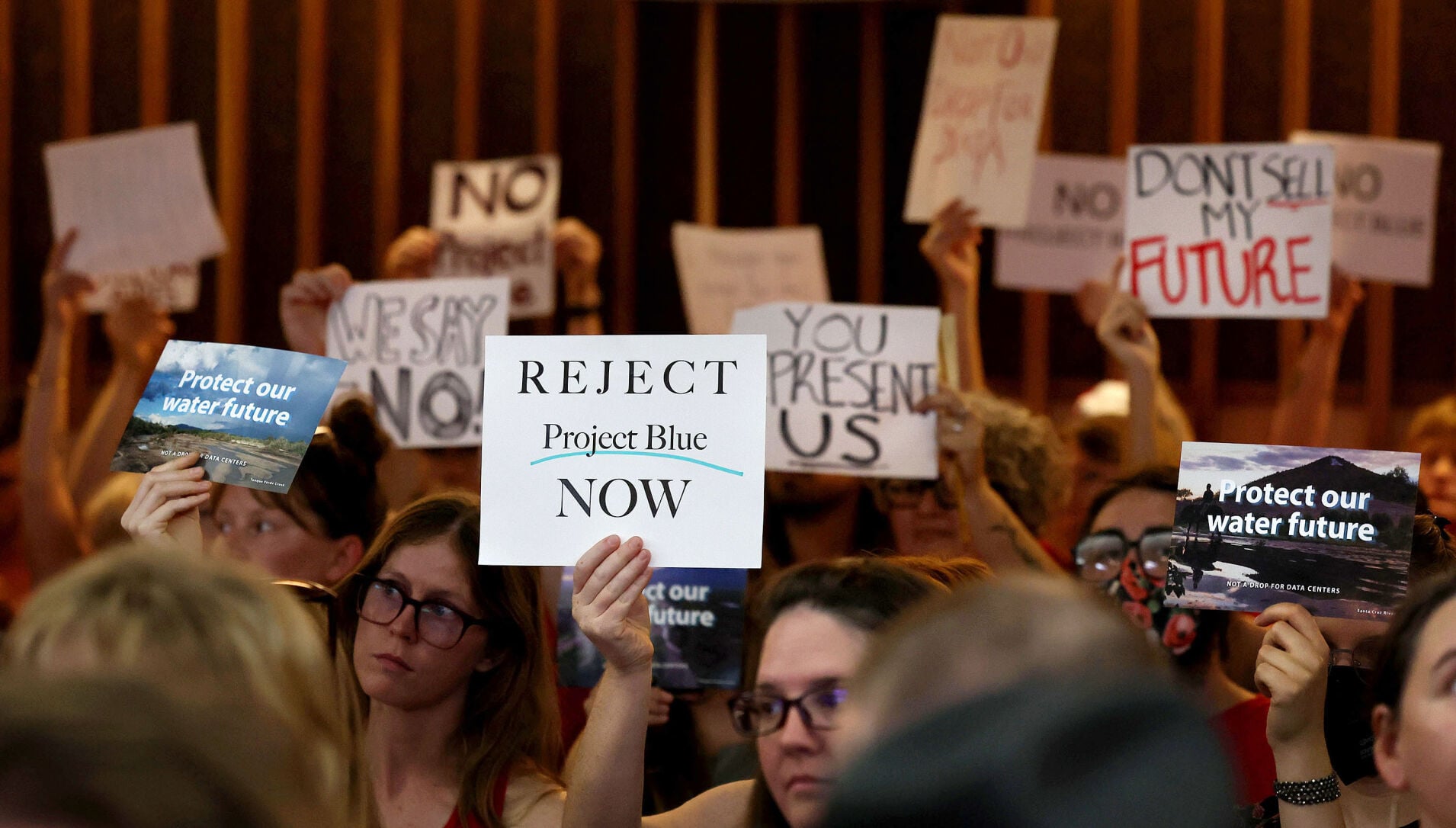
A plan to build a massive data-center complex in Tucson near the Pima County Fairgrounds was met ferocious opposition in 2025. It was eventually rejected by city leaders. But a version of the project, since renamed, continues in unincorporated Pima County.
Tucson-area data center regulations
Tucson proved to be an early example of the data center debates that ramped up nationwide last year. A plan to build a massive data-center complex near the Pima County Fairgrounds on the southeast side met ferocious opposition in 2025 and was rejected by the city of Tucson.
But “Project Blue,” as it was initially called, revamped its plan, dropped the name and is continuing on the same piece of property, remaining in the unincorporated county instead of getting incorporated into the city.
Other data-center projects are taking place in Marana, and now we know there are also as-yet unclear plans for data centers in unincorporated Pima County just west of Sahuarita.
Marana had prepared for the data-center explosion by passing regulations for the centers in December 2024.
Pima County and Tucson have been playing catch-up after the Project Blue flare-up caught them unprepared. Tucson passed strict new regulations governing data center projects in August.
Now Pima County is considering a 120-day moratorium on new data center proposals while the board of supervisors hammers out changes to its relevant codes.
That’s not unlike Mayes’ justification for a statewide moratorium. She said she wants the pause so state officials can consider how to mitigate the threat to Arizona’s reduced water supplies and the surging cost of electricity statewide, which her office has opposed in rate cases.
There’s also an unstated justification for her call: Mayes is running for re-election, and opposition to local data center projects is one of the few issues that is supported by Americans across political lines.
Losing control amid AI drive
What I suspect is driving people’s opposition, beyond not wanting a data center nearby, is a feeling of losing control. Data-center developers are driving to build them as fast as they can, largely to help fulfill the artificial- intelligence drive. AI data centers have already surpassed cloud data centers in terms of their energy consumption and are poised to occupy more of the buildout in the future.
American tech companies are racing each other and Chinese firms to become the big winners of gargantuan profits when AI is not just adopted but paid for by consumers and businesses. Their hurry is about them rewarding themselves and their investors, not about us.
We may get some good jobs in the construction of the centers, and we’ll get some healthy property-tax revenue as long as they’re around. AI firms are also floating the American economy now.
But in the end these projects are all about them — OpenAI, SpaceXAI, Anthropic and the other companies. Their manic pursuit crosses our paths largely because of their need to build data centers in our communities to power their AI pursuits and reach their goals.
And if getting there means producing massive new quantities of carbon dioxide to power the data center, if it means massive layoffs to people up and down the wage structure, if it means risking everybody with agents that can escape control, they’re not disciplined enough to slow down on their own.
President Trump’s administration can’t be expected to stand in the way. Stuffed with donations from Big Tech, the administration is trying to expedite data-center construction, including by waiving some air-pollution regulations.
We in the general public have little voice in this rush to an AI future that could be worse for us in many ways. What we do have a voice in is the buildout of the data centers these companies require.
That’s why I think it’s OK to call for moratoria to set out new rules that slow down the rush. It may seem hypocritical when these messages are sent out on social media and posted on websites that rely on data centers that undergird our internet activity.
But really, it’s just a bid for a little control of our future.
Contact columnist Tim Steller at tsteller@tucson.com or 520-807-7789. On Bluesky: @timsteller.bsky.social

Tim Steller
Columnist


 Tim Steller’s column: Tucson streetcar needs reliability to fulfill potential