A year ago, staff cuts by the Trump administration forced the National Weather Service in Tucson to shuffle the schedule for its daily weather balloon launches.
Now the balloons have stopped flying altogether, at least in part because of global supply-chain issues made worse by the war with Iran.
Weather service meteorologist Kevin Strongman said the Tucson office halted its twice-daily “atmospheric soundings” in late January due to a worldwide shortage of helium.
Records indicate there hasn’t been a balloon launched from the roof of the agency’s office on the University of Arizona campus since Jan. 25.
Strongman said the interruption is meant to be temporary, though he couldn’t say how long it might last. “That’s our hope: to resume the program,” he said.
People are also reading…
Strongman referred additional questions to officials at the National Oceanic and Atmospheric Administration, which oversees the Weather Service. The administration’s public affairs office did not provide the Star with a response by press time.
In an email sent after this story was published on Sunday, NOAA spokeswoman Erica Grow Cei called the situation in Tucson “somewhat unique,” and said that “neither cost nor helium availability” were actually the cause.
According to Cei, the balloon flights were halted due to access issues that prevented an outside vendor from safely delivering helium to the forecast office’s rooftop launch site at Sixth Street and Park Avenue.
Cei said those issues should be addressed “shortly” so balloon launches can resume in Tucson, likely later this summer.
Weather experts say the lack of daily atmospheric readings has weakened the accuracy of some forecasts, especially during the volatile monsoon season in Southern Arizona.
“There have been a few busts, particularly in the Tucson area,” said U of A scientist and weather modeler Patrick Bunn. “We were a day early predicting the first big event of the season.”
Winds of war
Weather balloons directly record temperature, humidity, barometric pressure and other measurements, as they rise to an altitude of about 100,000 feet while towing reusable sensor packets called radiosondes.
Though modern forecasting is heavily reliant on computer modeling, satellites, radar and other ground-based instruments, the information gathered by balloon remains a vital source of real-time data.
“The weather balloons are the only way for us to see what’s happening in vertical space,” Bunn said. “Our models really need that input data.”
For decades, the local Weather Service office was located at Tucson International Airport, where the twice-daily balloon launches were conducted using highly flammable hydrogen gas.
When launches were moved to the service’s office at the U of A about 20 years ago, safety regulations required forecasters to switch to non-combustible helium to fill their balloons at the campus location.
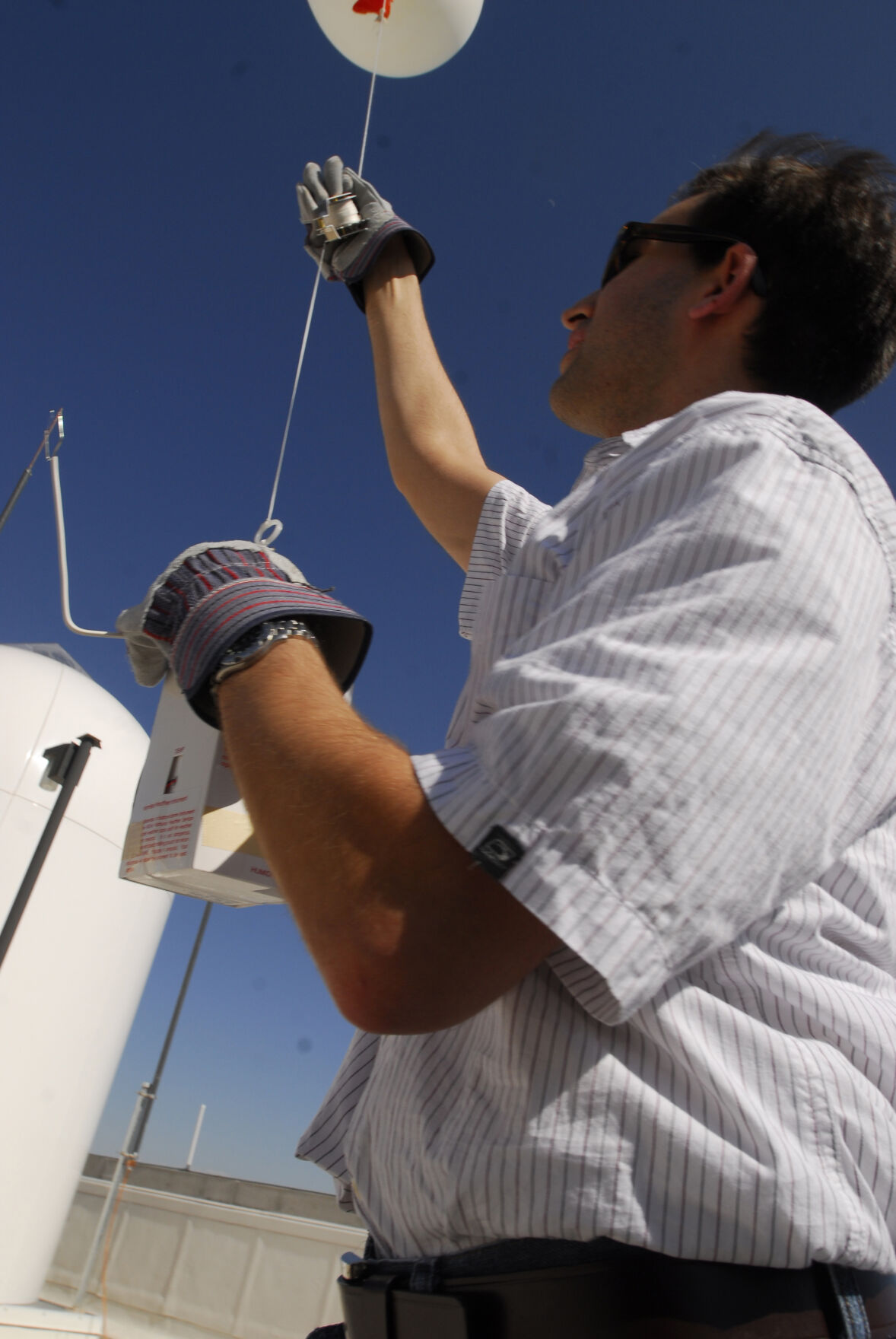
A weather balloon is released from the rooftop of the Tucson forecasting office in this 2007 photo.
But helium, used in everything from medical imaging to industrial manufacturing, is a finite resource that cannot be manufactured or stockpiled. Most of it is recovered as a byproduct of natural gas processing in a handful of countries, with the U.S. and Qatar accounting for more than 75% of global supply.
Roughly one-third of the world’s helium production has been offline since March, when Iran responded to strikes by the U.S. and Israel by choking off shipping in the Strait of Hormuz and attacking a major natural gas facility in Qatar.
The resulting shortage has caused prices to spike and some U.S. distributors to cancel delivery contracts to all but their high-priority customers in health care and other key sectors.
According to supply-chain analysts, it could take three to five years to repair the damage in Qatar, even without additional strikes or disruptions in the Persian Gulf, and the current helium crisis is expected to drag on just as long.
Rising no more
Bunn is a senior research scientist with the Power Forecasting Group at the U of A’s Arizona Institute for Resilience.
Working under sponsorship agreements with the Pima County Regional Flood Control District, Arizona Department of Environmental Quality and local electric utilities, Bunn’s group produces high-resolution weather forecasts for Arizona and New Mexico to predict everything from wind and solar energy production to flooding and other potential storm damage.

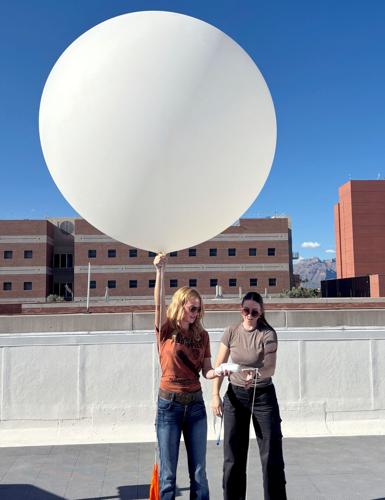
National Weather Service Meteorologist Kei Malarkey, right, prepares for a weather balloon launch with visiting Mica Mountain High School student Mackenzie Campbell in 2025.
Bunn and long-time meteorologist Pat Holbrook also publish a daily online recap and forecast discussion throughout the summer that others in the weather business have called “the best monsoon tracker in Arizona.”
Bunn said their model still largely works as designed, but the lack of upper air data is definitely having some effect on its accuracy. Quantifying the full extent of that effect is probably “worth a research paper,” he said.
Cei downplayed the impacts of the pause in balloon launches. “More data is always valuable, but our internal assessments have not found a significant degradation in our forecast performance,” the NOAA spokeswoman said. “NWS Tucson continues to meet its mission to serve the public in southern Arizona.”
With the Old Pueblo temporarily out of commission, the only balloon data now being collected over Arizona is in Flagstaff, Yuma and Phoenix, where the Salt River Project conducts a daily sounding at 5 a.m.

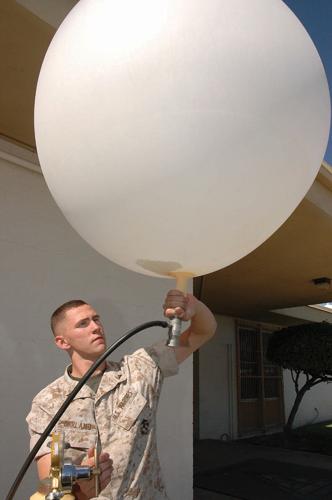
Lance Cpl. Darien Garland fills a sonde, or weather balloon, with helium at Yuma Marine Air Station in 2005. The military base is one of just three locations in Arizona that is still conducting regular weather balloon launches.
While those balloons provide valuable information, Bunn said, it is only really valid for the roughly 40 square-mile area around those locations.
As long-time U of A research meteorologist Mike Leuthold put it: “You can’t use what’s happening in Phoenix as a proxy for Tucson.”
Until the abrupt halt in twice-daily soundings, the Tucson Weather Service office had one of the longest-running weather balloon data sets in the country, with observations dating back to the 1950s.
Bunn said those records have allowed researchers to chart changes to the region’s monsoon pattern in recent decades, as once-consistent afternoon rain events have given way to “more randomized bursts” of intense storm activity.
“It’s a very long-range archive of climatological data,” he said. “It’s a difficult thing to understand why (the Weather Service) wouldn’t want that to continue.”
Forecasting trouble
If federal forecasters are unable to resume daily balloon flights in Tucson, Bunn said the university might be able to step in to help, either with a funding boost or connections to other potential sources of helium.
The university could also look for a local partner to take over the weather balloon launches in Tucson, much the way SRP handles daily soundings for the Phoenix area. Among the possible candidates for such a partnership are TEP and the 25th Operational Weather Squadron at Davis-Monthan Air Force Base, Bunn said.
Even before the balloons stopped flying earlier this year, Leuthold said, data collection in Tucson had been compromised by the Trump Administration and its campaign to slash the federal workforce, especially in areas related to climate science.

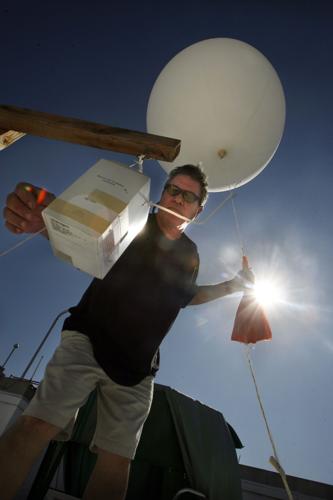
Hans Hanson from the National Weather Service prepares to launch a weather balloon on July 2, 2008, from the roof of the agency's Tucson forecasting office at Park Avenue and Sixth Street.
Launching a balloon requires two people and takes about an hour, he said, so when the local office was hit by cuts in 2025, forecasters opted to delay their usual 5 a.m. sounding until 11 a.m. to take advantage of day-shift staffing.
As a result, the Weather Service has been missing out on prime early morning data that is considered the “gold standard” for predicting summer storm activity, said Leuthold, who helped develop the computer model for monsoon forecasting still in use today.
Now, instead of two slightly less useful daily measurements of local atmospheric conditions, the computers and the scientists running them have to get by without any fresh weather balloon data.
“I’m just glad I’m retired. It would drive me crazy as a forecaster,” Leuthold said. “I guess I picked the right time to get out.”


 Weather service cuts could hamper Tucson monsoon storm predictions