GARNERVILLE, N.Y. — A years-long plan to honor those who served in the quick and oft-forgotten 1991 Operation Desert Storm peaks this fall when a memorial on the National Mall in Washington, D.C., will be dedicated as part of USA 250 celebrations.
Much of the project's artistry and planning is taking place in a small studio at Garner Arts Center in Rockland County, New York. That's where Emily Bedard, one of the artists involved in the project, has created models of the panels that make up the memorial's main display.
Bedard ensures the work animates the vision of the veterans behind its fruition, and meets the stringent specs mandated by the federal process for a monument placed on the National Mall.

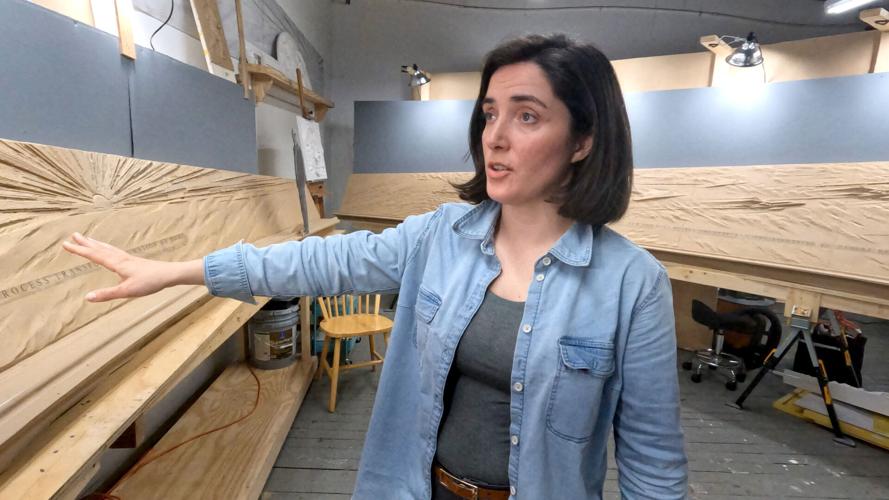
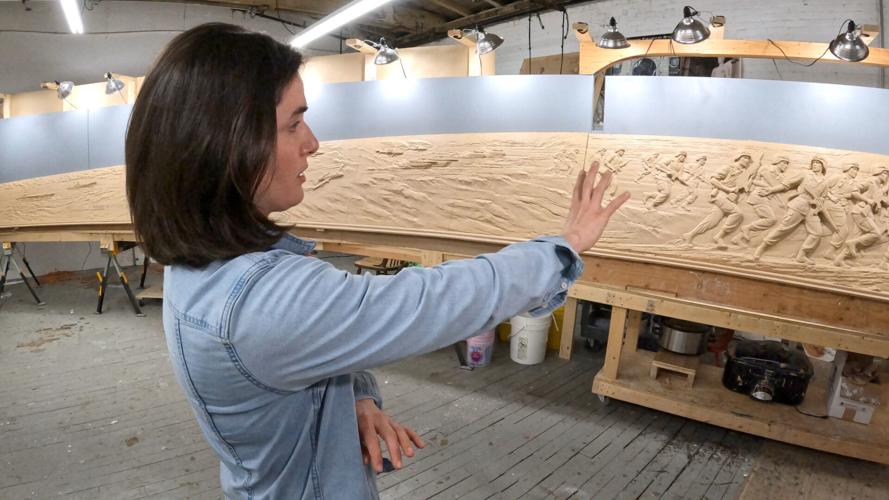
Emily Bedard, art director and lead sculptor for Foster Reeve, and artist behind the Desert Shield and Desert Storm Memorial, shows her original clay creation of the memorial on April 2 in her studio in Garnerville, N.Y.
"We're not trying to celebrate war by any means," Bedard said during a recent visit to her main studio. Those who served, and the historic significance of this short but decisive action, she said, should be honored and remembered.
People are also reading…
The Desert Shield and Desert Storm Memorial has been funded by the nonprofit National Desert Storm Memorial Association. Its board is comprised of veterans who served during the conflict, including Scott Stump, a Marine Corps Reserve veteran who was on active duty in eastern Saudi Arabia and Bahrain during Desert Shield and Desert Storm.
Decisive, but also deadly

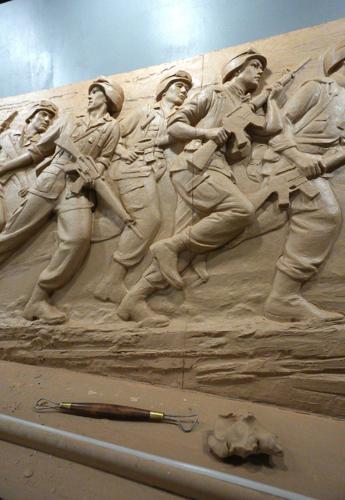
Emily Bedard is creating a bas-relief sculpture for the Desert Shield and Desert Storm Memorial in her studio in Garnerville, N.Y. It will be unveiled this fall in Washington, D.C.
Desert Storm, sometimes called the Gulf War, brought "so many firsts" for the U.S. military, Stump said. It was the first "hot" conflict after the Cold War.
"It was also the first all-volunteer force that deployed," Stump said. That fact boosted troops in many Americans' minds, Stump said. He recalled how, in the wake of Desert Storm, veterans were greeted with "thank you for your service," rather than the derision that had met Vietnam veterans when they returned home.
The war influenced future American action in the region, bringing lessons in coalition-building and surge techniques; it also fostered an illusion of ease to victory. And, it locked in the antagonistic relationship between the U.S. and Saddam Hussein.
The U.S. reported 148 combat dead, 145 non-battle deaths, 21 prisoners of war and 467 wounded in action among the more than 700,000 service members in theater.

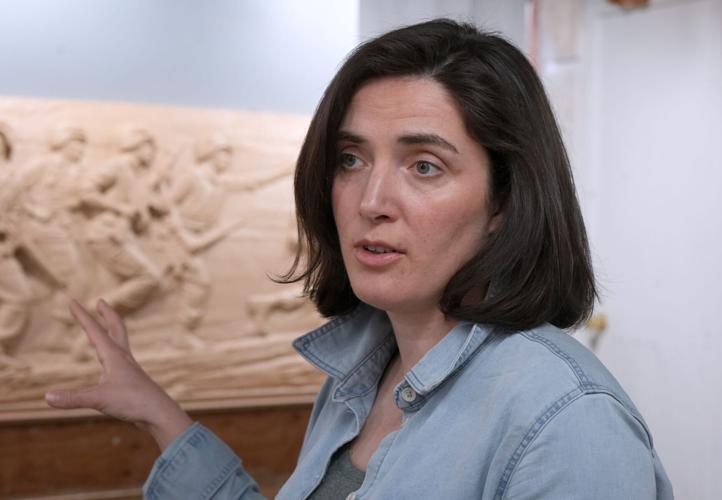
Emily Bedard, art director and lead sculptor for Foster Reeve, and artist behind the Desert Shield and Desert Storm Memorial, shows her original clay creation of the memorial on April 2 in her studio in Garnerville, N.Y.
Memorial to a near-forgotten war
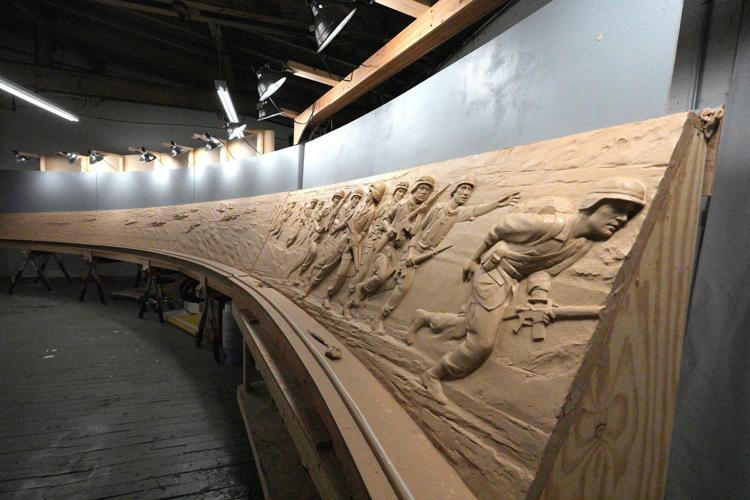
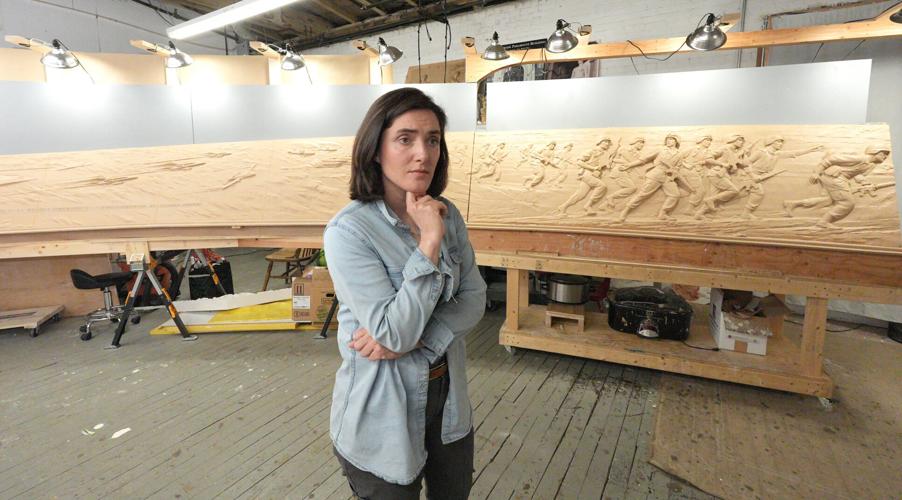
Bedard's main studio space contains a one-third scale of the Desert Shield Desert Storm Memorial, set up in two sections. Another studio holds a single full-size panel that can be used for reference.
The panels increase in size to 7 feet high as troops are shown engaging in a ground war. They then recede in size to echo the denouement of the war.
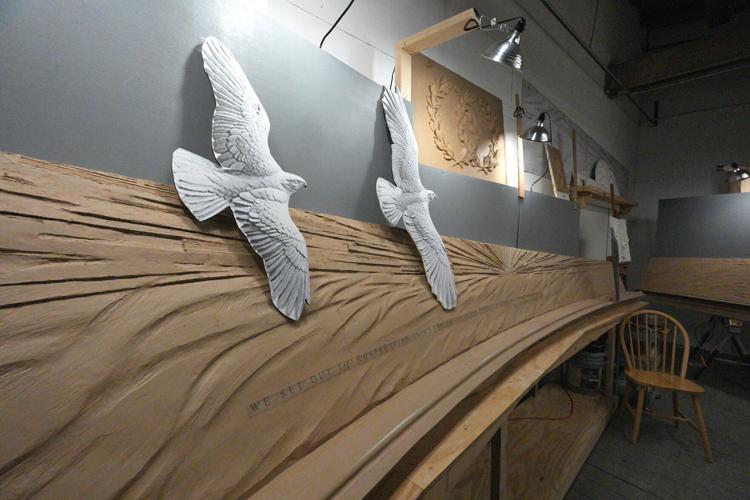
The declaration of peace is shown with two birds: a falcon, Kuwait's national bird, and an American bald eagle, created in stainless steel by artist Robert Eccleston.

The Desert Shield and Desert Storm Memorial, shown April 2 in Garnerville, N.Y., includes a declaration of peace with two birds: a falcon, Kuwait's national bird, and an American bald eagle, created in stainless steel.
"The liberation panel," Bedard said as she gestured toward the final piece, "shows the dawn of a new day."
Bedard keeps keyed into every detail. And every detail counts. The whitish with speckled gray granite that's been chosen, she said, changes tone in different light and becomes a yellowish hue when wet. That shift, Bedard said, evokes the large and shifting dunes of the region.

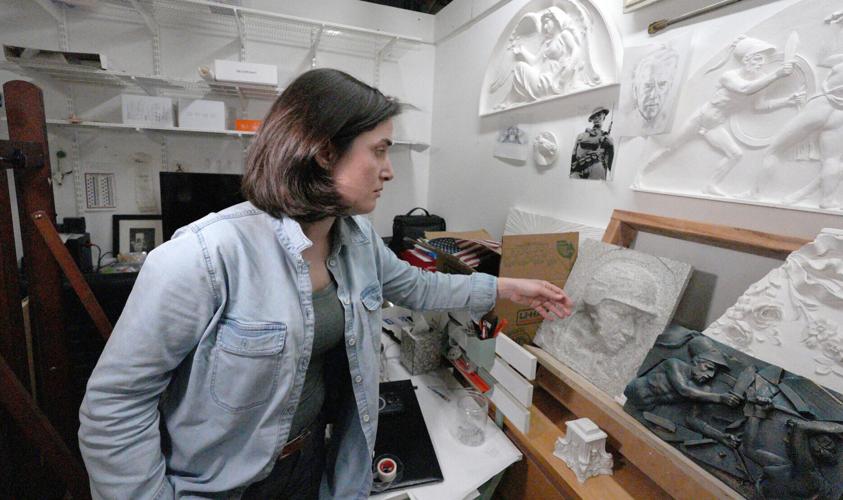
Emily Bedard, art director and lead sculptor for Foster Reeve, and artist behind the Desert Shield and Desert Storm Memorial, shows her original clay creation of the memorial on April 2 in her studio in Garnerville, N.Y.
Her attention to detail included tracking down military uniforms, either from eBay or veterans of the conflict. She said veterans helped with models so they knew how to carry equipment, how to walk through the landscape.
Embracing ancient and modern techniques
Bas-relief or low-relief sculpture has been used for millennia. Here, it helps the story of what's sometimes called the 100-hour war unfold, from the buildup of warships, then air defense, in the region.
Bedard has been involved in every step, from sculpting the clay to make bas-relief model panels, to the scaling up the panels using robotic technology, to overseeing the final work for the granite panels in Carrara, Italy.

Emily Bedard, art director and lead sculptor for Foster Reeve, and artist behind the Desert Shield and Desert Storm Memorial, shows her original clay creation of the memorial on April 2 in her studio in Garnerville, N.Y.
Bedard honors the ancient art of bas-relief and also embraces modern techniques.
A Computer Numerical Control or CNC machine ("like a 3D printer in reverse") scans her work to create the template out of foam. The CNC model is used to then carve the stone in Italy.
Then Bedard teams up with expert carvers there to refine the works. Bedard, armed with pencil and vision, shows the expert carvers where to make any alterations.
"We're refining on a very micro level," she said, like adding detail to faces, detailing laces on combat boots.

Sculptor Emily Bedard is creating the Desert Shield and Desert Storm Memorial in her studio in Garnerville, N.Y.
Bedard, who is 38, hardly remembers Desert Storm — she was just a little kid. But her elementary school friend's dad was in the U.S. Air Force and a Desert Storm vet, and she heard stories of his service. And later, she considered enlisting, with dreams of becoming a fighter pilot.
Bedard ultimately figured that her talents lie in the arts.

Emily Bedard, art director and lead sculptor for Foster Reeve, and artist behind the Desert Shield and Desert Storm Memorial, shows her original clay creation of the memorial on April 2 in her studio in Garnerville, N.Y.
Joining the Desert Shield Desert Storm Memorial effort, she said, is a way "I can use my work as a sculptor in service to the country."
Building a national memorial is not for the faint of heart, Stump said.
"It's been a journey," he said, recalling how he recognized the need and initiated the effort in 2010, as the 20th anniversary of the conflict approached.
But after clearing a "gauntlet" of restrictions and raising all the necessary funds — "we haven't received any taxpayer funding," Stump said — the unveiling of the memorial is approaching on Oct. 24.
"Truly we have created a space in and of itself essentially out of nothing," Stump said. "I think the visitor will feel that sense of enclosure ... a symbolic desert environment and conditions where this conflict unfolded. It's essentially an oasis."
Bedard looks forward to the ceremony and seeing the reaction of those who served in Desert Storm. "It's nice to honor veterans in their lifetime," she said.