Artificial intelligence is ramping up fast. Some 57% of Americans have already used it for personal purposes, and over half of U.S. businesses are putting AI to work, the research organization Brookings reports.
AI can spark creativity, enhance communications, and drive new efficiencies. But those benefits come with a steep environmental cost.
“Data centers are projected to drive nearly 50% of the growth in global electricity demand by 2030,” says Chad A. Hunter, a vice president at green banking platform GreenFi. “Asking a platform like ChatGPT just five questions consumes enough electricity to charge a standard smartphone to over 40%.”

Chad Hunter, created this AI photo of himself using lower-energy AI tools, with carbon emissions offset.
Water is also a monumental concern. “The water usage required to cool these high-performance chips is immense,” says Hunter, whose company helps guide climate-conscious consumer choices. “A large data center can consume up to five million gallons of water per day, roughly the same amount used by a town of 10,000 to 50,000 people.”
People are also reading…
All of this amounts to a potential climate catastrophe in the making. But experts point to a range of strategies that can help bring AI to life without killing the planet in the process.
Toward greener AI
“Models” are key to making AI work. In AI, models are computer programs or algorithms trained on vast datasets that enable AI applications to recognize patterns, make decisions or generate content.
By fine-tuning the models, developers could score a sustainability win. “Think smaller or distilled models — better retrieval, so the model doesn’t have to ‘rethink’ what it already knows,” says Channing Ferrer, the Americas CEO of Brevo, a cloud-based software company that uses AI and is B Corp-certified, meaning it meets high benchmarks for environmental stewardship.
Cleaner algorithms are just a starting point. Companies can also take a closer look at how they power the massive data centers needed to support AI’s vast computational demands.
“On the generation side, solar paired with battery storage is now the cheapest and fastest way to deploy new electricity capacity,” says Mark McNees, director of social and sustainable enterprises at Florida State University's Jim Moran College of Entrepreneurship and managing consultant at The McNees Group.
“When Meta built a data center in Aiken, South Carolina, it partnered with a solar developer to install 100 megawatts of on-site generation,” he says, noting that it takes years to ramp up a new gas turbine, where solar can be deployed in months. “This isn't just environmental activism: It’s the fastest path to capacity.”

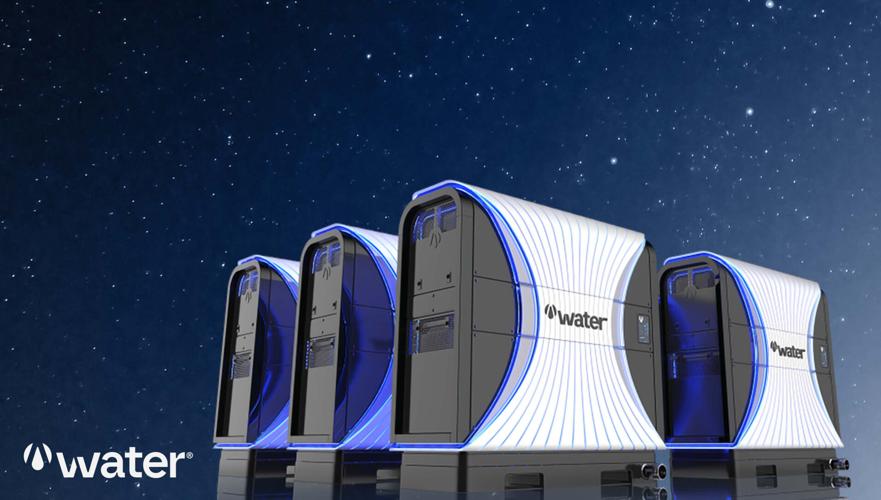
VVater’s Farady Reactor is an award-winning, chemical-free water treatment technology to destroy contaminants like PFAS, microplastics, and pathogens.
When it comes to water," the solutions already exist,” says Kevin Gast, CEO and co-founder of VVater, a tech company focused on sustainable water use. “This isn’t some moonshot problem where we need to wait for a genius in a lab coat to save us.”
He points to closed-loop recycling systems, on-site treatment, alternative water sourcing from treated wastewater and stormwater capture, along with other existing strategies, as ways to make data centers more sustainable. But there’s a snag.
“The actual problem is that we’re stuck in a 100-year-old infrastructure mentality. We still pipe water miles to a centralized plant, treat it, then pipe it miles back,” he says. Every mile of that journey represents potential water loss.
“The future is decentralized. Treat the water where you need it. Recycle it on-site. Stop making data centers compete with families for drinking water,” he says. “Some operators are already doing this, and the efficiency gains are remarkable.”
Looming threat
All these strategies can help make AI more sustainable. But the elephant in the room remains: Until alternate power and water efforts ramp up, the massive data centers represent a looming threat.
Industry analysts at ConstructConnect Project Intelligence are currently tracking 76 U.S. data center projects in progress, all with start dates expected in 2026. In fact, a coalition of more than 230 environmental groups has demanded a national moratorium on new data centers nationwide.
While it’s unclear whether that can happen — given the momentum around AI and Wall Street’s enthusiasm for it — experts say there are other ways to move the needle.
Ferrer points to the need for developers to build sustainably. “The answer isn’t really to ‘stop building data centers.’ What we should do is build them with rules that protect local water (and) stabilize the grid,” he says.
“Responsible AI is a leadership choice,” he says. “If you're serious about sustainability…then you build AI leveraging models that are as efficient as possible by default, powered as cleanly as possible and reported on with transparency.”
That transparency can help ensure AI is used in the most environmentally responsible ways. “Moving forward, AI providers must offer transparency, so consumers can choose providers who build sustainably, rather than those who simply build fast and leave the environmental bill to the next generation,” Hunter says.
Consumers can also be more thoughtful about their own engagements with AI. For example, if a Google search for broccoli triggers an AI-generated summary where a simple link would have been enough, “we are wasting resources,” he says.
“You wouldn’t use a supercomputer to balance a checkbook, yet many of our current AI interactions use sophisticated, power-hungry models for trivial tasks,” he says. Users can be mindful of their own AI footprint — and press providers to deliver AI with sustainability in mind.
The rise of AI creates a precarious moment, but some see light at the end of the tunnel.
“The good news is that this is entirely fixable,” Gast says. “If the AI industry can figure out how to generate a Pixar-quality movie from a text prompt — I’m pretty confident we can figure out how to recycle water.”