CAIRO — A trove of ancient artifacts from Egypt's last dynasty was discovered in 63 tombs in the Nile Delta area and experts are working to restore and classify the finds, an official with the country's antiquities authority said Monday.
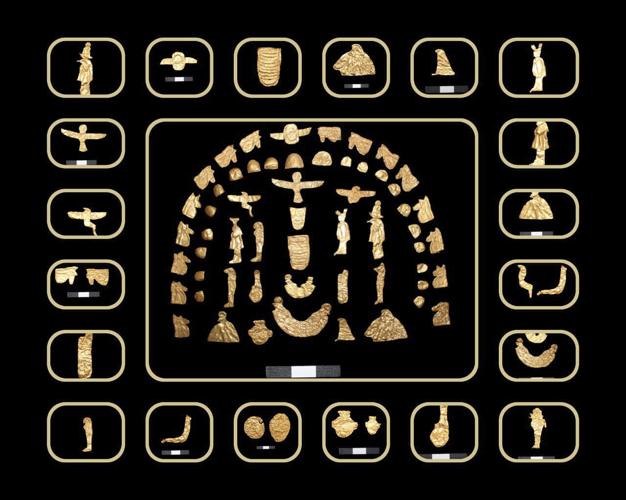
The artifacts include gold pieces and jewelry dating back to Egypt's Late and Ptolemaic periods, and some items could be displayed at one of the country's museums, said Neveine el-Arif, spokeswoman for the Ministry of Tourism and Antiquities.

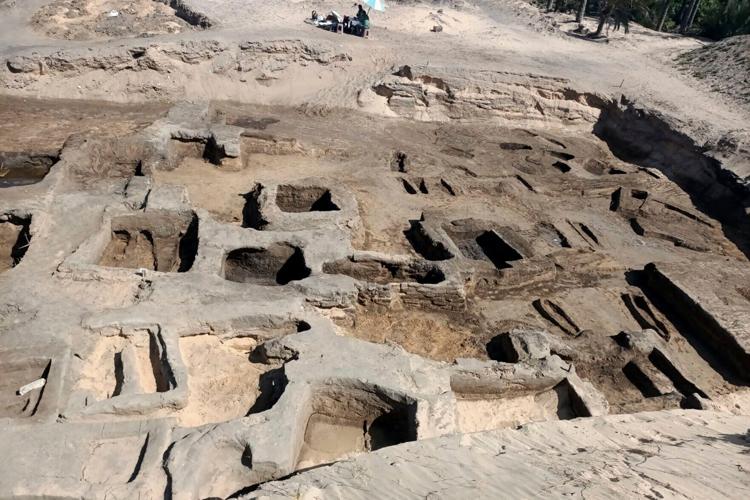
The site where archaeologists discovered 63 mud-brick tombs at the Tell al-Deir necropolis, in the Nile Delta town of Damietta, about 125 miles north of Cairo, Egypt.
An Egyptian archaeological mission with the Supreme Council of Antiquities discovered the mud-brick tombs at the Tell al-Deir necropolis in Damietta city in Damietta governorate, the ministry said in a statement last month.
Other items found in the area of the tombs include statues, funerary amulets and a pottery vessel containing 38 bronze coins dating back to the Ptolemaic period.
People are also reading…

An artifact discovered in a tomb at the Tell al-Deir necropolis in the Nile Delta town of Damietta, about 125 miles north of Cairo, Egypt.
The Ptolemaic dynasty was Egypt's last before it became part of the Roman Empire.
The dynasty was founded in 305 B.C. after Alexander the Great of Macedonia took Egypt in 332 B.C. and one of his generals, Ptolemy, became Ptolemy I.
Leadership was handed down through Ptolemy's descendants and ended with Cleopatra.
Egypt exhibited artifacts from the Ptolemaic period for the first time in the Egyptian Museum in Cairo in 2018, with around 300 artifacts on display.
Photos: Egypt unveils recently discovered ancient workshops, tombs in Saqqara necropolis

Canopic jars, which were made to contain organs that were removed from the body in the process of mummification, are seen at the site of the Step Pyramid of Djoser in Saqqara, 24 kilometers (15 miles) southwest of Cairo, Egypt, Saturday, May 27, 2023. Saqqara is a part of Egypt's ancient capital of Memphis, a UNESCO World Heritage site. (AP Photo/Amr Nabil)

A Canopic jar, which was made to contain organs that were removed from the body in the process of mummification, are seen at the site of the Step Pyramid of Djoser in Saqqara, 15 miles southwest of Cairo, Egypt.

A recently unearthed ancient wooden sarcophagus is seen Saturday in Saqqara near Cairo, Egypt.

An Egyptian archeologist points at a colored painting showing the offering of sacrifices at a recently uncovered tomb that was said to belong to a top official of the fifth Dynasty named "Ne Hesut Ba" in Saqqara, Egypt.

Mostafa Waziri, secretary-general of the Supreme Council of Antiquities, displays a recently unearthed ancient wooden sarcophagus at the site of the Step Pyramid of Djoser in Saqqara, 24 kilometers (15 miles) southwest of Cairo, Egypt, Saturday, May 27, 2023. Saqqara is a part of Egypt's ancient capital of Memphis, a UNESCO World Heritage site. Waziri said the workshops had been used to mummify humans and sacred animals, dated back to the 30th Pharaonic Dynasty 380 BC to 343 BC and Ptolemaic period 305 BC to 30 BC. (AP Photo/Amr Nabil)

A colored painting is seen on a recently unearthed ancient wooden sarcophagus in Saqqara, Egypt.

A visitor is reflected on a panel that holds recently unearthed ancient artifacts Saturday in Saqqara, Egypt.

Canopic jars, made to contain organs removed from a body during the mummification process, are displayed in Saqqara, Egypt.

Mostafa Waziri, secretary-general of the Supreme Council of Antiquities, displays a recently unearthed ancient wooden sarcophagus Saturday in Saqqara, about 15 miles southwest of Cairo, Egypt.

Visitors pose for pictures Saturday on top of recently unearthed ancient embalming workshops in Saqqara, Egypt.