PHOENIX — Backers of an initiative to reform the state's universal voucher program want a judge to rule that Republican lawmakers are illegally trying to give voters a biased view of what their measure would do.
A lawyer for the committee pushing the Protect Education Act says Arizona law requires lawmakers on the Legislative Council to craft an "impartial analysis'' of any proposal being sent to voters. She says that means a synopsis written in clear and concise terms, not tinged with partisan coloring, and free from misleading wording, whether by adding things not in the measure or leaving out material facts.
But the description approved earlier this month on a party-line vote by the Republican members of the council — all of whom oppose the initiative — falls short, says the attorney, Bo Dul.
People are also reading…
"It affirmatively misrepresents the initiative's provisions and adds extra-textural language designed to cast the measure in the worst possible light, while also omitting accurate information that may cast the initiative in a favorable light,'' she wrote in a new lawsuit.
The lawsuit asks Maricopa County Superior Court Judge Daniel Martin to order lawmakers to rewrite the description in a legal form.
Dul said GOP lawmakers are inaccurately describing the voucher initiative, but also another measure.
She is telling Martin he also should force the Legislative Council to get rid of biased wording in its description of another ballot measure, this one crafted by Republicans in the name of protecting voucher funds given to children in military families. She said it hides from voters the crucial fact that if it is approved, it would void the entire voucher reform initiative.
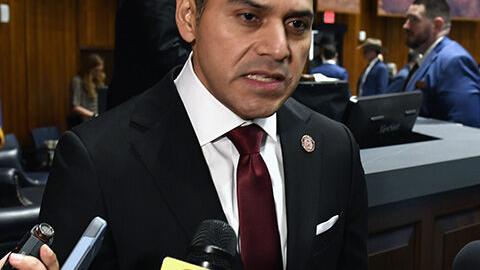
There was no immediate comment from Republican House Speaker Steve Montenegro, who chairs the Legislative Council.
Descriptions must be neutral
The Legislative Council is required under state law to come up with an explanation of each ballot measure — and do it in a way designed to highlight the key provisions without drifting into language designed to sway voters.
Those explanations can have a lot of influence. They are placed into a brochure that the secretary of state sends to the homes of the state's more than 4.3 million registered voters.
Dul said the wording approved by the Republican-controlled panel fails to meet the legal requirements of neutrality.
One issue involves a key provision of the initiative that would deny education vouchers to children from families earning more than $150,000 a year.
Dul told Martin the legislative wording fails to make clear that this cap would apply only to students in the "universal'' voucher program that lawmakers approved in 2022, which makes the vouchers, known as Empowerment Scholarship Accounts, available to any students. She said the initiative itself says the income limit would not apply to those who already were eligible for vouchers before 2022 because they meet certain requirements, such as having a disability, attending a public school rated D or F, or having parents in the military.
But a proposal by Democrats to add that clarification was rejected by Republicans.
GOP lawmakers also refused to add specific examples of the kind of purchases — listed in the initiative itself — that could not be made with voucher dollars, such as out-of-state travel, amusement park tickets and jewelry. That proposal, too, failed to get GOP support.
Conversely, Dul said one of the things Republicans put into the explanation is entirely false.
As approved by the panel, the description of the Protect Education Act would tell voters that the committee backing the initiative would have the legal power to "sue families and private schools that participate in the program for any violations of the proposition.''
But the actual language of the initiative, she said, simply gives the committee the legal right to defend challenges to the ballot measure only if it is challenged in court.
"The provision confers only standing,'' Dul told the court. "It creates no cause of action and does not identify families or private schools as potential targets.''
She said that language added by Republicans "was intended to be inflammatory and clearly advocacy-oriented and nowhere within the language of the initiative itself.''
Clear language requested
The lawsuit challenges more than the description written by Republicans of the Protect Education Act.
Also at issue in the new lawsuit is the GOP lawmakers' explanation for voters of another measure — this one of their own making — that is billed as protecting voucher funds for students from military families.
It is linked to the fact that one of the provisions of the separate Protect Education Act would end the existing practice where voucher recipients are allowed to keep anything they don't spend in their annual allocations, currently about $7,500 a year per student, and save it up for college or other purposes.
More to the point, the GOP lawmakers' measure says that if any measure is approved at the ballot that eliminates the "banking'' ability of children in military families, the entire other measure — meaning the Protect Education Act, its income caps, limits on purchases and additional state oversight — is voided, not just the part dealing with banking of voucher funds.
Dul said there should be clear language explaining to people that if they vote for the Republican plan to protect voucher dollars for children in military families, they automatically would be negating the broader ballot measure reforming vouchers.
No date has been set for a hearing.

Howard Fischer is a veteran journalist who has been reporting since 1970 and covering state politics and the Legislature since 1982. Follow him on X, Bluesky and Threads at @azcapmedia or email azcapmedia@gmail.com.