SCOTTSDALE — Republican candidate Elijah Norton wants to bar the state treasurer's office from buying the stocks and bonds of companies he says are guilty of "discrimination.'' He said those include companies that have diversity, equity and inclusion policies.
He made that point during a half-hour debate Wednesday night with Democrat Nick Mansour, his rival in the November election race for state treasurer. The discussion focused on their claims about who is more qualified to oversee the $33 billion being managed by the treasurer, and what is the best way to protect the funds while increasing the yield.
Norton drew questions because he has said the state should invest in companies that provide a good service and make a profit, "not engage in political activism or racial activism.''

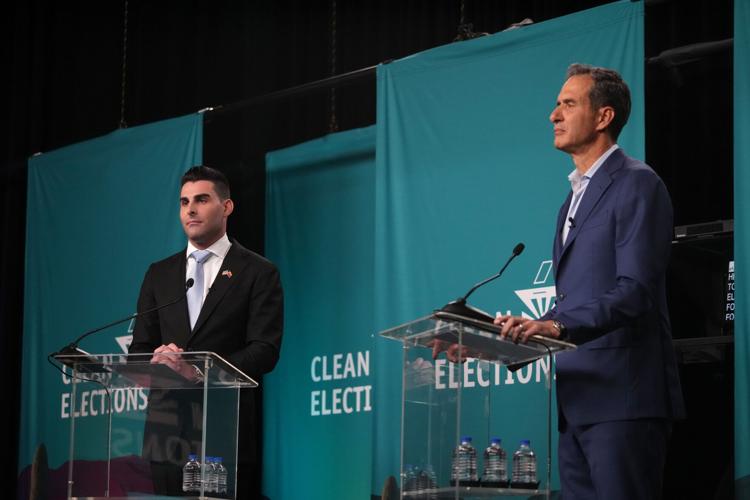
Arizona treasurer candidates, Republican Elijah Norton, left, and Democrat Nick Mansour, right, at a debate Wednesday.
"What I've said is I don't want to invest in companies that engage in racially motivated hiring practices,'' he said. "This is a real thing. Starbucks was sued by the Florida attorney general for having racial hiring quotas.''
People are also reading…
In that case, the company's diversity, equity and inclusion policies were accused of violating Florida's Civil Rights Act by illegally factoring race and sex into hiring practices. Starbucks agreed to pay $1 million to settle the case. But its attorney said there was no admission of liability or wrongdoing and the company would not change its programs or practices.
Norton said Arizona is a diverse state. "And I don't think the people of Arizona want their money invested in companies that have racial hiring quotas,'' he said.
'Will increase risk'
Mansour said he agrees with the general principle that the state should not be supporting discrimination. But he said what Norton is proposing goes beyond that.

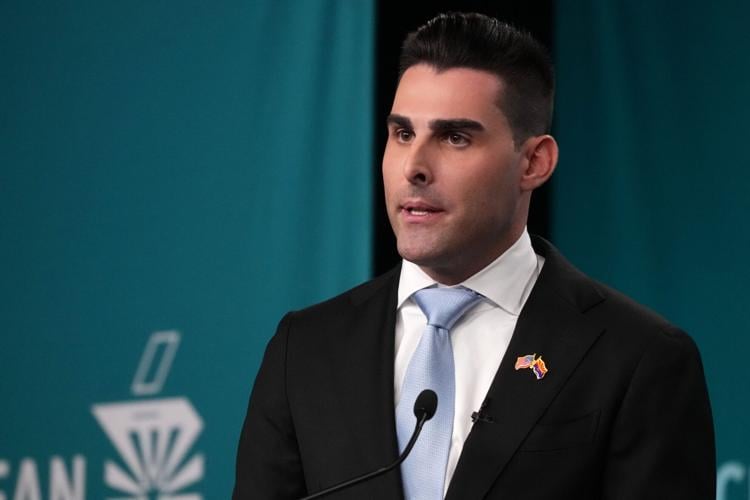
Democratic candidate for Arizona treasurer Nick Mansour during a Clean Elections debate with Republican candidate Elijah Norton.
"As much as possible, we should not inject partisan political issues into how we manage these funds,'' Mansour said.
He said that, using Norton's test, Arizona would be precluded from putting its funds into any company with DEI practices. That would keep the treasurer's office from investing in more than 400 of the Fortune 500 companies, leaving fewer options, Mansour said.
"It will increase risk and it will result in bad returns,'' he said.
That figure may not be accurate. The Human Rights Campaign said 377 Fortune 500 companies publicly disclosed their DEI practices in 2025. But by this year that number had fallen to 131.
Norton, using a different metric, said his proposal would only preclude investment into about 8% of some 4,000 publicly traded companies. And he said there are no Arizona companies that would be off-limits to state investment.
Still, Norton said that, as he sees it, companies with DEI policies — including how they decide who to hire and promote — would be off-limits to state investment if he were treasurer.

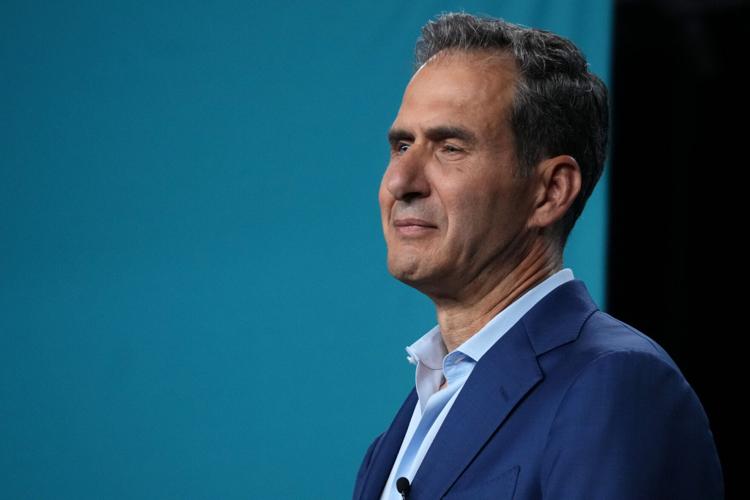
Republican candidate for Arizona treasurer Elijah Norton during a Clean Elections debate with Democrat Nick Mansour.
Mansour, however, said there should be "very few exceptions'' to the practice of the treasurer to invest funds where they are safe and can get the best yield, regardless of whether companies have DEI policies.
"I'm not saying that there shouldn't be any,'' Mansour said. "But it should be rare. It should be decided by the Legislature and the governor together. It shouldn't be at the whim of the treasurer.''
And he said it should not include a refusal to invest in any company with a DEI policy.
"That's just a really bad fiscal decision,'' the Democrat said. "It will make our investments riskier.''
There already is precedent for making some companies off-limits for state investments.
In 2021, Republican Kimberly Yee, the current state treasurer, announced she was selling off the state's $143 million it held in bonds and commercial paper for Unilever. That followed the company's announcement it would no longer sell its Ben & Jerry's ice cream in the West Bank and contested eastern Jerusalem, which Israel claims as its capital. Unilever had acquired the company in 2000.
But that decision was not Yee's. She cited a 2016 Arizona law that says state entities are prohibited from doing business with any company that boycotts Israel. The decision not to sell ice cream in the Palestinian territories occupied by Israel, she said, triggered that law.
Investment strategies
Beyond politics and DEI, the big difference between Norton and Mansour at Wednesday's debate was how best to invest state funds — particularly the $11 billion in the Permanent Land Endowment Trust Fund, which is used as the basis for providing money for public schools.
Norton said current policy is to invest 60% of available funds in stocks and 40% in bonds. "And there's a reason for that,'' he said.
In general, when there is strong corporate growth, investors buy stocks and push prices higher. But when investors fear a recession, they move their money to generally safer corporate bonds, raising their prices.
"When the stock market goes down, the bond market serves as a security to ensure that the state does not suffer big losses,'' Norton said.
Mansour, however, said that has proven to be too conservative.
"We have lost out on $3.6 billion over the last 13 years,'' he said. "Instead of being $11 billion, this could be $15 billion today.''
His preference would be to move at least 70% of state funds into stocks, and possibly as much as 80%.
"This is a fund for education,'' Monsour said. "I am a parent. This is a way to invest for the long term to make more money for our kids and to keep our taxes low.''
Norton said the numbers work only if the market keeps rising.
The flip side is if the market goes the other way. "The market's at record highs and it could happen any day,'' he said.
"We could lose $1 billion to $2 billion over 10 years,'' Norton said. "This is not a risky strategy that Arizona can afford.''
Barbs over their backgrounds
The two candidates also traded barbs over their business practices and whether they should be trusted to manage the state's money.
Mansour said Norton's firm, which sells vehicle service contracts and extended auto warranties, now known as Veritas Global Protection, has been the subject of numerous complaints and lawsuits over its business practices, including making robocalls and not paying up when customers file claims.
Norton said those instances amount to no more than "a tenth of a tenth of a percent'' of the firm's $500 million a year business.
And Norton, in turn, said the privately run Arizona College of Nursing, which Mansour chaired, had agreed to settlements to end complaints about its practices. Mansour said there were only four lawsuits over his 14 years with the college.
Mansour also noted that Yee, now running for state schools chief, has not endorsed fellow Republican Norton in the treasurer's race. In fact, Yee recruited Katherine Haley to run against Norton — unsuccessfully — in the GOP primary.
Howard Fischer is a veteran journalist who has been reporting since 1970 and covering state politics and the Legislature since 1982. Follow him on X, Bluesky and Threads at @azcapmedia or email azcapmedia@gmail.com.