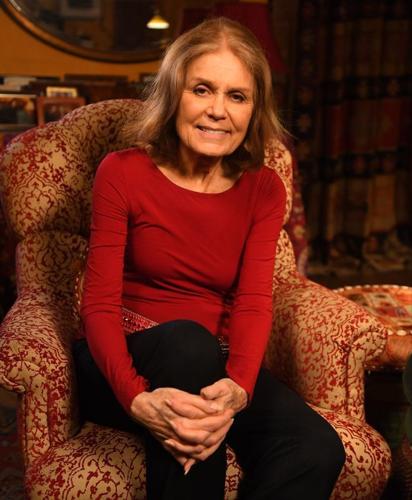
At the Nashville Public Library, Gloria Steinem’s words greet visitors in the “Votes for Women” room, the permanent installation that honors the ratification of the 19th Amendment to the U.S. Constitution.

Keel Hunt
“Women have always been an equal part of the past. We just haven’t been a part of history.“
Those words are in a central position on the architectural “halo” that a visitor sees overhead on entering this shrine that opened six years ago.

Steinem
Steinem, who died at 92 recently, helped shape that history. Over her long career, while many took note of her enduring glamour, she was fundamentally a writer, an organizer of far-flung communities of women and a co-founder of Ms. magazine. She wasn’t the only voice for progressive feminism -- far from it -- but her tireless career of advocacy and organizing made her one of the movement’s steadiest influences.
People are also reading…
These other Steinem-isms might serve now as a memorial to this important woman and her insistent career. For your consideration:
- “The truth will set you free, but first it will piss you off.”
- “Any woman who chooses to behave like a full human being should be warned that the armies of the status quo will treat her as something of a dirty joke. That’s their natural and first weapon. She will need her sisterhood.”
- “We are the women our parents warned us against, and we are proud.”
- “The future depends entirely on what each of us does every day; a movement is only people moving.”
- “The first problem for all of us, men and women, is not to learn, but to unlearn.”
- “When unique voices are united in a common cause, they make history.”
- “We’ll never solve the feminization of power until we solve the masculinity of wealth.”
- “I never wanted to be a politician or elected person myself, so I loved to work for other women who did -- and hope that more girls will do that. The problem is the feeling that we’re divided from politics, that our vote doesn’t count or what we do doesn’t count. In fact, everything we do counts.”
- “Now we know that, say, women can do what men can do -- most folks would agree with that. But we don’t know that men could do what women can do.”
How far we have come, and how far we have to go.
The crusade for women’s suffrage was long, bitter and hard-fought. In 1920, when ratification came, Black women who had joined the push would not be assured the vote until 1965, when Congress adopted the Voting Rights Act, and President Lyndon B. Johnson signed it. But the 1920 ratification, when it came, was especially valued by women who had lived through the fraught years of transition to full citizenship.
I know this, because both my grandmothers were born in a time when women could not vote, and I remember each of them telling me in their later years how they were resolved never to miss an election.
Here’s one more thing Steinem wrote, a sentence in her final essay. One more lesson we should all learn and heed, whatever our age:
“When you’re lucky enough to have lived a long life, as I have done, your role as an older person is to remind us how far we have come.”
Hunt is the author of “Coup: The Day the Democrats Ousted Their Governor” and other books on Tennessee’s political history: KeelHunt.com. He wrote this for the Nashville Tennessean and USA TODAY Network via Reuters Connect.