


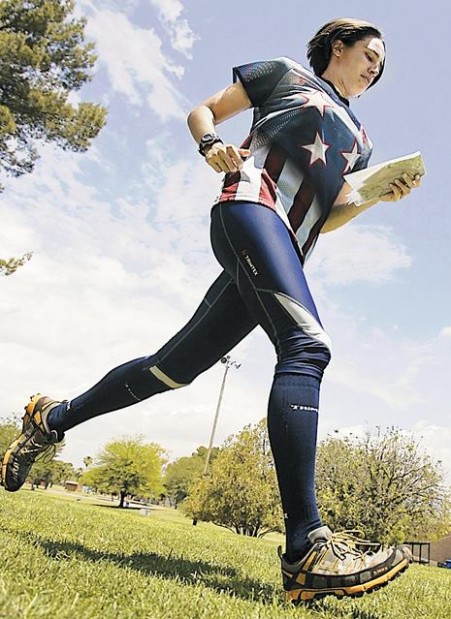
Cristina Luis began her orienteering career as a little girl, whether she knew it or not.
"My mom always gets really carsick," she said. "So when I was really little, my dad would hand me a map in the car. He'd say, 'You're the navigator.' "
She's taken it literally. The 30-year-old Tucsonan is a captain at Davis-Monthan Air Force Base, where she's a navigator on a HC-130 search and rescue plane.
In her free time, Cristina has developed into one of the nation's top female orienteers. Using little more than a thumb compass and a detailed map, she races through wild areas for sport.
Cristina qualified for the U.S. national team last month; she and four other American women will travel to Miskolc, Hungary, in August for the World Orienteering Championships.
Cristina talked to the Star about her sport, her passion and her future:
People are also reading…
What is it: "A lot of people think orienteering is like Boy Scouts, with compass work and pace-counting. It's like that on crack. It's actually a high-speed running race."
Fast, faster, fastest: "There are three disciplines: The shortest races are about 15 minutes, and the longest one is 1 1/2 or 2 hours. For the most part, you run at a 10K pace or a 5K pace."
The map: "I've always been into maps. I followed pirate maps, maps of the world. I studied geography in high school. With orienteering, you use maps especially made for the race. There are little points all over the map, and you have to go to those points in order. When you arrive there, there's a flag to let you know you arrived at the right space. You use a little digital 'fingerstick' to check in."
Look! "The first thing I do when I get a map is find the triangle on there. You know … 'You are here. '"
What to wear: "You bring yourself and your compass, and long pants to cover your legs to avoid scratches. There are orienteering shoes, but I've been wearing cross country-style shoes, things with really aggressive tread."
But that's it … "People keep giving me suggestions — 'Check out this lightweight jacket' — but it doesn't really matter. It's like showing up at a local 5K for me. Sure, you're going into the woods, but it's just a running race."
The best route … "is pretty much a straight line. You have to find out what the best way to get from one point to another is."
Game face: "When I'm running through the woods, I don't really think about snakes or weird spiders. Sometimes you see them, but you forget about them. But if I'm hiking with friends and see a snake, I freak out. I'm in a different mode."
How to train: "A lot of it is physical training. Running in terrain is a good thing, too."
The amazing race: "There were tryouts this spring in a place called Cobb, Calif., for the world championships. They take five people; I was fifth. I did not expect to make it, at all, this year. I came in third each day. I had my best runs of the year, all in the same weekend."
Headed for Hungary: "The world championships start in August. I'll probably get there a week or so early to prepare. There are four races, but each country only has two people running in each race. There are three individual races and a three-person relay."
Underdog: "Orienteering's huge in Scandinavia; it started there as a military thing. There are other countries that are up-and-coming — Switzerland, the Czech Republic and Russia — but Finland, Sweden and Norway are the dominant countries."
Her start: "I was a softball player at the University of Rochester, third base, for a year and a half. I was involved with the outdoors club in college. I found out about orienteering my senior year. I had heard about it, and I had always been into maps. I knew I'd like it."
Air Force: "I joined the Air Force after grad school at the U of A. I was actually deployed from October to January in Djibouti. It really wasn't bad. Mostly, we were on 24-hour alert. I have two more years in the Air Force. If I get out, I'll probably do something really different. I taught eighth-grade science for a year between grad school and the Air Force. I'd like to teach."
Smart guys: "Orienteering is actually kind of a nerdy crowd. You have to enjoy thinking while doing sports, which not everyone likes. There are a lot of scientists and teachers who did it; occasionally, you'll get somebody with a social-sciences background. One woman on our team is a trainer, and another's a sports physiologist. It's definitely a pretty smart crowd. These are people who get you."
It's all about … "Patience. You have to be able to analyze what you've done wrong or right while you're racing. That's the key."


 University of Arizona climbs to No. 36 in total sports rankings | Greg Hansen


