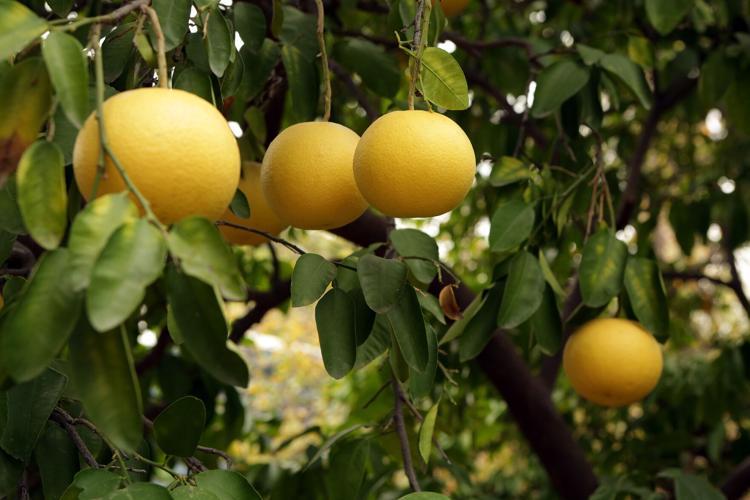
Don’t be fooled by the cooler autumn weather or the rain.
The stress of this summer’s heat has been taking out citrus trees, peaches and even pomegranates. Just like it did last summer and the summer before that, going back years now.
And if the trees didn’t die, it’s probably because we poured water on them, a weekly deep watering in many cases, thousands of gallons into the ground for an eventual harvest of maybe several dozen fruits per tree.
I get it: I have three citrus trees, two pomegranates and a tiny pineapple guava I’ve been nurturing for years. In fact, I was deep-watering the tangerine tree with city water while reading stories in the Star about PFAS pollution in Tucson’s groundwater and cuts to our Colorado River supply.

Arizona Daily Star columnist Tim Steller
That’s what prompted me to call a handful of experts and ask them whether we should even be trying to grow what we used to in Tucson. Collectively, their answer was no; it’s time to change. We have too much heat and too little water to squander it on inefficiently growing a relative few fruits.
People are also reading…
In fact, when I asked Deborah North, a master gardener affiliated with Pima County Cooperative Extension, if she would plant citrus now, her answer was a firm no, because of the water it takes to keep the trees alive.
“I think it’s something that people should be rethinking because to water to three feet of depth, that is a lot of water,” she said. “We just really need to be strongly thinking – what value are we getting out of our trees?”
As we enter the ideal tree-planting time of year, she recommends starting with native trees.
“Within that canopy and adjacent to it is where you plant your fruit trees,” she said.

Our hotter climate and dwindling water supply is making many fruit trees untenable in Tucson.
Local water conservation pioneer Brad Lancaster has been using some of the concepts North advocates. He told me he has been noticing at his home the growing stress, especially on exotic and non-native trees.
“I was initially distressed and disturbed by that,” Lancaster said. “Then I thought, ‘OK, let’s shift how I’m thinking about this. Can I put in different plants that would do better for these changing conditions?”
“I replaced some fruit trees with edible cactus like nopal or the Opuntia ficus indica (Barbary fig).”
Lancaster has been creatively using shade and, of course, the water harvesting he’s known for, to change how he gardens. He has a Valencia orange tree that has been doing OK, but has planted a successor beneath it: A native Condalia that produces berries and is thriving.
“I’m slowing pruning back the citrus to make room for the Condalia and eventually I will take the citrus out,” he said.
He’s even phasing out his summer vegetable gardening, limiting plantings to heat-adapted tepary beans, purslane and amaranth.
“I’ll plant those with the rain, and if there’s enough rain to germinate, I have a garden. If we don’t have enough rain, I don’t have a garden.”
Decisions like this to go with the native and heat-tolerant plants are backed up by a change that the U.S. Department of Agriculture made in 2023: Tucson’s hardiness zone went from 9A, a zone where the average lowest winter temperature is between 20 and 25 degrees, to zone 9B, where the average lowest winter temperature is between 25 and 30 degrees.
This makes a big difference for deciduous fruit trees like peaches and apples, which require long stretches of cold weather below 45 degrees, along with a lot of watering, in our climate.
Community Gardens of Tucson recently removed apricots from the group’s list of approved fruit trees for that reason, said Sammy Kaplan, garden operations coordinator, in an email.
“The required number of chill hours for even apricots that are better adapted for warmer climates is something you can no longer reliably expect to receive in Tucson,” Kaplan said. “While we do still allow trees such as citrus which require quite a high amount of water, we also strongly encourage the planting of lower water-use trees such as pomegranate and quince.”
The gardens strictly use drip irrigation, which maximizes water efficiency, and respond to weather conditions by watering when necessary.
What Barbara Eiswerth has seen in her years of harvesting food with Iskashitaa Refugee Network is a decline in the dependability of harvests, along with the death of fruit trees.
Olive harvests for oil, for example, used to dependably occur around Oct. 11, when trees had about half green olives and half black. Then they pushed the harvest back to November.
“After a few years, we were seeing black, mature olives in January and February and August,” she said. “The trees are confused.”
This confusion reflects a changing climate growing hotter but with sometimes intense rains. North, the master gardener, thinks she sees Arizonans starting to absorb the lessons nature is teaching us about what to grow, and what not to.
“It feels almost as though the Titanic is turning,” she said.
Contact columnist Tim Steller at tsteller@tucson.com or 520-807-7789. On Bluesky: @timsteller.bsky.social

Tim Steller
Columnist


 Tim Steller’s column: Ciscomani ‘bipartisan’ except when it mattered most