

Some concerts end the second the house lights come up. This performance followed my wife and me out of the Lobero Theatre in Santa Barbara, California, lingering deeply well after the final notes faded. We immediately found ourselves hunting down recordings of the Branford Marsalis Quartet, desperate to stay inside the music that had just moved us so deeply. Anyone who loves live music knows that rare feeling where a performance forces you to slow down, quiet your thoughts and reflect. That is the exact kind of mental space this evening opened up.

Dr. Barton Goldsmith
For nearly two hours, four musicians made an undeniable case for jazz as our most human art form. It isn't because the genre is intricate; it’s because it requires radical listening, which tunes the audience directly into the subtle variations happening on stage.
Branford Marsalis clearly isn’t interested in chasing anyone’s attention by playing faster or louder. He would open a tune on tenor or soprano saxophone, lay out the emotional roadmap in a few elegant phrases, and then drift toward the back of the bandstand. Standing there as an observer at his own show, he let his bandmates take the initial idea somewhere he hadn't planned. Too many bandleaders cannot resist hogging the front-and-center spotlight. Marsalis understands that the real genius lies in recognizing the exact moment to step back.
People are also reading…
The result is a unit that bypasses the typical dynamic of a frontman and three sidemen; it feels like four old friends locked in a late-night conversation.
Joey Calderazzo’s piano work swung wildly between gentle lyricism and sonic ambush. His touch was light enough to border on classical impressionism right before he would drop a heavy, unexpected harmony that knocked you sideways. Every phrase made perfect sense, but only in hindsight. Barefoot and jacketless, Calderazzo gave the room absolutely everything he had.
Bassist Eric Revis held the collective together with a profound warmth. He wasn't merely keeping time; he was telling a narrative with his instrument. During one original composition, Revis turned his bass into something mimicking a human singing voice, dropping the entire theater into a dead silence before the room erupted.

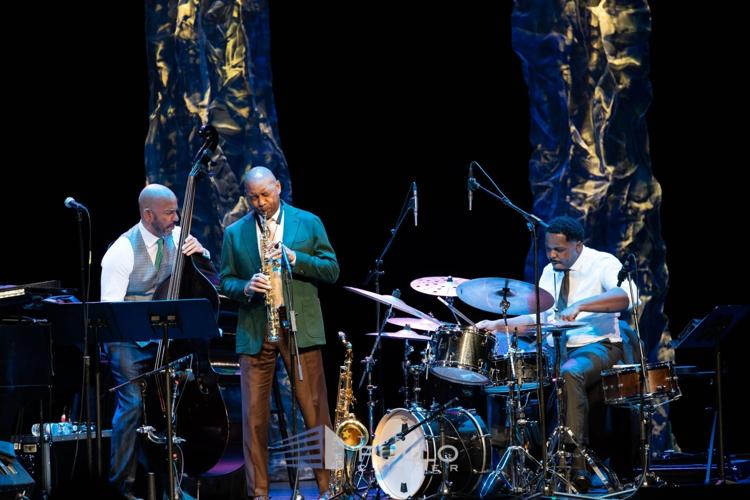
The Branford Marsalis Quartet, led by jazz saxophonist Marsalis, center, performs in 2023 at the Pullo Center in York, Pa.
Then there is Justin Faulkner on drums, though "drummer" is far too small a word for what he pulls off. Shifting between sticks, brushes, mallets and bare hands, he altered the texture of the music the way a painter switches tools for a new section of canvas. None of it was a cheap display of speed. It was pure imagination — a cymbal shimmer here, a brushed snare there, an accent you never saw coming. Faulkner made it obvious that improvisation only means something when it serves the music rather than the player’s ego.
Solos rose out of the ensemble naturally and slid back just as fluidly, with each player seamlessly picking up where the last left off. Remarkably, despite four people improvising in real time, the overall effect was incredibly calming. We live in an exhausting world built to constantly interrupt us with buzzing phones and fragmented alerts. For two hours, the deadlines and bills waiting outside the theater ceased to exist.
The setlist leaned heavily on modern jazz while nodding reverently to tradition, featuring pieces tied to Keith Jarrett, standard songbook classics, and a love letter to Duke Ellington to close the night. Earlier, "Mood Indigo" drifted through the hall as if it were being discovered for the very first time. That Ellington closer brought the house to its feet. It was an ovation recognizing that these men have put in the decades required to learn how to listen to one another. You cannot fake that kind of onstage trust.
Good jazz doesn’t hand you easy answers; it hands you better questions and asks you to sit with the unknown for a while. In my own therapy practice, I tell clients something very similar. Healing rarely shows up in a massive, dramatic breakthrough. It arrives quietly, through patience, curiosity and staying present long enough for something authentic to surface.
The night ultimately gave us permission to just breathe, notice and be completely present. That turned out to be more than enough.