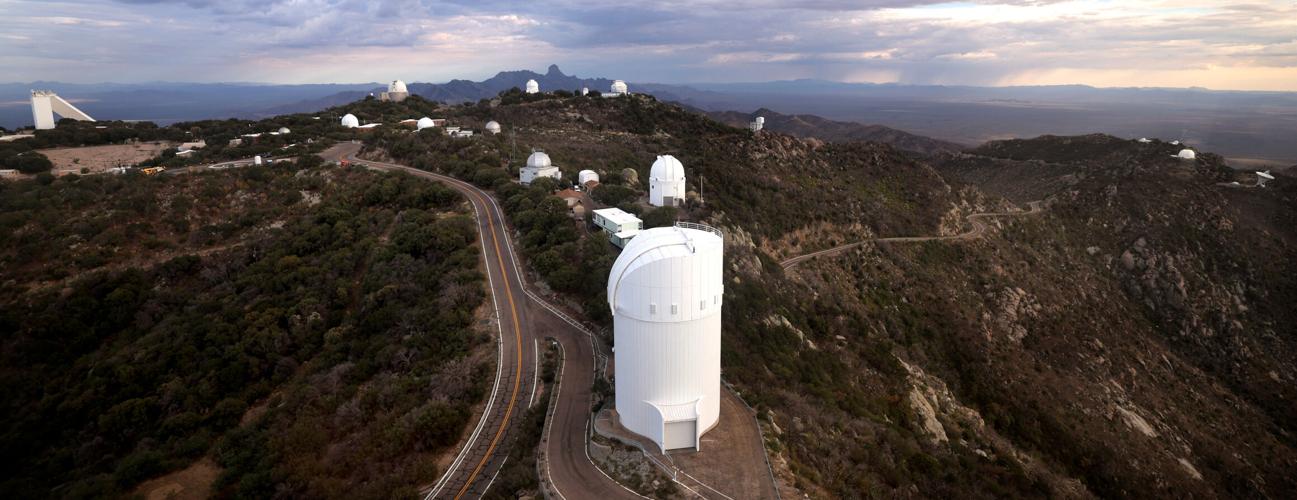
Just an hour southwest of Tucson, high above the Sonoran Desert, sits Kitt Peak National Observatory, which has inspired a sense of wonder about the universe for decades through scientific research and public outreach.
Founded in 1958, Kitt Peak National Observatory, located in the Quinlan Mountains on the Tohono O'odham Nation, features a large array of telescopes, with more than 20 optical and two radio telescopes across its mountain-top campus.
As Kitt Peak Operations Manager Peter McMahon puts it, “You can’t swing a cactus up here without hitting a telescope.”
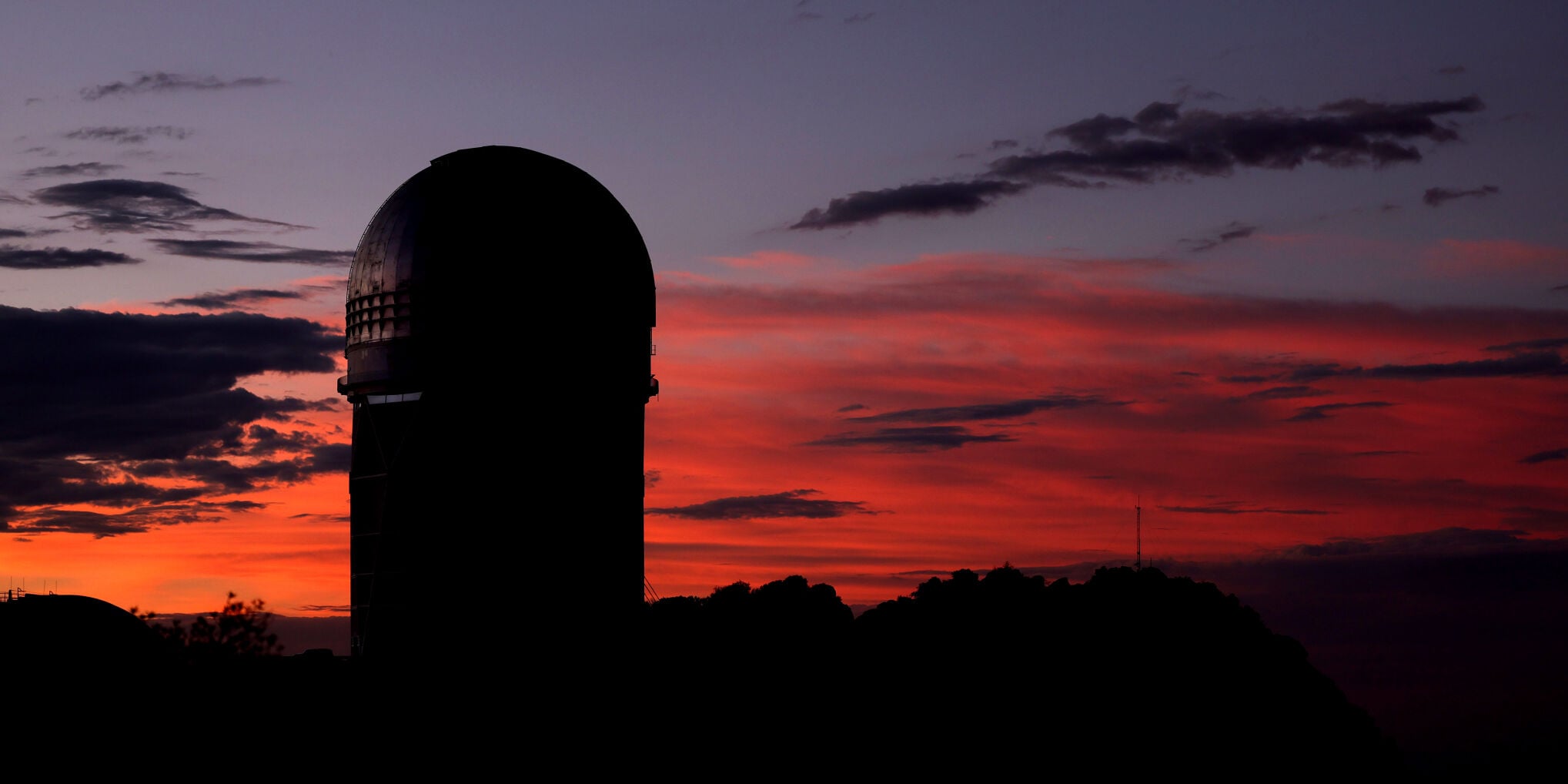
The sun sets on a monsoon night over the Nicholas U. Mayall 4-meter Telescope at Kitt Peak National Observatory.
The mission of the observatory is to inform and educate the public about basic astronomy, current research, and the nature of the scientific process, he said.
“Since it was founded, Kitt Peak has been a prime location to do astronomical research,” McMahon said. “There's this pedigree of discovery from the early 1960s to this day. These are telescopes that have been around for a while and are not only still doing relevant research, but in some cases they're doing the most cutting-edge, most meaningful research that they've ever done.”
People are also reading…
At Kitt Peak, scientific history and groundbreaking research exist side by side. In a single trip, visitors can see the telescope that helped discover dark matter, across from telescopes currently being used to study dark energy based on those past discoveries.
Today, some of the research telescopes are measuring the masses and densities of planets around other stars, discovering new exoplanets, and searching for comets and meteors. The Mayall telescope currently hosts the Dark Energy Spectroscopic Instrument, the most powerful multi-object survey spectrograph in the world, and is building the largest, most detailed 3D map of the universe.
“In many ways, the golden age of discovery at Kitt Peak is now,” McMahon said. “And what I think is really cool about the outreach that we do is the fact that you can come and personally explore our visitor center or telescopes by yourself or with our guides, amongst all of that going on.”
At an elevation of 6,877 feet, Kitt Peak can be 20 degrees cooler than the desert below, making it a perfect escape on a hot summer day.
“I think it's one of the best kept secrets, or maybe the best kept secret, to beat the heat this time of year in Tucson. You can come up and spend a whole day, you can go on one or more of the daytime tours, you can bring lunch, go on a daytime tour and then go on the nighttime tour,” McMahon said.
With tours operating around the clock, Kitt Peak is exciting both at night and during the day. While the evening hours are dedicated to stargazing and viewing the night sky through telescopes, the daytime tours focus on the scientific achievements and current research taking place at the observatory.
Kitt Peak offers three different tour options for daytime exploration of the facilities, including tours of the McMath-Pierce Solar Telescope, the KPNO 2.1-meter telescope and the Nicholas U. Mayall 4-meter Telescope.
The general admission price for each daytime tour is $24.95, or you can take a combined tour of all three telescopes for $49.95. Or, tour both the KPNO 2.1-meter telescope and the Nicholas U. Mayall 4-meter Telescope for $39.95. During the summer, daytime tours are free for kids under 17.
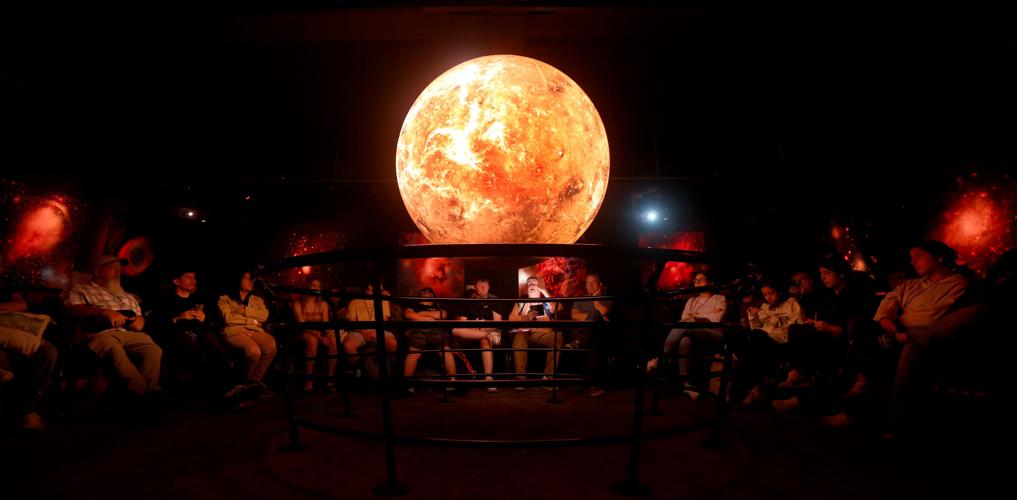
During the tour of the McMath-Pierce Solar Telescope, guests will experience the inside and outside of what was the largest solar telescope in the world for over 50 years. The tour includes a Science on a Sphere audiovisual show called The Sun, Our Living Star, in the new “Taṣogida Ki: Center for Astronomy Outreach,” billed as the world's first science center inside a working telescope.
The KPNO 2.1-meter Telescope is special for being one of the earliest telescopes on Kitt Peak, and visitors can learn about the landmark observations made there by Vera Rubin that established the existence of dark matter.
The Mayall 4-meter Telescope tour focuses on the ongoing research to map the known universe.
For visitors looking to see a sky full of stars from what feels like the top of the world and learn about the planets and constellations, the observatory offers several regular nighttime viewing programs, including the Dark Sky Discovery Program, the Magnificent Moon Program, Astro 101: Binocular tour of the night sky, as well as special programs for meteor shower viewing and lunar eclipses.

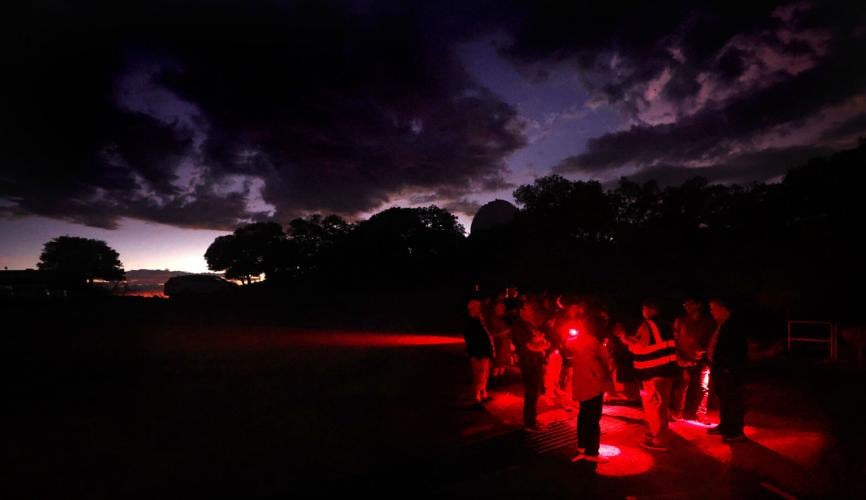
Guide Jim Schweder gathers his nighttime tour groups for a talk on the way to the Tasogida Ki: Center for Astronomy Outreach on a cloudy night this month at Kitt Peak National Observatory.
Prices for the tours range from $59 for Astro 101 to $109 for the Dark Sky Discovery Program, and during the summer, nighttime tours are $12 for kids under 17.
For a splurge, for $1,300-$2,000, the Overnight Telescope Observing Program offers the full observatory experience and makes guests a visiting astronomer at Kitt Peak, with overnight use of one of four Visitor Center telescopes, a personal guide and provided meals.
The most popular offering, though, is the Nightly Observing Program.

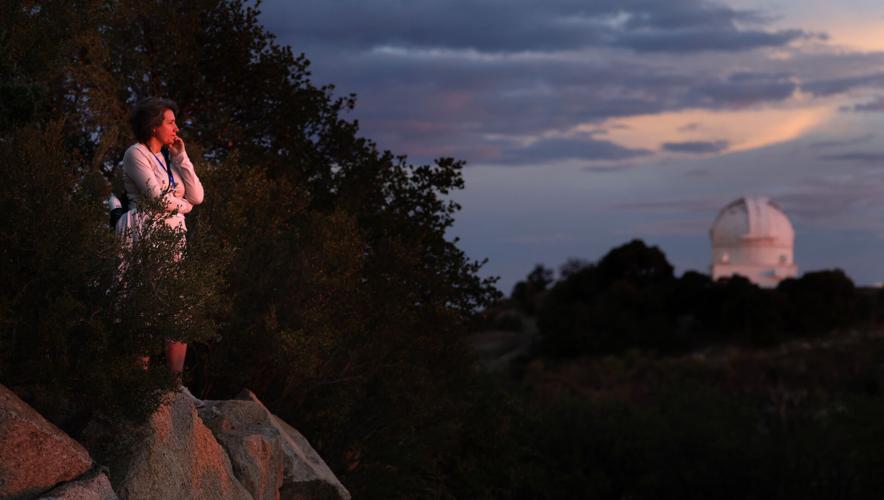
One of the night tourists finds a spot above the rest to watch the sunset from Kitt Peak National Observatory on July 14.
The night starts with a light meal and a sunset walk around part of the observatory grounds. The views from the top of the peak are breathtaking, with basins and mountain ranges stretching out endlessly, thousands of feet below. While the sun dips below the horizon and the sky begins to dim, the guides give an introduction to our sun and the other planets that make up our solar system.
After dark, when the stars come out, is when the real magic happens. If the sky is clear, as it is most nights in Southern Arizona, guests are treated to an exploration of the night sky through the large dome telescopes and a tour of some of the more visible objects, from planets to stars, nebulas and even other galaxies.

Guide Jim Schweder talks about Venus as the planet is projected for the group in the Astronomy Visualization Center in the Tasogida Ki: Center for Astronomy Outreach at Kitt Peak National Observatory.
“We'll pick three or four of the brightest objects that you can see with that telescope. We bring the telescope up, let everybody walk through, and then we're telling them about the science behind what they're looking at,” said Jim Schweder, who has been leading astronomy programs at Kitt Peak National Observatory for about four years.
Guests also have the opportunity to look at the sky through 12-inch telescopes, take pictures with electronic telescopes, and observe constellations with binoculars.
“We point out in the sky all the constellations that they can see, and the history of them, and then there's a lot of cool things you can see with the binoculars,” Schweder said. “A lot of people really want to see the night sky, if it's a clear, moonless night. A lot of these people don't ever get to see the Milky Way, and it's very nice up there.”

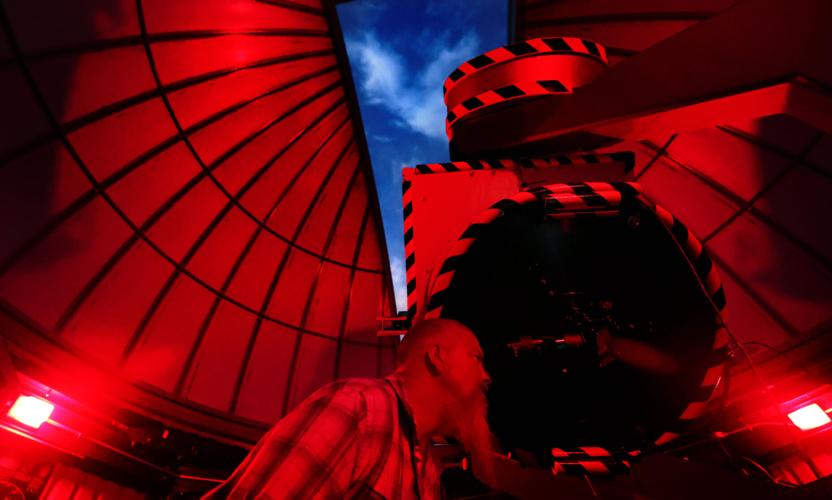
Mike Kozeniesky gets a look at a star through the Shreve .5-meter telescope just before complete darkness falls over Kitt Peak National Observatory on July 14.
During the Magnificent Moon program, “It's done in another telescope, and we focus more time on looking at the moon and then we go and look at a couple bright objects,” Schweder said.
“‘Dark Sky’ is looking at all the main things that people want to see, but then we go a little bit deeper and show some of the dimmer galaxies, so all of a sudden, you're looking at a galaxy that's 50 million light years away, or looking at a quasar.”
Schweder said his favorite part of guiding is introducing people to hobby astronomy and the science behind it. He enjoys the nights he spends under the stars.
“I just find it all so neat,” he said. “There's always a handful of objects that when people first put their eyeball on the eyepiece, they're just amazed.”

A view from the Mayall 4-meter Telescope of most of the more than 20 other observatories and telescopes at Kitt Peak National Observatory.
It’s that fascination and awe that continues to draw visitors from around the world.
“We get a lot of people from all over the world that know Kitt Peak. A lot of our overnight guests fly into Tucson just for a tour, and people who live in Tucson can take advantage of that whenever they like,” McMahon said. “If you want to cool off and do something really epic and amazing and experience something really meaningful in Tucson, you can do all of that.”