On a recent Saturday morning, Bob McBratney wandered up a cul-de-sac at the edge of Oro Valley and lay down under a mesquite tree, disappearing completely in a tall patch of weeds.
The retired doctor wasn’t lost or in distress, but JJ the Labrador retriever sniffed him out anyway.
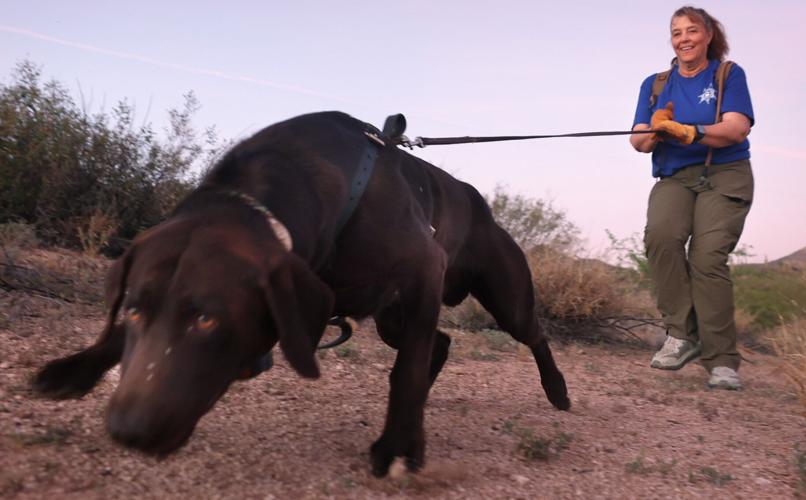
Dragging his handler, Jamie Carpenter, behind him, the chocolate brown dog tracked McBratney across roughly half a mile of desert and pavement, following tiny wisps of scent left by the man as he weaved his way through the neighborhood.
In less than 30 minutes, JJ’s nose led him to the patch of weeds and finally to McBratney, who sat up to greet his rescuer.
“Good boy, JJ!” McBratney said, after the dog nuzzled his face.
“Good boy!” Carpenter said. “Good boy!”
People are also reading…
You could tell by the way he whipped his tail, JJ knew what they were saying was true.

JJ, a Labrador retriever, has the scent and is on the trail, bringing Jamie Carpenter along for the ride during a workout of Southwest Rescue Dogs Inc.
Welcome to training day for Southwest Rescue Dogs, Inc., a nonprofit, all-volunteer K-9 search-and-rescue organization that’s been serving Southern Arizona since 1993.
Carpenter and McBratney are active members of the group. JJ is getting ready to take his final certification exam so he can join them in the field for real emergency calls.
SRDI is part of a network of five local search and rescue groups, all staffed entirely by trained volunteers who provide a range of services free of charge — from dogs and horses to air patrols and underwater divers.
Working shoulder-to-shoulder with the Pima County Sheriff’s Department and other first responders, the groups have taken part in a combined 75 missions over the past 12 months. They were called out 19 times in January and February alone, providing more than 390 people and more than 2,000 hours to those efforts, according to the nonprofit Search and Rescue Council, Inc., which coordinates the five groups.
The dogs are typically called in for cases involving missing hikers, lost children or people with dementia who wander away from home, said SRDI vice president Mike Wilke. The group was also involved in the early stages of the search for Nancy Guthrie.
Wilke said they have five dogs on their roster at the moment — three trained to locate human remains, one trained for so-called “live-find” searches and one certified in both disciplines. Five more dogs are on track to complete their training and join the team in the coming months, JJ included.
Working breeds
Carpenter said she fell into rescue-dog training in 2017 as an empty nester in search of a new challenge — preferably something meaningful and service-oriented and outside.
Her first trainee was Andy, her black Lab she managed to get search certified but who lived out his days as more of a mascot for SRDI.
“He was very happy sitting on the couch,” Carpenter explained. “He was meant to be our PR dog.”
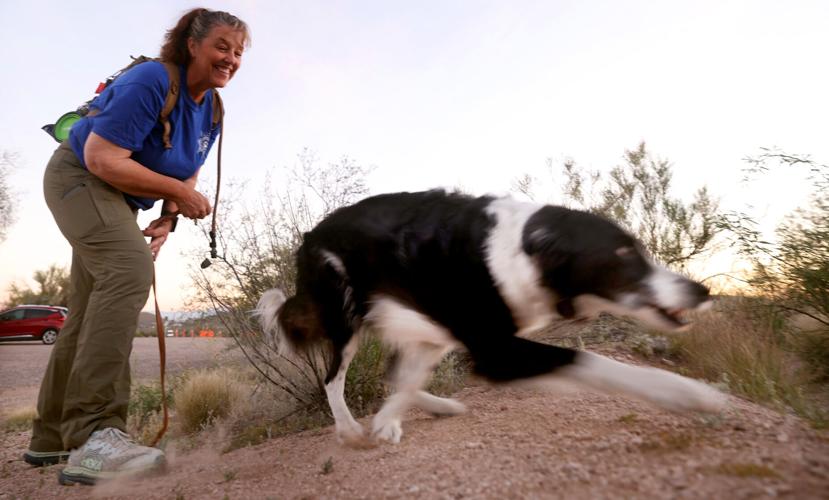
Next came Doc, a busy border collie she inherited when her father-in-law died. The dog came from herding cattle on a ranch in West Texas, so “Doc needed a job when I got him,” Carpenter said.
It took about a year to train him to track down people instead of stray cows.
Doc is 9 now and still going strong, with more than 40 search missions under his collar.
“He's dual-certified, so he's what we call a wilderness canine,” Carpenter said. “He will find anybody that's out there, whether they're, you know, alive or not.”
She got JJ as a pup in 2022 and has been grooming him to join the team almost ever since.
“It's definitely my passion,” said Carpenter, who also volunteers these days with the Southern Arizona Rescue Association, SRDI’s all-human search-and-rescue sister organization. “I think it is a great resource to the community and a great way to give back to the community. And I get to enjoy the outdoors and play with my dogs.”
Wilke had two main things to offer when he first started volunteering with SRDI about 13 years ago: years of backcountry experience with the U.S. Forest Service, and a young, energetic Australian cattle dog named Dexter.
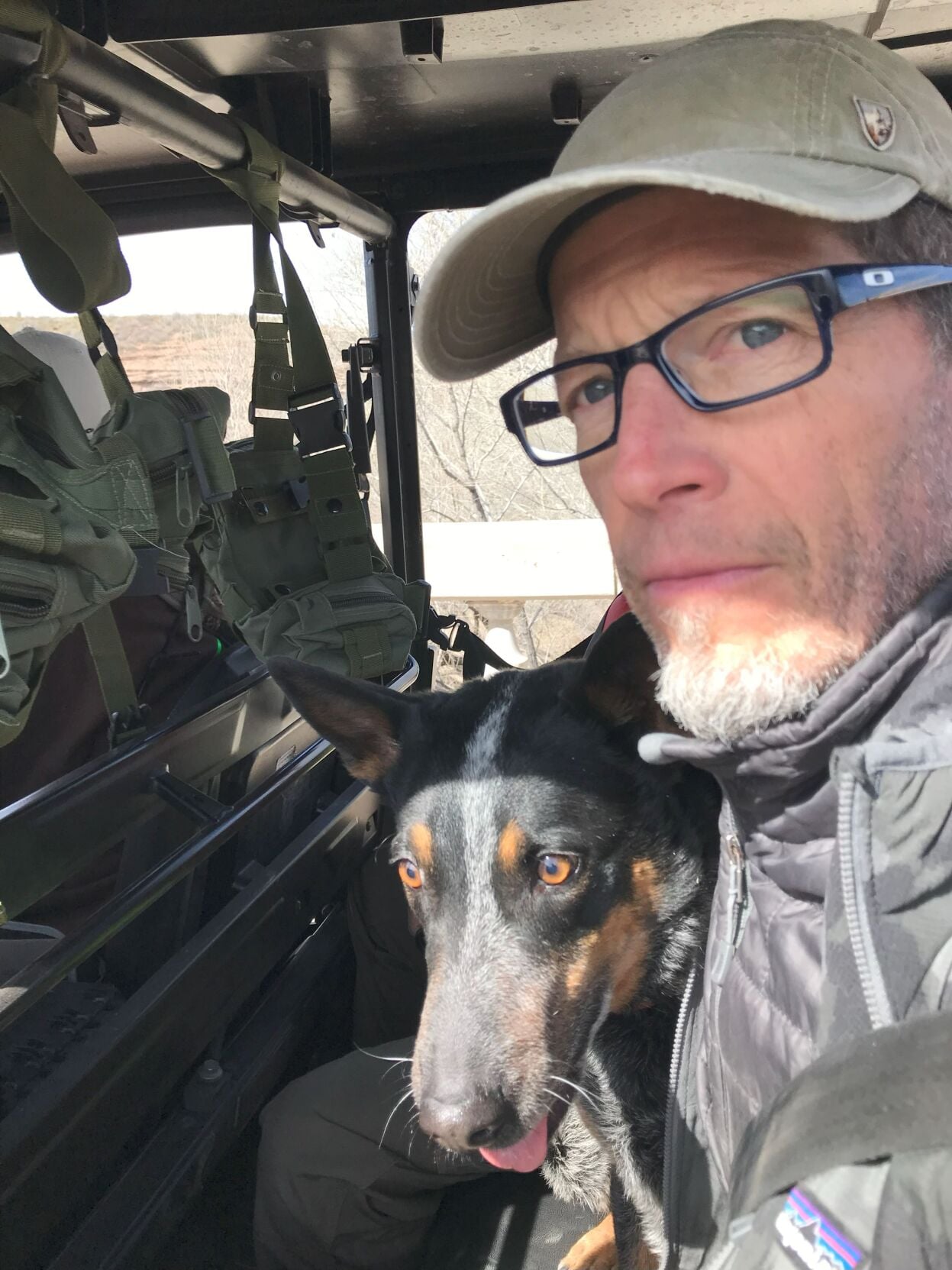
Mike Wilke and his rescue dog, Dexter, in the field.
“I'm just kind of an outdoor guy. I know the trails around here and have been in pretty much every mountain range, so search and rescue is kind of a natural for me,” he said.
Dexter started out as a tracking dog, tethered to Wilke with his nose to the ground as he followed the path of a specific person whose scent he had been told to search for. Then someone on the team suggested turning the dog loose to conduct his own area searches.

Doc, a border collie, takes off as soon as Jamie Carpenter looses the leash for a search during a training session at a Southwest Rescue Dogs Inc. workout in Tucson.
“When I finally took him off the leash and he was allowed to find his own way to the person, he was just ecstatic,” Wilke said.
He later got Dexter certified as a cadaver dog as well. It was just a matter of “giving him a different scent picture that I wanted him to respond to,” Wilke said.
Dexter took part in 50 to 60 searches over his decade-long career. He was retired about three years ago at the age of 12, but not before he notched at least one confirmed recovery — a lost hiker in the Tucson Mountains found dead by suicide.
“We went out not knowing the gentleman was deceased,” Wilke said.
Led by the nose
Training dogs for search-and-rescue mostly involves channeling their staggering, natural-born sense of smell into a fun game of hide and seek.
“Any dog that you're training has to have some sort of reward system, something they really like,” Wilke said. “Some dogs get a food reward. Dexter loved to tug, so I had some tug toys and that was his reward.”

Mike Wilke and his rescue dog, Dexter, prepare to go to work.
Carpenter said Doc’s “paycheck” is a ball. “He wants you to throw the ball.”
JJ’s reward is beef baby food, which she carries in the jar so she can dole it out to him when he earns a treat.
But what the Lab seems to crave more than anything is the positive attention he gets for a job well done. “He's a dog who loves to track, so he gets a lot of his reward just out of tracking,” Carpenter said. “He would prefer to be rewarded with another track.”
Early on, the training can be as simple as putting a half dozen coffee cans on the ground with different scent sources in them, then leading dogs down the line and rewarding them when they hone in on the smell you’re teaching them to find.
They also use animal bones and other enticing smells during training to teach the dogs to avoid distractions and pay attention to the task at hand. “I mean, they're still going to go over to it if it's a pork chop. But these real working dogs, they honestly put their reward above all this other stuff,” Wilke said. “It's just amazing, man. They're just so focused. It's really a joy.”
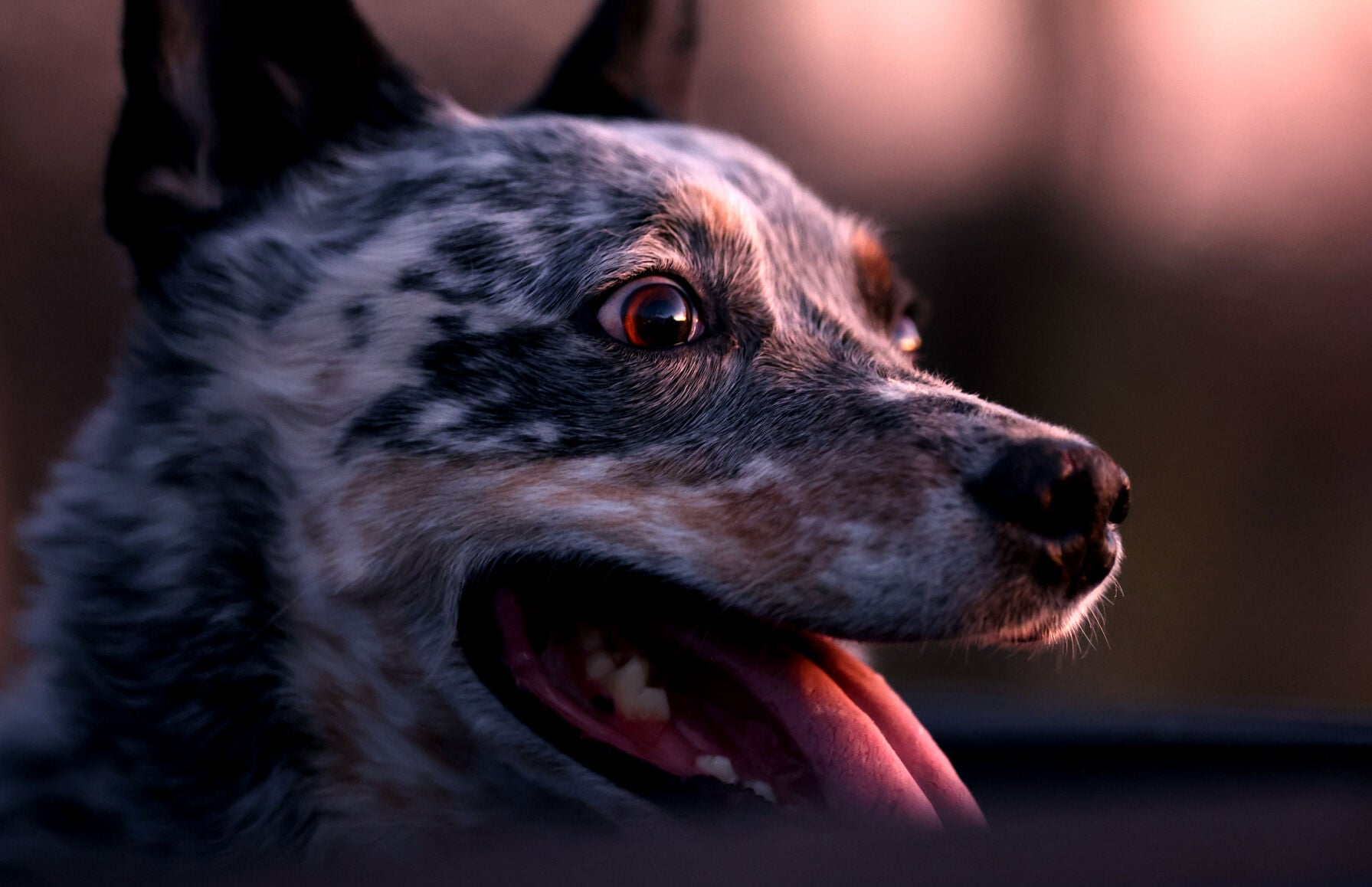
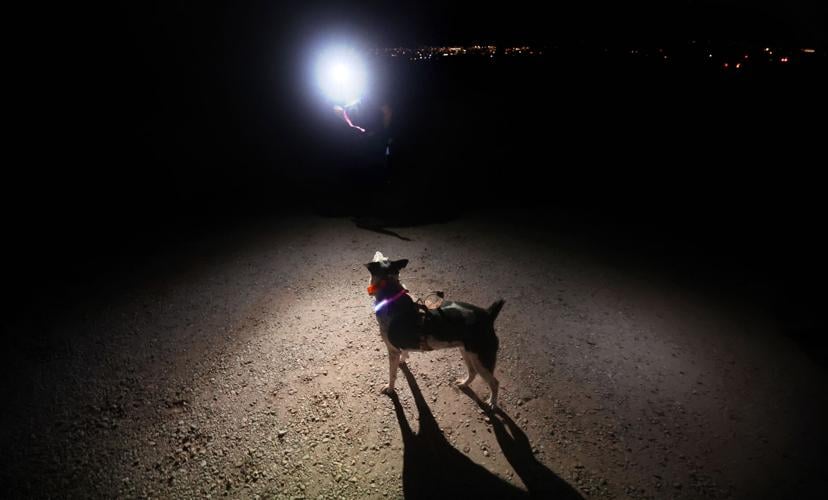
Nunca, a blue heeler, keeps an eye out on all the activity at a Southwest Rescue Dogs Inc. workout in Tucson, eagerly waiting in a truck bed for the next training run.
Some dogs are taught to seek out specific individuals based on a sample of their scent from a personal item like a hat or a glove or a water bottle. Others are trained to follow their noses to any and all humans in a given search area.
For cadaver dogs, Wilke said, they train with “legally obtained materials” they get through the medical examiner’s office — a finger, a tooth, occasionally an arm. Usually a piece of cotton gauze or other small item that has come into contact with those remains will be used for the training itself.
Since the average canine nose is thought to be as much as 100,000 times more sensitive than that of a human, very little residual scent is needed for a trainee to find it. Wilke said he’s seen Dexter pick up a faint smell from a source that's as much as half a mile away.
There are even some dogs that specialize in finding buried remains dating back centuries, making them useful in historical research or on surveys for sensitive cultural resources at construction sites.
Train like dogs
In theory, Wilke said, any dog can be trained to follow its nose, but certain breeds are better suited to the rigors of search and rescue work.
In his experience, herding dogs and other working breeds seem to have the best work ethic and body type for the job. Size matters when you’re hiking great distances in the backcountry, he said. A toy breed might be too small to cover much ground while a giant dog runs the risk of wearing out or succumbing to the heat, leaving its handler with a 100-pound burden to carry back out.
Temperament is important, too.
“We've got a lady whose (first) dog didn't work out mostly because it wanted to bite people. It was very protective of her,” Wilke said.

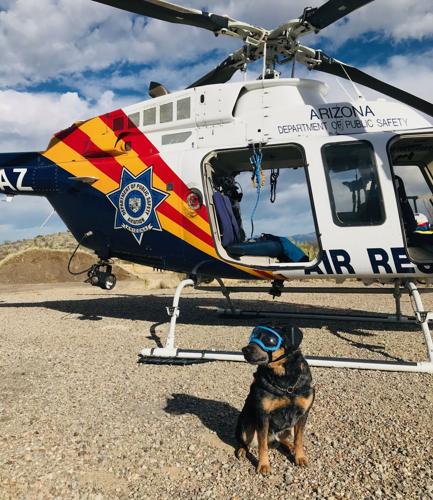
Dexter the rescue dog strikes a pose during helicopter training.
Rescue dogs also need strong nerves, so they can stay calm and focused while searching along busy streets or around distractions ranging from strangers and sirens to horses and helicopters. “They can't be completely afraid of their shadows and that kind of thing,” Wilke said.
His other cattle dog, for example, probably doesn’t have a future as a first responder. Though the 3-year-old is a decent enough hiker, she gets so anxious in the car that he has to drug her to keep her from throwing up or foaming at the mouth.
To train for SRDI, dogs must be between the ages of 6 months and 7 years, with a handler who is at least 18. All dogs must pass a basic obedience test.
Advanced obedience training is required for search dogs like Doc that are trained to work off-leash, Carpenter said. “So when we do turn him loose, he's not going to approach other dogs. He's not going to go chasing a deer. He's specifically out there looking for a human.”
Wilke said the final certification test for live-find dogs typically involves locating an unknown number of subjects hiding across a half-mile-square plot within a set amount of time.
The test for human-remains certification requires the dog and its handler to search several smaller areas — maybe an acre or so each — to find scent sources scattered on the ground, hanging from trees or buried just under the surface. Wilke said one of the areas is left empty to test whether handlers can recognize when their dogs don’t find anything.
SRDI holds three practice sessions each month to train new recruits and provide a refresher course for those already on the team.
“We do trainings during the day, and we do trainings at night,” Carpenter said. “Our dogs have to be used to working with headlamps and working in the dark and being comfortable with that.”

Azul, a blue heeler, looks back to see if Maliaca Oxnam is keeping up during a training search in Tucson for Southwest Rescue Dogs Inc.
The sessions also offer a chance to test new skills and game out unusual situations. During nighttime training on March 18, for example, the dogs had to sniff out someone who was up in a tree, Carpenter said. “We do different scenarios, because we never know what people are going to be doing when we find them.”
The animals aren’t the only ones who require training.
Each search team includes a dog, its handler and a field assistant known as a flanker, who might be called on to handle the radio, carry extra water and supplies and provide another set of eyes.
Before a human can deploy with the team, he or she must be certified in CPR and outdoor emergency care and undergo training in radio communications, wayfinding, basic wilderness survival, knot and rope skills, biohazard handling and procedures for working around helicopters and crime scenes.
“You don't want the rescuers to be part of the problem. You don't want them to go out there and then have to be rescued as well,” Wilke said.
Step by step
The training session last month that sent JJ into the weeds after McBratney was designed to test the dog’s tracking skills across variable surfaces.
McBratney was given a head start of roughly an hour before Carpenter and JJ started out after him with Wilke and another flanker following close by.
As McBratney hid, he listened in on the radio and traced the team’s progress on his cell phone using a mapping tool synced with the dog’s GPS collar. The search party followed his trail along a blind course that took them across the Loop near Overton Road, right in the middle of a marathon they didn’t know was going on that morning.
“That was just an added bonus for our training,” Carpenter said, providing both visual distractions and a stew of other human scents to contaminate the trail JJ was trying to follow.
Wilke said tracking dogs literally follow in the steps of their targets by smelling the invisible rafts of skin and oil people leave behind with every footfall. Factors such as temperature, wind, humidity and terrain can all impact a dog’s ability to track.
On a hot day, when the direct trail left by a subject has been largely baked away, the dog might have to rely on faint wisps of scent lingering in the shade of nearby bushes or caught against a rock, a curb or a reflector poking up from the surface of the road.
“They call it island hopping,” Carpenter said. “You go from shade spot to shade spot. (Dog teams) have to be very resourceful once it gets super hot.”
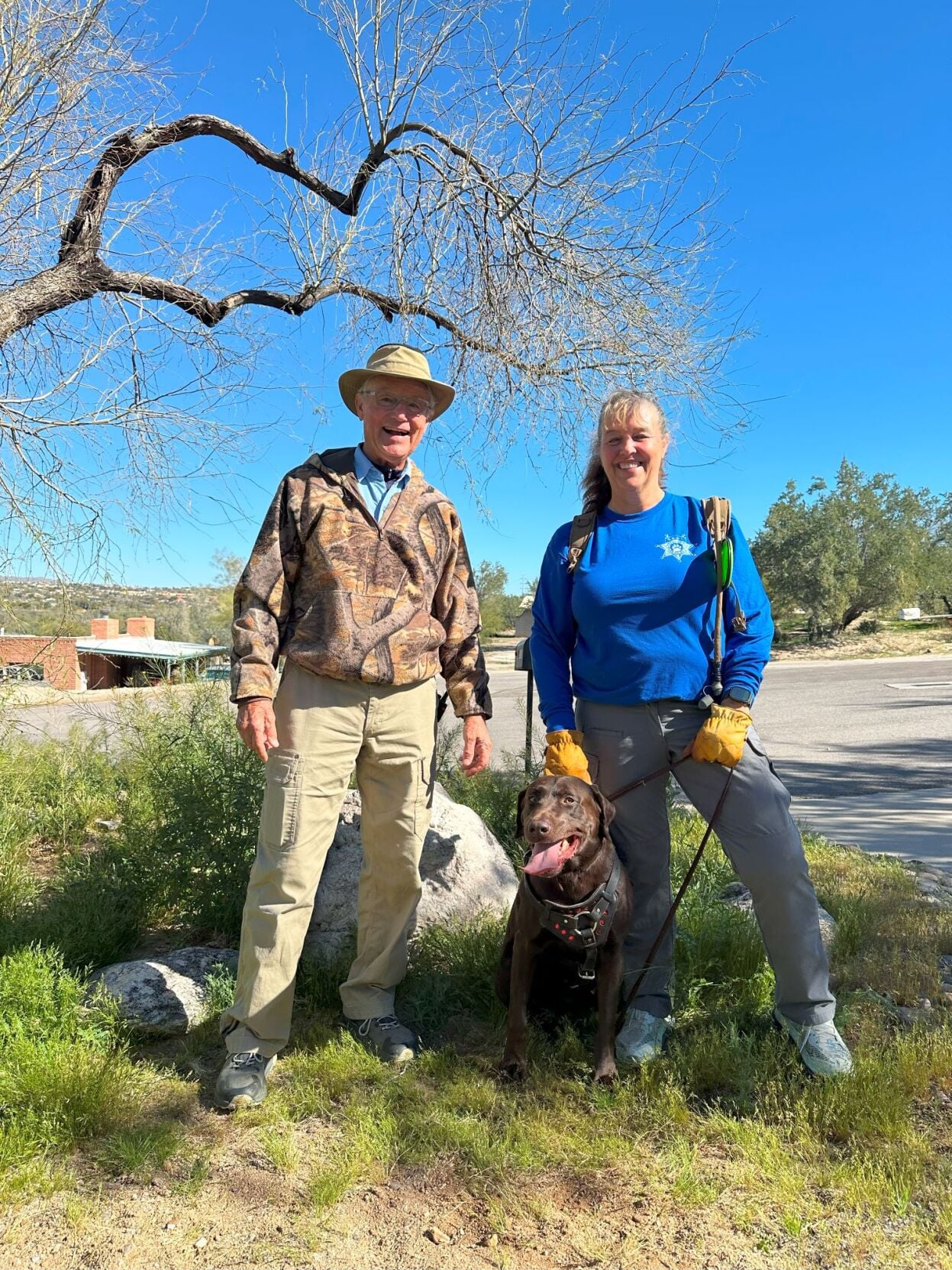
Bob McBratney, left, poses with JJ the Labrador retriever and his handler, Jamie Carpenter, after the dog successfully tracked McBratney to the yard of a home at the edge of Oro Valley during rescue training on Feb. 21.
Handlers almost never see what their dogs are smelling, so they have to be able to recognize clues the animals give off. Trainers will record their practice searches on video so they can go back and learn the telltale movements and behavior.
“We have to infer where the scent is by what the dog's doing,” Wilke said. “When you can read your dog, it's fantastic to watch.”
JJ, for instance, tends to crouch and wiggle with his nose turned down and his tail wagging slightly when he is locked on track. “They call him the honey badger, because he pulls really hard and he's got that real waggle to him,” Carpenter said.
If the dog pops his head up several times, it means they are approaching a sharp turn in the scent trail, and he’s trying to reacquire the odor that has suddenly disappeared from in front of him.
Finally, as he closes in on his subject, JJ’s tail will start wagging like crazy. That’s his proximity alarm, Carpenter said.
In the end, it took JJ about as long to trace McBratney to the end of his trail as it took the man to walk it in the first place. As far as Carpenter is concerned, this good boy is more than ready to pass his certification test and report for active search-and-rescue duty.
“It's incredible what our dogs are capable of,” she said. “They're definitely a lot more capable than we give them credit for.”