A pregnant Colombian woman in her third trimester has been released from Eloy Detention Center, three weeks after what the woman described as a violent arrest by a border agent in Arizona.
Lesli Vaca Díaz, 29, said she was released from U.S. Immigration and Customs Enforcement detention July 25 and arrived at her older brother’s home in Colorado late that night.
“We cried and hugged each other, and called my family to surprise them that I had gotten out,” she told the Arizona Daily Star on Monday, speaking in Spanish. “I’m so happy and grateful to God.”

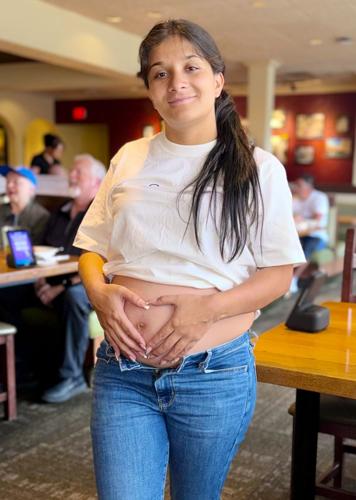
Lesli Vaca Díaz, now 30 weeks pregnant, displays her baby bump at a Colorado restaurant July 27, two days after her release from ICE’s Eloy Detention Center in Arizona.
Vaca Diaz’s release, under ICE supervision, came one week after the Star reported on her July 2 arrest by Border Patrol agents, after she crossed the U.S.-Mexico border near Douglas. Vaca Díaz, who was 27 weeks pregnant at the time, said a border agent struck her so hard on the back that she had the wind knocked out of her and fell to her knees, before the agent “slammed” her against the side of his vehicle.
People are also reading…
After a medic told her she was at risk of pre-term labor, Vaca Díaz was helicoptered the same night to Banner University Medical Center in Tucson, where she was admitted for several days, she said.
Vaca Díaz said she’s still suffering pain due to the border agent’s strike to her back, near her kidneys and spine, and she wants to file a complaint against the agent she says struck her.
In a July 17 statement to the Star, U.S. Customs and Border Protection, Border Patrol's parent agency, said the agency is investigating the claims.
"While in CBP custody, the individual was transported to a hospital for pregnancy-related care and evaluation,” the emailed statement said. “CBP’s Office of Professional Responsibility is investigating the allegations, and no additional information is available at this time. CBP remains committed to upholding the highest standards of professionalism.”
Vaca Diaz said she did not get enough nutritious food while detained at Eloy and she struggled to sleep, especially when the air conditioning broke, and she felt she was “suffocating.”
She said she’s lost weight since her arrest.
“I’m very thin,” she said.
She’s resting and recovering from what she said was a psychologically and physically harmful experience that she believes put her pregnancy at risk.
Vaca Diaz’s brother, José Antonio, said he’s felt “helpless” and “emotionally exhausted” due to how much he’s been worrying about his little sister since she was detained three weeks ago.
“I wanted to help and protect her, but so much was beyond my control,” he said in a Monday message, written in Spanish. After his sister’s release, “I feel immense happiness and relief. It's as if a huge weight has been lifted from our shoulders. The most important thing for us is knowing she’s safe with her family, and that she can continue her pregnancy in a peaceful environment.”
Advocates say ICE is detaining more pregnant, nursing or postpartum women under the second Trump administration, despite a 2021 policy directive advising against detaining those women except under “exceptional” circumstances.
As of July 16, ICE was detaining 70 pregnant women and 12 women who were either postpartum or nursing, ICE told the Star. ICE has not responded to the Star's query on whether ICE is bound by the 2021 directive.
The ACLU sent a letter to ICE in October 2025 documenting claims of medical neglect and abuse of pregnant women at ICE facilities nationwide.
Over nine months, “Almost all the women we interviewed reported inadequate prenatal care, denial of prenatal vitamins, and/or medical neglect while detained, which further underscores why ICE should not detain pregnant individuals,” the letter said.
In an emailed statement, DHS defended its care of pregnant women in ICE custody, which is civil detention, not intended as punishment for any crime.
"Pregnancy in ICE detention is exceedingly rare — making up 0.15% of all illegal aliens currently in custody, as of June 30,” DHS said in the statement. “Pregnant women receive regular prenatal visits, mental health services, nutritional support, and accommodations aligned with community standards of care. In addition to medical, mental health, and dental services provided to all detained women as required by ICE detention standards, facilities provide women with pregnancy services such as pregnancy testing, routine or specialized prenatal care, postpartum follow-up, and nursing services."

Colombian national Lesli Vaca Díaz, who was 30 weeks pregnant as of July 24, displays a photo from an ultrasound she received while in ICE custody in Arizona. Her older brother José Antonio shared the image, which is a screenshot he took during a video call with his sister in late July. Vaca Diaz was released from Eloy on July 25.
While at Banner UMC in Tucson, Vaca Díaz said she struggled to sleep due to the armed border agent standing guard in her room.
She repeatedly asked to call her family and a lawyer, but border agents and hospital staff following agents’ orders prohibited her from making any calls, Vaca Díaz said. On July 4, someone at the hospital finally let her call Tucson immigration lawyer Luis Campos.
Holding non-criminal immigrants “incommunicado” at a hospital raises due-process concerns and raises questions about hospital priorities, said Campos, who is representing Vaca Díaz in her immigration case.
“When the hospital participates in or at the least acquiesces to Department of Homeland Security (orders), there’s a concern the hospital has become complicit, especially when those agents are requesting unreasonable things,” such as denying phone calls to a woman in an advanced stage of pregnancy, he said.
“To me, that’s completely unreasonable and inhumane,” Campos said. “Hospitals and other similar medical facilities have a duty to their patients, regardless of immigration status, to provide treatment and care in a non-threatening environment.”
Banner declined to answer the Star's specific questions on Vaca Díaz's claims earlier this month, citing privacy laws.
"Banner Health is committed to providing safe, high-quality care to all patients while maintaining a secure environment for patients, staff, and visitors," a spokesperson said in a July 16 email. "We maintain policies governing the care of patients who are in the custody of law enforcement or correctional agencies, including federal immigration authorities. Under those policies, the custodial agency remains responsible for custody, security and related restrictions applicable to individuals in its custody, while Banner clinicians remain responsible for medical care and treatment decisions."
Vaca Díaz said she was deported earlier this year, but returned to the U.S. because she no longer has any connections in Colombia; her whole family is in Colorado.
Vaca Díaz said she’s pursuing an asylum petition. After her release from Eloy, she was initially fitted with an ankle monitor until the ICE officer realized she was pregnant and removed it, she said.
On Monday, she got approval to return to the job she had before she was deported, as a driver for a rental car company, Vaca Díaz said.
Being with her family again is healing, she said Monday.
“I'm recovering psychologically because being confined gives you a lot of (negative) mental thoughts,” she said. Living with her brother again, “I feel safe, and lucky,” she said.
Contact reporter Emily Bregel at ebregel@tucson.com. On X, formerly Twitter: @EmilyBregel

Emily Bregel
Border reporter

 Two pregnant detainees hospitalized in Arizona; one claims border agent struck her