Like so many Tohono O'odham tribal members lured into driving or storing loads of marijuana, Jenny Lopez got an offer from Mexican drug smugglers she couldn't refuse:
If she'd drive a car loaded with marijuana across the U.S.-Mexico border and through the Tohono O'odham Nation to Phoenix, she'd get money to buy a car, two days in Rocky Point and some cash, a Tohono O'odham police report shows.
She got her trip to Rocky Point, but her car was seized and the promise of cash evaporated on May 10 when O'odham police stopped her north of the U.S. - Mexico border and found 145 pounds of marijuana in the cushions and back seats of her 1996 Dodge Intrepid.
Police arrested Lopez, 33, and her passenger, Lucy Ann Garcia, 41, after the two admitted to knowing about the drugs. The U.S. Attorney's Office lodged felony drug charges against them that carry a maximum sentence of 20 years, although Lopez's case was later dismissed.
People are also reading…
On a poverty-stricken reservation intersected by one of the border's busiest drug smuggling corridors, more tribal members are accepting similar offers — lured by quick, easy money and little threat of punishment, say tribal leaders.
The percentage of suspected drug smugglers arrested by Tohono O'odham police who are tribal members has increased sixty-fold in the last two decades, said Sgt. David Cray, a 19-year veteran of the agency's anti-drug unit.
Mexican drug smugglers "flash cash to them, and once they get sucked in, it's hard to get out," said Tohono O'odham Police Chief Joe Delgado.
Spurred by concerns about erosion of tribal culture and the decreasing quality of life on the Tohono O'odham Nation, tribal Chairman Ned Norris Jr. is openly discussing what he calls a crisis and soliciting more assistance from non-tribal agencies. That marks a dramatic shift from past tribal leaders who downplayed the issue.
"It's important for us to get these kind of things out on the table and accept the fact that, unfortunately, we've got people within the nation that are bought into the business of smuggling," Norris said.
Some tribal members and non-tribal law enforcement officials applaud the shift.
"There wasn't a lot of openness to help from the outside," said Anthony Coulson, head of the U.S. Drug Enforcement Administration's Tucson office. "This is a whole new paradigm for us."
But merely acknowledging the problem won't make it disappear, say tribal members. Smuggling is deeply rooted and often a family affair, making tribal members more apt to ignore it than report it.
That's a major reason it continues, said Edward Reina, Tohono O'odham Nation director of public safety.
"On all tribes, it isn't just one family, we are all related," Reina said. "Nobody wants to turn anybody in. If they do, they will not be part of the family."
After a 1999 arrest, former Tohono O'odham Nation tribal judge Mary Audrey Dolaretta Juan was convicted on drug- smuggling charges and sentenced to one year in federal prison. Juan is the sister of Vivian Juan-Saunders, who preceded Norris as tribal chair from 2003 to 2007.
This year, in March, the former judge's son, Dandrich B. Juan, 35, was arrested by Tohono O'odham police on suspicion of smuggling marijuana. Court records show it wasn't Dandrich's first arrest: In 1997, he was sentenced to 37 months in federal prison on drug charges.
The core values and culture of the O'odham are under assault, some say, with so many tribal families involved in the smuggling.
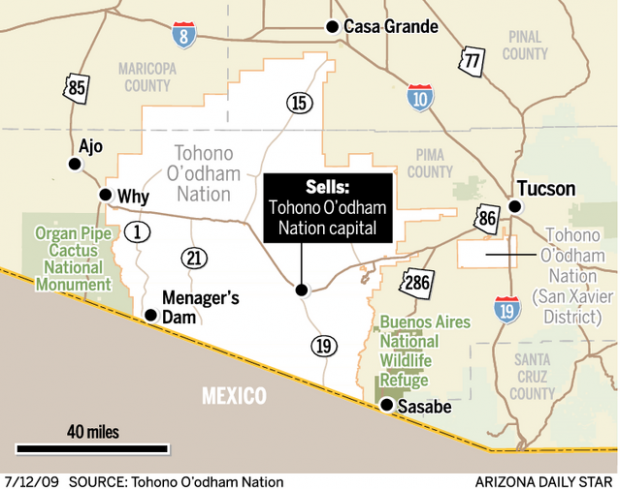
"It's a continuation of the genocide of our culture," says tribal member Ofelia Rivas, an activist for O'odham rights and resident of the small border village of Ali Ak Chin, commonly called Menager's Dam.
When Sgt. Cray began working on the Tohono O'odham police drug unit in 1991, an estimated 99 percent of people the unit arrested for drug smuggling were non-tribal.
Mexican drug smugglers carried drugs across the border, left them at a predetermined spot and drivers picked them up.
But as tribal police caught on and began busting them, smugglers started recruiting tribal members to store loads or drive drugs north.
Today, at least 60 percent of those arrested for drug smuggling are tribal members, Cray said. Through the first six months of 2009, 29 of the 45 arrests O'odham police made for smuggling drugs were of tribal members.
That's even higher than the statistics Chairman Norris presented in April at a Senate hearing on border violence. He said nearly 30 percent of the 534 drug cases that originated from O'odham police arrests and prosecuted by the federal government from 2004 to 2009 were of tribal members.
The jump is due to a surge in recruiting that stems from the growing number of Border Patrol agents on the Tohono O'Odham Nation and the recent construction of steel vehicle barriers that line most of the 75 miles of international border. Whereas police must have reasonable suspicion to pull over tribal drivers, they can question any non-tribal person driving on the reservation's restricted areas, which include desert roads or routes south of Arizona 86.
There's no shortage of willing drivers, tribal leaders say.
"There's so much unemployment," Cray said. "It's easy to find a driver."
The Tohono O'odham Nation's unemployment rate is 26 percent, and the average income is $8,100, tribal officials say.
Smugglers offer $700 to $5,000, depending on the type of load, to tribal members to either drive a load or store drugs at their home or in a shed, Norris said.
"If you don't have food on the table and somebody comes along and says drive 15 miles and make so much money, people are going to do it," Rivas said.
Tribal members who get enticed by the money range from teenagers to the middle-aged and include as many women as men. But tribal officials are most concerned about the youths who get sucked in. "It's difficult to get that culture and tradition back," Reina said.
The temptation has always been there for O'odham youths, but the volume of marijuana coming across the border now has increased the opportunity to get involved, Norris said.
Smugglers have been employing another tactic to expand their operations: getting romantically involved with tribal women and having children with them, said Delgado, the police chief. As fathers of tribal children, they cannot be kicked off the reservation and can more easily draw people into the smuggling.
In Menager's Dam, these men often coerce or threaten other family members of the women into smuggling, Rivas said.
Even when tribal members willingly become involved, they are relegated to foot-soldier roles and not elevated into key, decision-making positions within the drug smuggling organizations, said the DEA's Coulson. "They are exploited by the organization, rather than a part of it," he said.
A common strategy right now is for tribal members to drive cars not registered to them with marijuana in hidden compartments, Sgt. Cray said.
Tribal drivers don't stick out on the reservation and the drugs are more difficult to sniff out than a car full of bales — decreasing the chance of being caught.
Most importantly, the tactic provides a tailor-made alibi. Tribal members tell police it's their friend's car and they had no idea about the drugs.
Without a confession, federal prosecutors usually pass on the case, Cray said.
The U.S. Attorney's Office in Tucson takes all "viable" cases from the Tohono O'Odham Nation, said Lynnette Kimmins, chief assistant U.S. attorney in the Tucson office. "It's got to be something that can be proved in court," she said.
Of the 2,303 drug prosecutions from U.S. attorney's Tucson office from fiscal years 2006 to 2009, 16 percent originated on the Tohono O'odham Nation, she said.
If the feds pass on a case against a tribal member, the case stays in tribal court, where the the maximum sentence is one year and convictions don't show up on the national police database, Cray said.
One tribal woman has been arrested four times with marijuana in her car but refuses to answer any questions, Cray said. The U.S. Attorney's Office declines prosecution each time because she hadn't admitted to knowing about the drugs.
"We catch people two, three, four times," Cray said. "It's kind of a joke. There is no real punishment."
Chairman Norris has recently met with officials from the Drug Enforcement Administration, Immigration and Customs Enforcement and the Arizona Department of Homeland Security to get assistance in combating the smuggling.
"There has been some resistance, some hesitation from some tribal leaders to not want to take advantage of those outside resources that may be available," Norris said. "But we're at a level where we need those resources. We have to be able to do that while at the same time protecting the sovereignty of the tribal nation itself."
Outside help is fine, but the real answer is focusing on known smuggling communities and persuading residents to stop tolerating the smuggling, said David Garcia, a tribal councilman from 1995 to 2003.
"People know that it's going on, but if it's a family member or relative, nobody is going to say anything," Garcia said.
Tribal member Rivas said the drug-smuggling organizations intimidate people so they don't say anything. They used to come into Menager's Dam with weapons set up on top of their trucks, she said.
"The majority of the people will not do anything for (fear of) their own safety," she said.
Tohono police officers have been doing more outreach work in communities, including conducting open forums to talk about the smuggling.
"A lot of them are saying they are tired of this and they are reporting the violators," said Reina, the tribe's public safety director. "Without the communities' involvement, we can't do anything. They know everybody that does this."
Tohono O'odham police also work with the Boys and Girls Club in programs such as boxing and talk to graduating high school students about the dangers of getting involved in drug smuggling, Delgado said. Once a person starts, he said, it's difficult to stop.
On the day police arrested Lopez and Garcia, Garcia told them that they had driven another load of drugs across the border two days earlier.
Lopez was on release pending federal charges from that arrest when she was stopped on June 14 by a Border Patrol agent in the same area where O'odham police nabbed her the month before.
When the agent approached the truck, the criminal complaint says, Lopez said, "I don't have any drugs in the car, you can check if you want."
Agents did, and found 65 pounds of marijuana in the gas tank and spare tire of the 1997 Ford pickup she was driving.
Lopez is back in federal prison, awaiting trial on the drug charges.
1 percent
of suspected drug smugglers arrested by Tohono O'odham police in 1991 were tribal members.
64 percent
of suspected drug smugglers arrested by Tohono O'odham police through June 2009 were tribal members.
16 percent
of drug prosecutions handled by the U.S. attorney's Tucson office in fiscal years 2006-2009 originated on the Tohono O'odham Nation.
75 miles
of U.S.-Mexico border are on the Tohono O'odham Nation.
SOURCES: Tohono O'odham Nation, U.S. Attorney's Office