

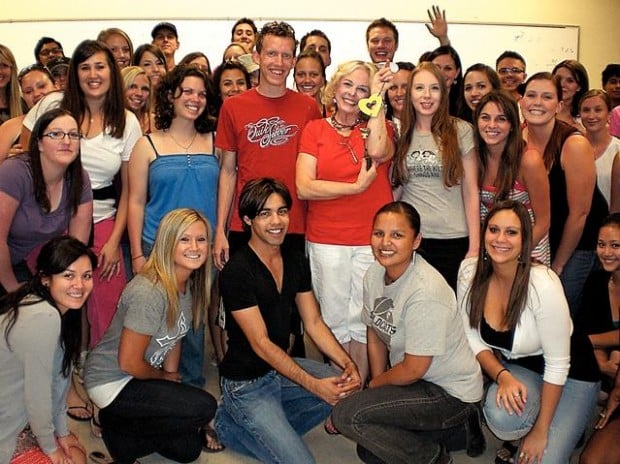
The recipient of this week's Ben's Bell is Patti Harada, who teaches dozens of UA students every semester how to turn pain and trauma into powerful forces of self-growth.
Harada was nominated by several of those students, including Alyssa Shaffer, who said the semester she's spent in Harada's Psychology of Death and Loss class at the University of Arizona has been amazing, adding that "people have had their lives changed here."
"I think it should be mandatory in all schools and not just at the college level, but in high school, too," she said. "If people could just hear these things, they'd realize they're not alone."
Harada, an adjunct faculty lecturer, began teaching the class in 1999 after working for decades as a grief and trauma counselor in California and Tucson — she also has been the support-group counselor for Homicide Survivors for about eight years.
People are also reading…
Through the years, Harada, 62, also has taught psychology of love and spirituality, human sexuality and the psychology of religion and spirituality. But the death and loss class has always been a constant in the psychology department, one that fills quickly each semester and typically attracts 65 to 70 students.
"I teach a particular way of dealing with pain, basically teaching people to become peaceful with their body when they have pain and to become, effectively, kind to themselves," she said. "I teach people how to grow through deep crisis."
In class, that means a lot of deep thinking about pain and grief. Harada leads students in meditations and has speakers come in to talk about the pain they've endured — police officers share their experiences, for example, and parents talk about losing children or other relatives. Eventually, students begin to share their own stories and learn how to talk to others, so that even more people begin to heal themselves and move forward.
"The lessons that she teaches are life-altering," Shaffer said. "It sounds so simple — everybody dies. But if you think about it, it's so complicated, and there are so many different feelings. Some people are sad, or some people are angry or ashamed."
Shaffer, a senior who's majoring in psychology, added: "Everybody thinks that they're alone in their pain, or alone in thinking that death has only affected them, but sit in the class for one day and you hear life-changing stories about how death has come into someone's life and changed them. It makes you go from being a totally alone, independent person to being unified. It's amazing."
When asked to describe her motivation, she read the definition of the word "love":
"A profoundly tender, passionate affection for other people, a feeling of warm, personal attachment or deep affection," she said. "And that is all she has. She is love. When you meet her, when you see her, if there was ever a face of love, that's her."
Shaffer began thinking about giving something back to her instructor after a session earlier this semester, when Jeannette Maré-Packard visited the class to talk about the loss of her son, Ben, and how she and her husband, Dean, began the Ben's Bells project in his honor. Students also got to make beads for the bells during the session.
Afterward, Shaffer approached Maré-Packard and asked if Harada had ever been honored by the project.
"It just made sense in my mind that this person who's shown so much love for so many semesters, I was sure she'd been nominated and thanked," Shaffer said.
When she found out Harada hadn't been "belled" yet, she began talking to several classmates about the idea, and they wrote the nomination in the weeks that followed. Soon afterward, Maré-Packard was calling Shaffer and planning the surprise honor. During Tuesday night's class, Maré-Packard walked in.
"I'm getting so my memory is bad and I thought, 'Did I forget something we were supposed to do with Jeannette?' " Harada recalled. "Then I thought maybe she just dropped by. So I said, 'It's great to see you, come in and get a chair,' and then she told me: 'I'm here to bell you.'
"I took the bell and pressed it to my chest and threw my arms around her and cried."
After getting over her initial shock, Harada said she was honored to receive the bell, though still surprised to be recognized just for doing what she's meant to do. "I get so much out of what I give my kids," she said. "I can't even imagine doing it any other way."
Her motivation comes from her own dark days, Harada said, when she struggled to not be overwhelmed by the trauma in her life, before she realized the need to love herself and change her regret to remorse and find enlightenment in the process.
Then Harada turned the praise back on Maré-Packard for all the goodness she's brought to the world from her own pain and grief, and on her students for thinking enough of her to do something like this, especially Shaffer for leading the effort.
"I'm so grateful," Harada said. "I'm just so grateful that this is my life."
The project
The Ben's Bells Project began in March 2003, one year after Ben Maré Packard died of croup, just before his third birthday. His family hopes it reminds people to be kind, to help ease one another's pain. The latest phase of the project began in September 2005, weekly "bellings" for those among us who make our community a better, kinder place to live.
Vist www.bensbells.org/nominate.html to nominate someone for a Ben's Bell. To learn more about the project, and find out how you can make bells, go to www.bensbells.org or call 628-2829.


