
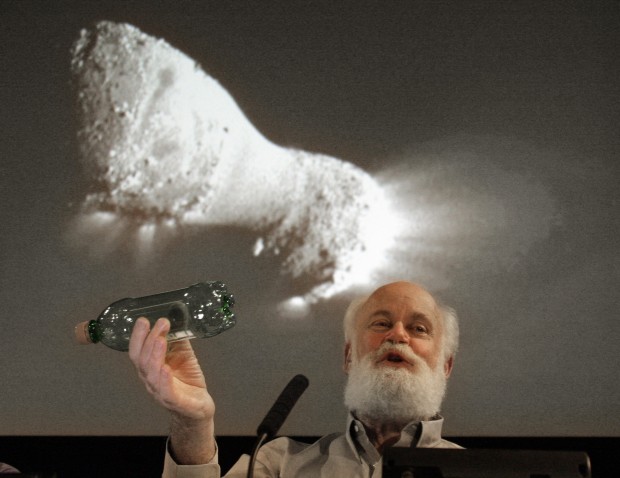
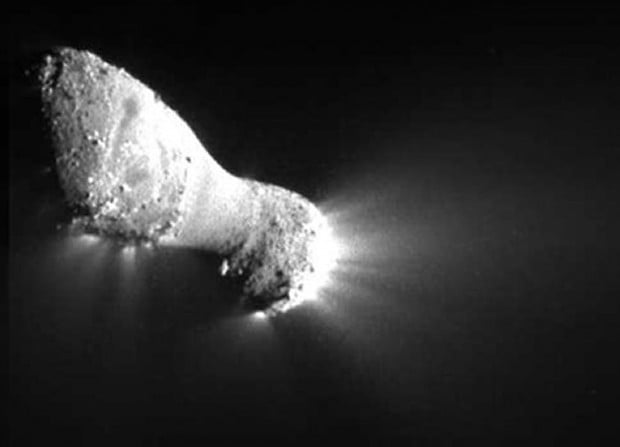
Comet Hartley 2 became the fifth cometary target of close-up photography early Thursday and the smallest and most interesting one visited so far, NASA scientists said.
Scientists said images of Hartley 2, taken as the Deep Impact spacecraft raced by at 27,000 mph, raised plenty of scientific questions. The answers will be found over the next few years in 120,000 images transmitted over months from two telescopes and an infrared spectrometer aboard the spacecraft, backed up by ground observations made in Arizona and elsewhere.
Jessica Sunshine, an astronomer at the University of Maryland, said she was intrigued by the comet's range of smooth and "clumpy" surfaces, and by its activity. It spins and wobbles, powered by jets of gas that were clearly visible in the photos.
Sunshine, deputy principal investigator for the mission, spoke in a NASA webcast Thursday.
People are also reading…
NASA scientists said they knew the comet's general shape beforehand from radar observations made from Earth and knew the comet was spewing gas from analysis done by astronomers on the ground in Arizona.
That analysis was done for the mission team, known as EPOXI, by Beatrice Mueller and Nalin Samarasinha, using a 2.1-meter (nearly 7-foot) telescope at the Kitt Peak National Observatory southwest of Tucson.
Mueller and Samarasinha are both senior scientists at Tucson's Planetary Science Institute.
Mueller said she was thrilled to see the close-up images. "That's why it's so exciting to be a solar system scientist."
The pair observed Comet Hartley 2 in September and October and recorded jets of cyanogen gas emerging from it.
Samarasinha, who will continue to observe the comet nightly until Sunday, said it's impossible to see the nucleus from Earth, even when it's relatively close at less than 15 million miles away.
The spacecraft, just 475 miles from the comet, sent back remarkably clear images.
The Kitt Peak observations and those made elsewhere will provide context for the closer images captured by Deep Impact, Samarasinha said.
"All these observations from different sources can help in solving the big picture," he added.
He called comets the "most pristine" sources of planetary history - frozen time capsules that haven't evolved.
How to recognize a comet … and what's the deal with those 'tails'? What is a comet?
A comet is an orbiting hunk of ice, frozen gases and dust, believed to be left over from the formation of the outer planets in our solar system.
Comets orbit the sun in long, elliptical paths between Jupiter and Earth, developing their characteristic tails when their gases sublimate and they lose material as they get closer to the sun. That cometary debris causes meteor showers when the Earth passes through it.
What does Comet Hartley 2 look like?
The comet is alternately described as a peanut, a bowling ball, a spud or a hambone.
In close-up photos, taken from spacecraft telescopes 435 miles away, it has a smooth, narrower middle and two bulging ends with some "clumpy" surfaces and visible jets of gas erupting from areas on the ends.
It's a little thing - about 1.25 miles on its long axis and less than a third of a mile on the short one.
What is the name of this NASA mission?
The spacecraft is called Deep Impact. It's the same craft that fired a projectile into Comet Tempel 1 in July 2005.
The mission is called EPOXI, a combination of two NASA mission names - the Extrasolar Planet Observations and Characterization (EPOCh), and the Deep Impact Extended Investigation (DIXI).
Source: NASA
Reporter Tom Beal can be reached at tbeal@azstarnet.com or 573-4158.